Made by Nathan Kessler · LessonRally (AI-assisted)
Digital classroom activity
What is a digital classroom activity?
Teachers who sign in can assign LessonRally activities to their Google Classroom classes: students open them in Classroom and answer online, and their grades go to the teacher's Classroom gradebook. Practice lets you try it first, the way students see it.
Students put the steps that turn bills into federal laws in order, from introduction to the president, then answer a question on each step: who can introduce a bill, what committees do, where tax bills must start, how the House and Senate settle differences, what happens when the president waits or vetoes a bill, how a veto override works, and the pocket veto.
Learning goal: Put the main steps of the federal lawmaking process in order and identify what happens at each step, from introduction to the president's decision and a possible veto override.
Estimated reading level7.1
Grade 5Hard
Grade 6Stretch
Grade 7On level
Grade 8Easier
Grade 9Easy
About this estimate
The estimate is halfway between the two middle scores of four readability formulas. Their scores run from 5.8 to 8.7.
Flesch-Kincaid Grade Middle scoreSentence length and syllables per word5.9
Gunning FogSentence length and words of three or more syllables8.7
Coleman-Liau Middle scoreLetters per word and sentences per 100 words8.3
Automated Readability IndexCharacters per word and words per sentence5.8
Grade 181216
Flesch Reading Ease
73.5 on a 0 to 100 scale where higher is easier: fairly easy. Not part of the estimate.
Text measured
559 words, 25 sentences
Adapted from common readability formulas (Flesch-Kincaid, Gunning Fog, Coleman-Liau and ARI, plus SMOG for long texts), which look at sentence length and word length. Answer choices count toward word length only. Grades below the estimate will likely find the text harder, grades above it easier. It does not measure ideas, background knowledge or images.
Question types: matching, multiple choice, select all that apply, number answer.
Student preview
The questions as students see them, without the answers.
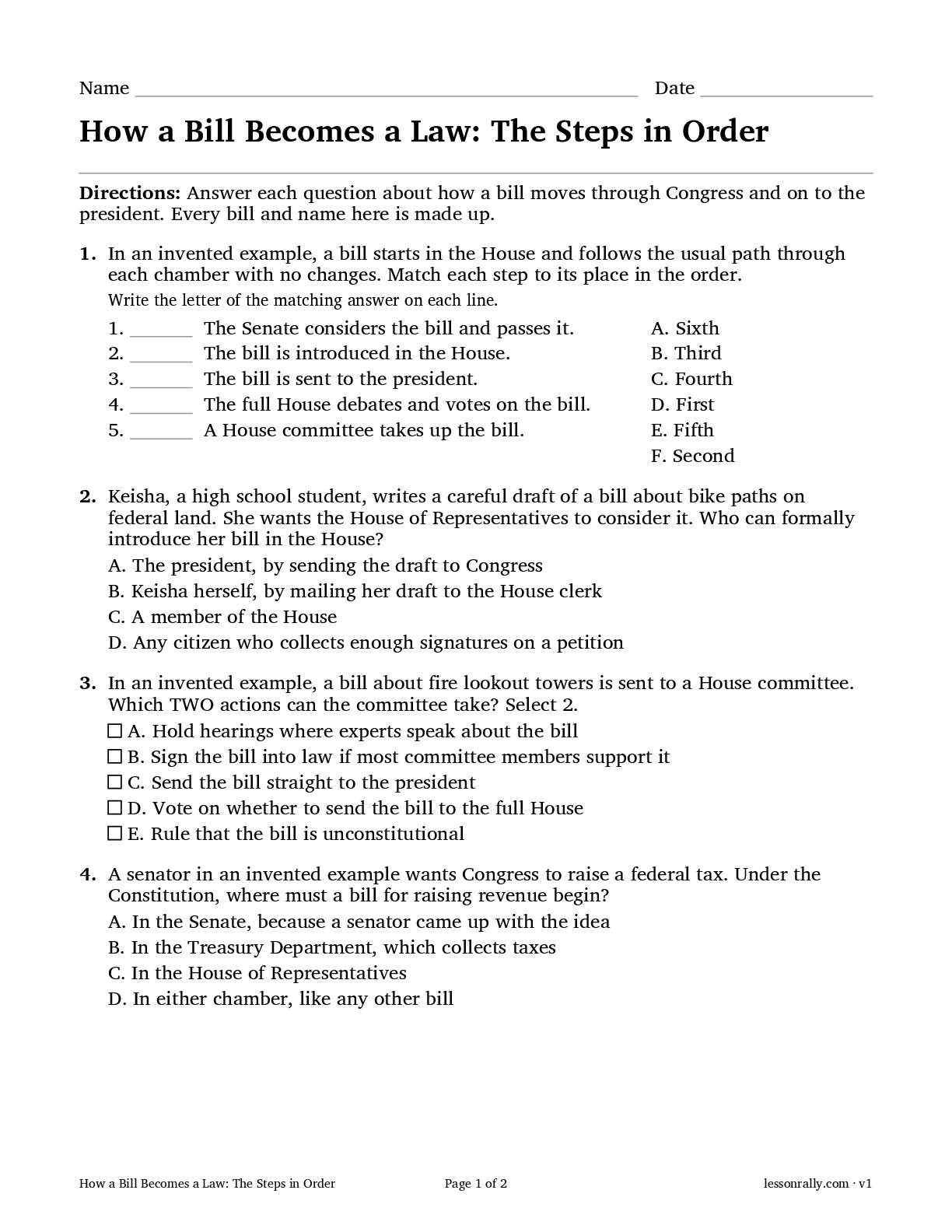
Answer each question about how a bill moves through Congress and on to the president. Every bill and name here is made up.
Question 1
In an invented example, a bill starts in the House and follows the usual path through each chamber with no changes. Match each step to its place in the order.
Match each item to an option.
Items
The Senate considers the bill and passes it.
The bill is introduced in the House.
The bill is sent to the president.
The full House debates and votes on the bill.
A House committee takes up the bill.
Options
Second
Fifth
Third
Sixth
First
Fourth
Question 2
Keisha, a high school student, writes a careful draft of a bill about bike paths on federal land. She wants the House of Representatives to consider it. Who can formally introduce her bill in the House?
Choose one answer.
A member of the House
Any citizen who collects enough signatures on a petition
Keisha herself, by mailing her draft to the House clerk
The president, by sending the draft to Congress
Question 3
In an invented example, a bill about fire lookout towers is sent to a House committee. Which TWO actions can the committee take? Select 2.
Choose 2 answers.
Vote on whether to send the bill to the full House
Hold hearings where experts speak about the bill
Sign the bill into law if most committee members support it
Send the bill straight to the president
Rule that the bill is unconstitutional
Question 4
A senator in an invented example wants Congress to raise a federal tax. Under the Constitution, where must a bill for raising revenue begin?
Choose one answer.
In the House of Representatives
In either chamber, like any other bill
In the Treasury Department, which collects taxes
In the Senate, because a senator came up with the idea
Question 5
The House passes an invented bill about flood maps. The Senate then passes its own version, which changes two sections. What must happen before the bill can go to the president?
Choose one answer.
Both chambers must agree on one version and pass the same text.
Both versions go to the president, who signs them together.
The president picks whichever version he or she prefers.
The Senate version goes forward, because the Senate voted last.
Question 6
A bill reaches the president while Congress is in session, and Congress stays in session. The president neither signs nor vetoes the bill, and ten days go by, not counting Sundays. What happens to the bill?
Choose one answer.
It goes back to the House for another vote.
It becomes law without the president's signature.
It is vetoed automatically.
It goes to the Supreme Court for a final decision.
Question 7
In an invented example, the president vetoes a bill and returns it to the House, where it started. All 435 representatives vote on passing it again. What is the smallest number of yes votes the House needs for its part of overriding the veto?
Enter a number.
votes
Question 8
Near the end of a session, Congress sends the president a bill. The president does not sign it, and ten days pass, not counting Sundays. Before the ten days are up, Congress adjourns, and the adjournment keeps the president from returning the bill. What happens?
Choose one answer.
The bill becomes law without a signature, because ten days passed.
Congress can override the veto with a two-thirds vote when it returns.
The bill becomes law as soon as Congress meets again.
The bill does not become law. This is called a pocket veto.