Teachers who sign in can assign LessonRally activities to their Google Classroom classes: students open them in Classroom and answer online, and their grades go to the teacher's Classroom gradebook. Practice lets you try it first, the way students see it.
Students work through school and home scenarios about using photos, songs, drawings and writing. They learn that copyright starts as soon as a work is created, that giving credit does not by itself make copying allowed, how Creative Commons licenses and public domain work can be used, and why fair use is decided case by case. Digital citizenship and media literacy practice.
Learning goal: Choose clearly safe ways to use creative work, such as asking permission, following a license, using public domain work or making your own, and explain why giving credit alone does not make copying allowed.
Estimated reading level7.0
Grade 5Hard
Grade 6Stretch
Grade 7On level
Grade 8Easier
Grade 9Easy
About this estimate
The estimate is the middle score of five readability formulas. Their scores run from 4.5 to 8.5.
Flesch-Kincaid GradeSentence length and syllables per word5.3
Gunning Fog Middle scoreSentence length and words of three or more syllables7.0
Coleman-LiauLetters per word and sentences per 100 words7.0
Automated Readability IndexCharacters per word and words per sentence4.5
SMOGWords of three or more syllables, for texts of 30 sentences or more8.5
Grade 181216
Flesch Reading Ease
76.7 on a 0 to 100 scale where higher is easier: fairly easy. Not part of the estimate.
Text measured
773 words, 31 sentences
Adapted from common readability formulas (Flesch-Kincaid, Gunning Fog, Coleman-Liau and ARI, plus SMOG for long texts), which look at sentence length and word length. Answer choices count toward word length only. Grades below the estimate will likely find the text harder, grades above it easier. It does not measure ideas, background knowledge or images.
Question types: multiple choice, select all that apply.
Student preview
The questions as students see them, without the answers.
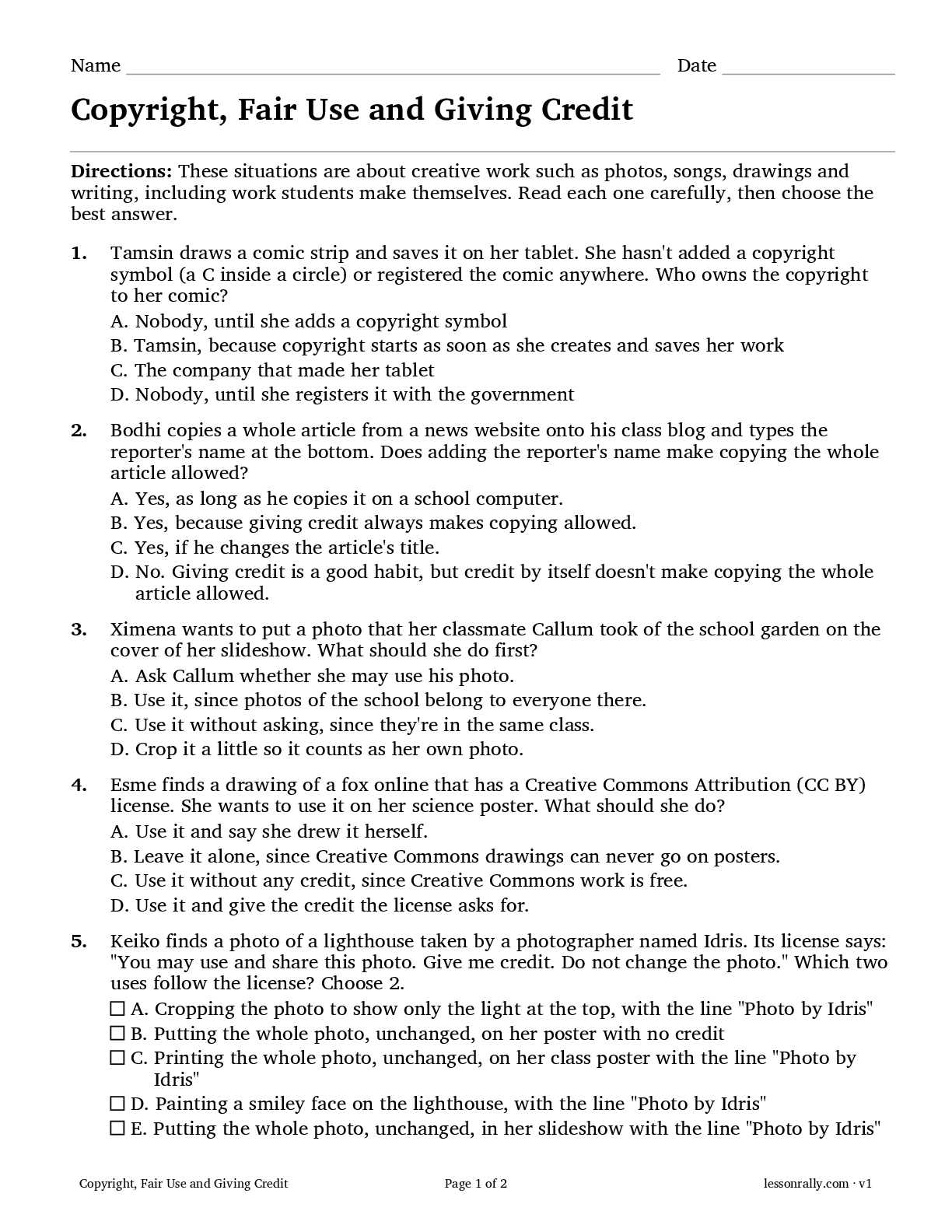
These situations are about creative work such as photos, songs, drawings and writing, including work students make themselves. Read each one carefully, then choose the best answer.
Question 1
Tamsin draws a comic strip and saves it on her tablet. She hasn't added a copyright symbol (a C inside a circle) or registered the comic anywhere. Who owns the copyright to her comic?
Choose one answer.
Tamsin, because copyright starts as soon as she creates and saves her work
Nobody, until she adds a copyright symbol
Nobody, until she registers it with the government
The company that made her tablet
Question 2
Bodhi copies a whole article from a news website onto his class blog and types the reporter's name at the bottom. Does adding the reporter's name make copying the whole article allowed?
Choose one answer.
Yes, if he changes the article's title.
Yes, because giving credit always makes copying allowed.
No. Giving credit is a good habit, but credit by itself doesn't make copying the whole article allowed.
Yes, as long as he copies it on a school computer.
Question 3
Ximena wants to put a photo that her classmate Callum took of the school garden on the cover of her slideshow. What should she do first?
Choose one answer.
Use it without asking, since they're in the same class.
Use it, since photos of the school belong to everyone there.
Ask Callum whether she may use his photo.
Crop it a little so it counts as her own photo.
Question 4
Esme finds a drawing of a fox online that has a Creative Commons Attribution (CC BY) license. She wants to use it on her science poster. What should she do?
Choose one answer.
Use it and give the credit the license asks for.
Use it without any credit, since Creative Commons work is free.
Leave it alone, since Creative Commons drawings can never go on posters.
Use it and say she drew it herself.
Question 5
Keiko finds a photo of a lighthouse taken by a photographer named Idris. Its license says: "You may use and share this photo. Give me credit. Do not change the photo." Which two uses follow the license? Choose 2.
Choose 2 answers.
Cropping the photo to show only the light at the top, with the line "Photo by Idris"
Painting a smiley face on the lighthouse, with the line "Photo by Idris"
Printing the whole photo, unchanged, on her class poster with the line "Photo by Idris"
Putting the whole photo, unchanged, on her poster with no credit
Putting the whole photo, unchanged, in her slideshow with the line "Photo by Idris"
Question 6
Farid's aunt owns a bakery and asks him to make a video ad for it. He finds a song whose license allows only noncommercial use, which means use that isn't meant to make money. What should he do?
Choose one answer.
Use the song but turn the volume down.
Ask the song's copyright owners for permission, or choose music whose license allows ads.
Use the song, since the ad is for his family.
Use the song and give the musician credit, since credit makes it okay.
Question 7
Greta's teacher shares a photo of a waterfall that the photographer dedicated to the public domain, giving up their copyright. Greta wants to use it in her report. What can she do?
Choose one answer.
Nothing, since every photo online is copyrighted.
Use it only if she changes its colors first.
Pay the photographer before using it.
Use it in her report and cite it the way her teacher asks.
Question 8
Lorenzo needs a dragon picture for the cover of his story. Every dragon picture he finds online is copyrighted and has no license that lets others use it. Which choice is clearly safe?
Choose one answer.
Take a screenshot of a dragon from a video game.
Trace a dragon from a movie poster and credit the movie.
Change the colors of a copyrighted dragon picture.
Draw his own dragon.
Question 9
Yusuf is writing a report about sea turtles and finds helpful facts in a library book. What is the best way to use those facts?
Choose one answer.
Write the facts in his own words and cite the book.
Copy whole pages and add the author's name.
Change a few words in each sentence and skip the citation.
Copy whole pages and leave out the author's name.
Question 10
Wes hears from a friend that using less than 30 seconds of a song is always fair use. Which statement is accurate?
Choose one answer.
Fair use only applies to songs, not to photos or writing.
That's right, as long as he also gives credit.
That's right: anything under 30 seconds is always fair use.
There's no number of seconds that is always safe. Whether a use is fair depends on several factors and is decided case by case.