Symbolism: The Unfinished Fence

10 questions · 10 points · Grades 9–10 · English · Preview the 10 questions

Made by Eleanor Wrenfield · LessonRally (AI-assisted)

Digital classroom activity

What is a digital classroom activity?

Teachers who sign in can assign LessonRally activities to their Google Classroom classes: students open them in Classroom and answer online, and their grades go to the teacher's Classroom gradebook. Practice lets you try it first, the way students see it.

Free for teachers. Sign in to assign activities to your Google Classroom classes.

Printable worksheet

Students read an original short story about a father's unfinished backyard fence and analyze how an object becomes a symbol. Questions trace what the fence comes to stand for in different passages, the words that build those meanings, and how the final image changes them. Practice with symbolism, symbols, figurative language and word choice.

Learning goal: Analyze how an object becomes a symbol through word choice and figurative language, and how a final image changes what it represents.

Estimated reading level 7.6

  1. Grade 5Hard
  2. Grade 6Stretch
  3. Grade 7On level
  4. Grade 8Easier
  5. Grade 9Easy
About this estimate

The estimate is the middle score of five readability formulas. Their scores run from 6.9 to 9.6.

  • Flesch-Kincaid GradeSentence length and syllables per word6.9
  • Gunning FogSentence length and words of three or more syllables9.6
  • Coleman-LiauLetters per word and sentences per 100 words7.6
  • Automated Readability Index Middle scoreCharacters per word and words per sentence7.6
  • SMOGWords of three or more syllables, for texts of 30 sentences or more8.5
Flesch Reading Ease
77.8 on a 0 to 100 scale where higher is easier: fairly easy. Not part of the estimate.
Text measured
1,232 words, 43 sentences

Adapted from common readability formulas (Flesch-Kincaid, Gunning Fog, Coleman-Liau and ARI, plus SMOG for long texts), which look at sentence length and word length. Answer choices count toward word length only. Grades below the estimate will likely find the text harder, grades above it easier. It does not measure ideas, background knowledge or images.

Common Core

Closest anchor: CCRA.R.4 Interpret words and phrases as they are used in a text, including determining technical, connotative, and figurative meanings, and analyze how specific word choices shape meaning or tone.Anchor Standards for ReadingShow 1 matched standardHide matched standard

Matched standard

  • RL.9-10.4

    Determine the meaning of words and phrases as they are used in the text, including figurative and connotative meanings; analyze the cumulative impact of specific word choices on meaning and tone (e.g., how the language evokes a sense of time and place; how it sets a formal or informal tone).

    Student preview questions 1, 3, 4, 6, 7, 9, 10

Matched independently by two AI models from this activity's questions.

© Copyright 2010. National Governors Association Center for Best Practices and Council of Chief State School Officers. All rights reserved.

Topic: Symbolism, Foreshadowing and Flashback Chosen by LessonRally

Question types: multiple choice, select all that apply.

Student preview

The questions as students see them, without the answers.

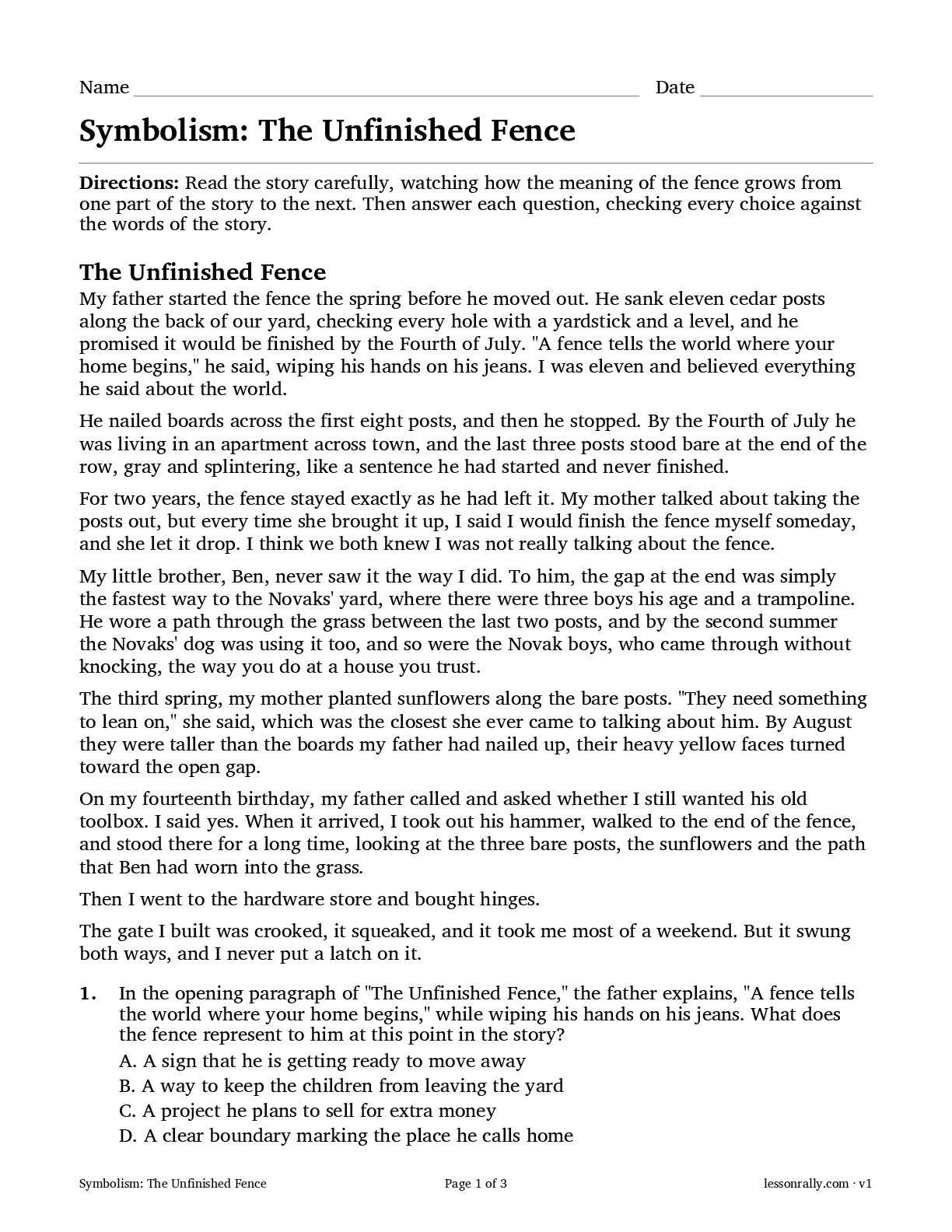
Read the story carefully, watching how the meaning of the fence grows from one part of the story to the next. Then answer each question, checking every choice against the words of the story.

The Unfinished Fence

My father started the fence the spring before he moved out. He sank eleven cedar posts along the back of our yard, checking every hole with a yardstick and a level, and he promised it would be finished by the Fourth of July. "A fence tells the world where your home begins," he said, wiping his hands on his jeans. I was eleven and believed everything he said about the world.

He nailed boards across the first eight posts, and then he stopped. By the Fourth of July he was living in an apartment across town, and the last three posts stood bare at the end of the row, gray and splintering, like a sentence he had started and never finished.

For two years, the fence stayed exactly as he had left it. My mother talked about taking the posts out, but every time she brought it up, I said I would finish the fence myself someday, and she let it drop. I think we both knew I was not really talking about the fence.

My little brother, Ben, never saw it the way I did. To him, the gap at the end was simply the fastest way to the Novaks' yard, where there were three boys his age and a trampoline. He wore a path through the grass between the last two posts, and by the second summer the Novaks' dog was using it too, and so were the Novak boys, who came through without knocking, the way you do at a house you trust.

The third spring, my mother planted sunflowers along the bare posts. "They need something to lean on," she said, which was the closest she ever came to talking about him. By August they were taller than the boards my father had nailed up, their heavy yellow faces turned toward the open gap.

On my fourteenth birthday, my father called and asked whether I still wanted his old toolbox. I said yes. When it arrived, I took out his hammer, walked to the end of the fence, and stood there for a long time, looking at the three bare posts, the sunflowers and the path that Ben had worn into the grass.

Then I went to the hardware store and bought hinges.

The gate I built was crooked, it squeaked, and it took me most of a weekend. But it swung both ways, and I never put a latch on it.


Question 1

In the opening paragraph of "The Unfinished Fence," the father explains, "A fence tells the world where your home begins," while wiping his hands on his jeans. What does the fence represent to him at this point in the story?

Choose one answer.

  • A clear boundary marking the place he calls home
  • A way to keep the children from leaving the yard
  • A sign that he is getting ready to move away
  • A project he plans to sell for extra money

Question 2

Right after the father's words, the narrator adds, "I was eleven and believed everything he said about the world." How does this sentence affect the father's words about the fence?

Choose one answer.

  • It proves that the father was lying about the fence.
  • It shows that the narrator still trusts the father completely.
  • It hints that the older narrator no longer trusts those words, casting doubt on the promise the fence stood for.
  • It explains why the fence was finished early.

Question 3

In the second paragraph, the last three posts stand bare, "like a sentence he had started and never finished." What does this simile add to the fence's meaning?

Choose one answer.

  • It ties the unfinished fence to something the father left incomplete when he moved out.
  • It shows that the father was a writer.
  • It shows that the father plans to come back and finish soon.
  • It suggests that the fence was built badly.

Question 4

When the narrator keeps promising to finish the fence "someday," the narrator adds, "I think we both knew I was not really talking about the fence." What has the fence come to stand for in the narrator's mind?

Choose one answer.

  • A part of the yard that the narrator wants to remove
  • Something the father left behind that the narrator still hopes to make whole
  • A reason for the narrator to argue with the mother
  • A boring chore that the narrator keeps putting off

Question 5

Which two details show the gap in the fence turning into a way through, rather than just an empty space? Select two.

Choose 2 answers.

  • "My mother talked about taking the posts out"
  • "He wore a path through the grass between the last two posts"
  • "who came through without knocking, the way you do at a house you trust"
  • "He nailed boards across the first eight posts"
  • "the last three posts stood bare at the end of the row, gray and splintering"

Question 6

The narrator's mother plants sunflowers along the bare posts and says, "They need something to lean on," which the narrator calls "the closest she ever came to talking about him." Why does the narrator hear the remark this way?

Choose one answer.

  • She is complaining that the father never helped in the garden.
  • She is reminding the narrator to finish the fence.
  • Though she is talking about the plants, her words also seem to point toward the father and his absence.
  • She is explaining exactly how sunflowers should be grown.

Question 7

By August, the sunflowers are "taller than the boards my father had nailed up, their heavy yellow faces turned toward the open gap." What does this image suggest about the gap?

Choose one answer.

  • It proves that the father will soon return.
  • It has become a place of brightness and new growth, not only a reminder of something missing.
  • It is about to be boarded up for good.
  • It frightens the family more than ever.

Question 8

On the narrator's fourteenth birthday, the father calls to ask whether the narrator still wants "his old toolbox." What does this gift add to the story of the fence?

Choose one answer.

  • It shows that the father plans to come back and finish the fence himself.
  • It puts the means of finishing the fence in the narrator's hands, so what happens next is the narrator's choice.
  • It shows that the father has forgotten the fence entirely.
  • It reveals that the narrator wants to become a carpenter.

Question 9

After standing at the end of the fence for a long time, the narrator goes to the hardware store and buys hinges. What does the word "hinges" signal about the narrator's decision?

Choose one answer.

  • The narrator wants to repair the father's toolbox.
  • The narrator will finish the fence exactly as the father planned.
  • The narrator plans to take the whole fence down.
  • The narrator will build a gate in the gap instead of closing it with boards.

Question 10

The father once said, "A fence tells the world where your home begins," and the story ends with the narrator's crooked gate, which "swung both ways" and has no latch. How does this final image change the meaning of the fence?

Choose one answer.

  • It shows that the narrator has given up on the fence.
  • It suggests that home can begin with an open way in, not only with a closed boundary.
  • It proves that the father will move back home.
  • It shows that the fence now keeps the neighbors out.

Reviews

No reviews yet.

Reviews come from teachers who assigned this activity to a class.

Sign in to write a review

Have a topic of your own? Make a printable worksheet and online quiz, free.

Create an activity

Answer key

Answer keys come with Premium

Print this worksheet with the correct answers marked. The key includes any explanations, sample answers, and rubrics supplied with the activity.

Answer keys aren't public: only teachers with Premium and the people who can edit an activity can download one, so students can't get a ready-to-print key from this page.

Premium includes:

  • No ads for you, and no ads for your students on the assignments you post.
  • Answer keys for printable worksheets, with the correct answers marked and any explanations, sample answers, and rubrics.
  • Create with AI: up to 100 activities a year (5 during the free trial), with every answer checked before you see the draft.

$29 a year, plus sales tax where it applies.

New Premium teachers can try it free for 7 days. A card or other payment method is needed to start. Unless you cancel before the trial ends, you are charged then and the plan renews every year.

Already have Premium or edit this activity? Sign in