Teachers who sign in can assign LessonRally activities to their Google Classroom classes: students open them in Classroom and answer online, and their grades go to the teacher's Classroom gradebook. Practice lets you try it first, the way students see it.
Students put the stages of the cell cycle and the phases of mitosis (prophase, metaphase, anaphase and telophase) in order, then answer questions about chromosomes and sister chromatids, spindle fibers, cytokinesis, checkpoints and a table of onion root tip cell counts.
Learning goal: Put the stages of the cell cycle and the phases of mitosis in order and explain what happens in each, including cytokinesis and checkpoints.
Estimated reading level7.6
Grade 5Hard
Grade 6Stretch
Grade 7On level
Grade 8Easier
Grade 9Easy
About this estimate
The estimate is halfway between the two middle scores of four readability formulas. Their scores run from 6.7 to 10.1.
Flesch-Kincaid GradeSentence length and syllables per word6.7
Gunning FogSentence length and words of three or more syllables10.1
Coleman-Liau Middle scoreLetters per word and sentences per 100 words8.2
Automated Readability Index Middle scoreCharacters per word and words per sentence6.9
Grade 181216
Flesch Reading Ease
72.8 on a 0 to 100 scale where higher is easier: fairly easy. Not part of the estimate.
Text measured
582 words, 20 sentences
Adapted from common readability formulas (Flesch-Kincaid, Gunning Fog, Coleman-Liau and ARI, plus SMOG for long texts), which look at sentence length and word length. Answer choices count toward word length only. Grades below the estimate will likely find the text harder, grades above it easier. It does not measure ideas, background knowledge or images.
Question types: matching, fill in the blank, multiple choice.
Student preview
The questions as students see them, without the answers.
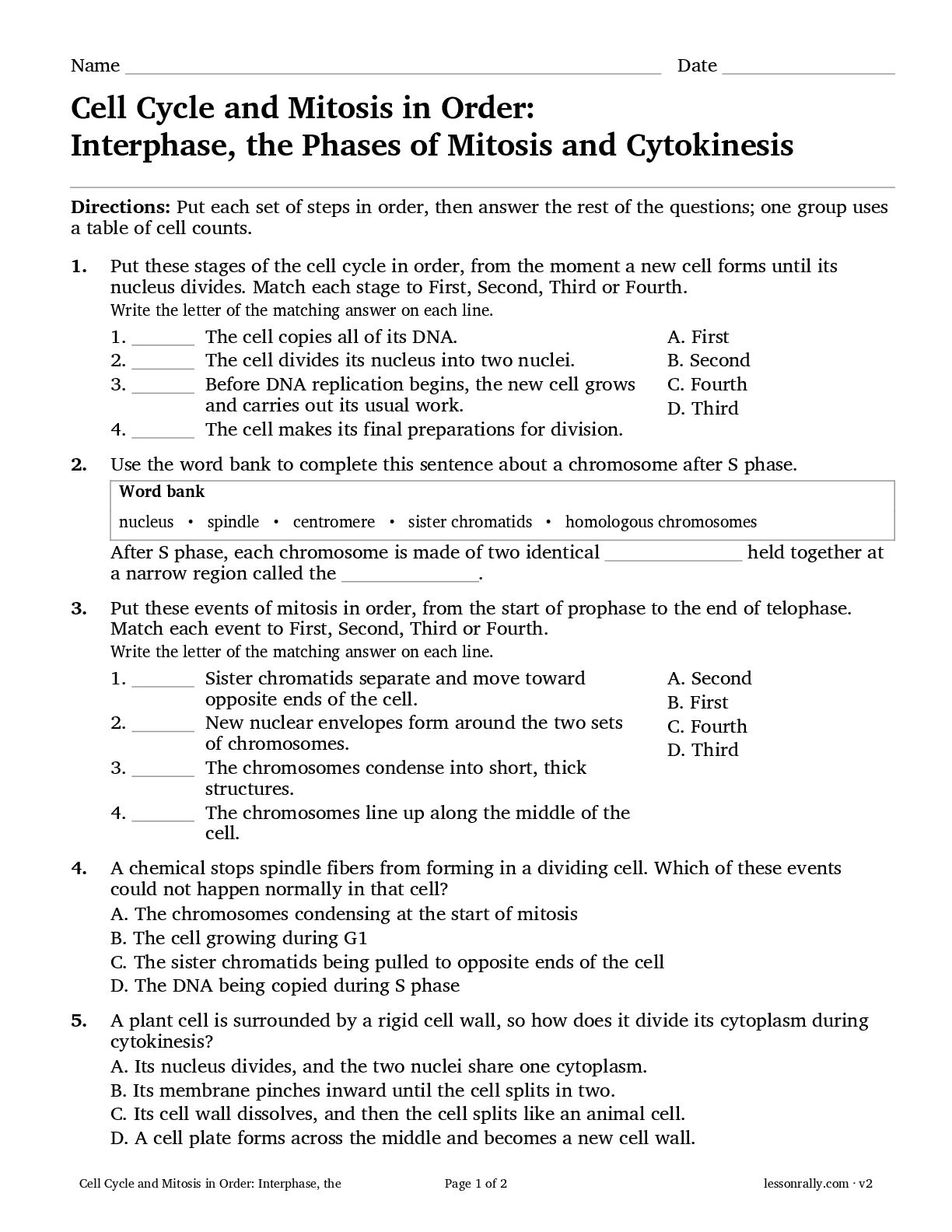
Put each set of steps in order, then answer the rest of the questions; one group uses a table of cell counts.
Question 1
Put these stages of the cell cycle in order, from the moment a new cell forms until its nucleus divides. Match each stage to First, Second, Third or Fourth.
Match each item to an option.
Items
The cell copies all of its DNA.
The cell divides its nucleus into two nuclei.
Before DNA replication begins, the new cell grows and carries out its usual work.
The cell makes its final preparations for division.
Options
Fourth
First
Third
Second
Question 2
Use the word bank to complete this sentence about a chromosome after S phase.
Fill in each blank.
After S phase, each chromosome is made of two identical blank 1 held together at a narrow region called the blank 2.
Word bank
centromere
nucleus
sister chromatids
homologous chromosomes
spindle
Question 3
Put these events of mitosis in order, from the start of prophase to the end of telophase. Match each event to First, Second, Third or Fourth.
Match each item to an option.
Items
Sister chromatids separate and move toward opposite ends of the cell.
New nuclear envelopes form around the two sets of chromosomes.
The chromosomes condense into short, thick structures.
The chromosomes line up along the middle of the cell.
Options
Third
Second
First
Fourth
Question 4
A chemical stops spindle fibers from forming in a dividing cell. Which of these events could not happen normally in that cell?
Choose one answer.
The cell growing during G1
The DNA being copied during S phase
The chromosomes condensing at the start of mitosis
The sister chromatids being pulled to opposite ends of the cell
Question 5
A plant cell is surrounded by a rigid cell wall, so how does it divide its cytoplasm during cytokinesis?
Choose one answer.
A cell plate forms across the middle and becomes a new cell wall.
Its membrane pinches inward until the cell splits in two.
Its nucleus divides, and the two nuclei share one cytoplasm.
Its cell wall dissolves, and then the cell splits like an animal cell.
Question 6
A human skin cell with 46 chromosomes divides by mitosis. How many chromosomes does each of the two new cells have?
Choose one answer.
92 chromosomes in each new cell
46 chromosomes in each new cell
46 chromosomes shared between the two new cells
23 chromosomes in each new cell
Question 7
A dividing cell passes through several checkpoints, including one near the end of G1 and one near the end of G2. What does the cell do at a checkpoint?
Choose one answer.
The cell divides its cytoplasm to form two new cells.
The cell checks for problems, such as damaged DNA, before moving on.
The cell copies its DNA so that each new cell gets a full set.
The cell pairs up its homologous chromosomes.
Counting Cells in an Onion Root Tip
In an investigation, 200 cells in the growing tip of an onion root were each sorted by stage. Cells in this region divide on their own schedules, not all at once.
200 cells from the growing tip of an onion root, sorted by stage
Stage
Number of cells
Interphase
172
Prophase
14
Metaphase
6
Anaphase
3
Telophase
5
Total
200
Question 8
What percent of the 200 cells were in one of the four phases of mitosis?
Choose one answer.
7 percent
14 percent
28 percent
86 percent
Question 9
Suppose the share of cells in each stage matches the share of time a cell spends in that stage. Which phase of mitosis would then take the least time?
Choose one answer.
Prophase
Anaphase
Telophase
Metaphase
Question 10
What can you conclude about the onion root tip cells from these counts?
Choose one answer.
In this sample, most of the cells were in interphase.
Cells in this root tip had stopped dividing.
In this sample, the cells were all dividing at the same moment.
Every onion root cell spends exactly 86 percent of its life in interphase.