Teachers who sign in can assign LessonRally activities to their Google Classroom classes: students open them in Classroom and answer online, and their grades go to the teacher's Classroom gradebook. Practice lets you try it first, the way students see it.
Students apply Mendelian genetics to a monohybrid cross in pea plants: they use the terms allele, genotype and phenotype, read a Punnett square, turn offspring counts into a ratio, and use a test cross to find an unknown genotype, with tables of data.
Learning goal: Use Punnett squares and offspring counts to predict and explain genotype and phenotype ratios in monohybrid crosses.
Estimated reading level7.9
Grade 5Hard
Grade 6Stretch
Grade 7On level
Grade 8Easier
Grade 9Easy
About this estimate
The estimate is halfway between the two middle scores of four readability formulas. Their scores run from 7.4 to 10.6.
Flesch-Kincaid Grade Middle scoreSentence length and syllables per word8.1
Gunning FogSentence length and words of three or more syllables10.6
Coleman-Liau Middle scoreLetters per word and sentences per 100 words7.7
Automated Readability IndexCharacters per word and words per sentence7.4
Grade 181216
Flesch Reading Ease
66.8 on a 0 to 100 scale where higher is easier: standard. Not part of the estimate.
Text measured
622 words, 20 sentences
Adapted from common readability formulas (Flesch-Kincaid, Gunning Fog, Coleman-Liau and ARI, plus SMOG for long texts), which look at sentence length and word length. Answer choices count toward word length only. Grades below the estimate will likely find the text harder, grades above it easier. It does not measure ideas, background knowledge or images.
Question types: fill in the blank, matching, multiple choice.
Student preview
The questions as students see them, without the answers.
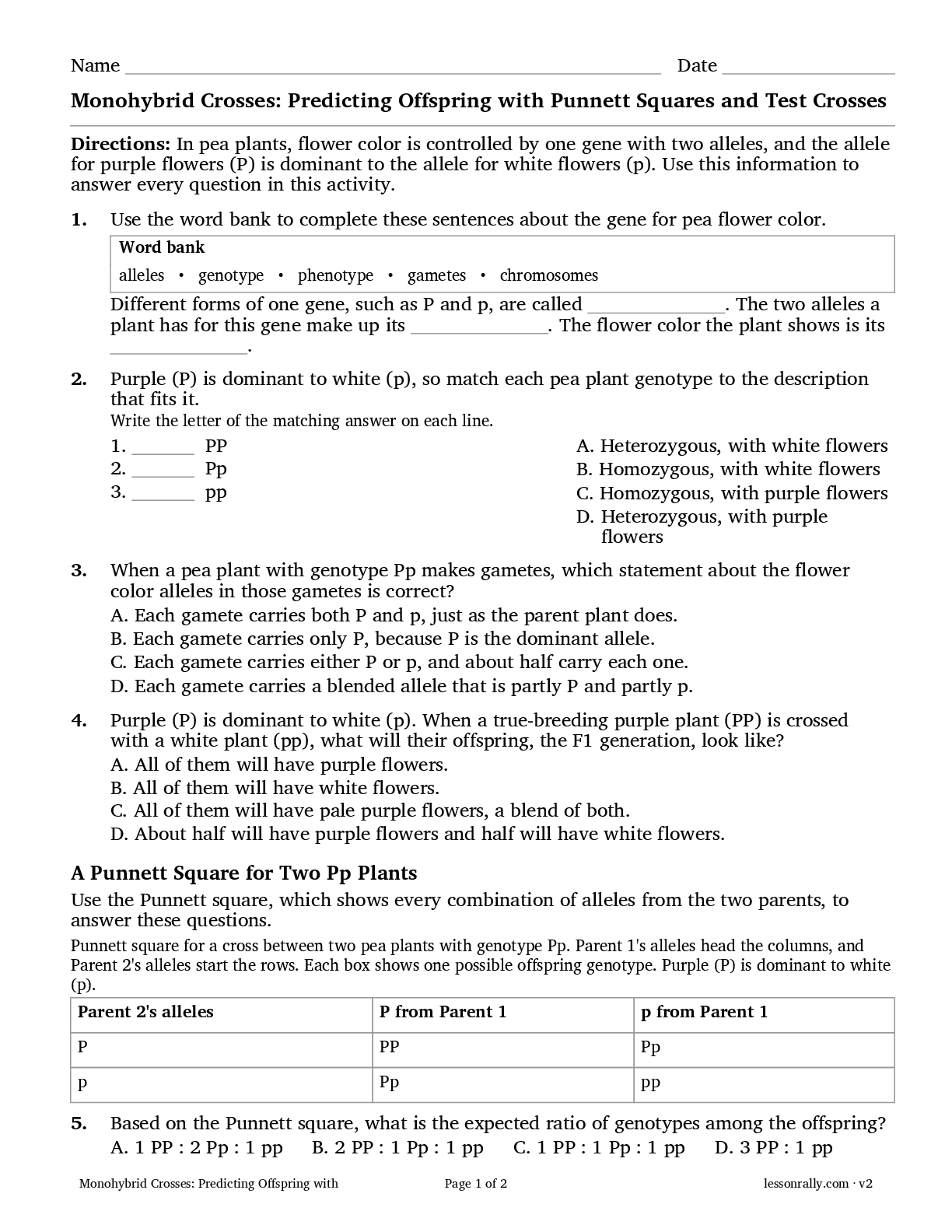
In pea plants, flower color is controlled by one gene with two alleles, and the allele for purple flowers (P) is dominant to the allele for white flowers (p). Use this information to answer every question in this activity.
Question 1
Use the word bank to complete these sentences about the gene for pea flower color.
Fill in each blank.
Different forms of one gene, such as P and p, are called blank 1. The two alleles a plant has for this gene make up its blank 2. The flower color the plant shows is its blank 3.
Word bank
gametes
chromosomes
alleles
phenotype
genotype
Question 2
Purple (P) is dominant to white (p), so match each pea plant genotype to the description that fits it.
Match each item to an option.
Items
PP
Pp
pp
Options
Heterozygous, with purple flowers
Homozygous, with white flowers
Heterozygous, with white flowers
Homozygous, with purple flowers
Question 3
When a pea plant with genotype Pp makes gametes, which statement about the flower color alleles in those gametes is correct?
Choose one answer.
Each gamete carries either P or p, and about half carry each one.
Each gamete carries both P and p, just as the parent plant does.
Each gamete carries a blended allele that is partly P and partly p.
Each gamete carries only P, because P is the dominant allele.
Question 4
Purple (P) is dominant to white (p). When a true-breeding purple plant (PP) is crossed with a white plant (pp), what will their offspring, the F1 generation, look like?
Choose one answer.
All of them will have pale purple flowers, a blend of both.
All of them will have white flowers.
All of them will have purple flowers.
About half will have purple flowers and half will have white flowers.
A Punnett Square for Two Pp Plants
Use the Punnett square, which shows every combination of alleles from the two parents, to answer these questions.
Punnett square for a cross between two pea plants with genotype Pp. Parent 1's alleles head the columns, and Parent 2's alleles start the rows. Each box shows one possible offspring genotype. Purple (P) is dominant to white (p).
Parent 2's alleles
P from Parent 1
p from Parent 1
P
PP
Pp
p
Pp
pp
Question 5
Based on the Punnett square, what is the expected ratio of genotypes among the offspring?
Choose one answer.
1 PP : 1 Pp : 1 pp
3 PP : 1 pp
2 PP : 1 Pp : 1 pp
1 PP : 2 Pp : 1 pp
Question 6
In one season, the two Pp plants in this cross produce only 4 seeds. Which statement about the flower colors of those 4 seeds is correct?
Choose one answer.
None of the 4 seeds can grow into a white-flowered plant, because both parents are purple.
Each seed has a 1 in 4 chance of growing into a white-flowered plant.
Exactly 1 of the 4 seeds will grow into a white-flowered plant.
Exactly 3 of the 4 seeds will grow into plants with genotype PP.
Offspring of Two Purple Plants
In an investigation, two purple-flowered pea plants were crossed, and the flower color of each of their 400 offspring was recorded in the table.
Offspring of a cross between two purple-flowered pea plants. Purple (P) is dominant to white (p).
Flower color of offspring
Number of offspring
Purple
298
White
102
Total
400
Question 7
Which ratio of purple to white offspring is closest to these results?
Choose one answer.
1 purple : 1 white
1 purple : 3 white
3 purple : 1 white
2 purple : 1 white
Question 8
What must the genotypes of the two purple parent plants have been?
Choose one answer.
Heterozygous (Pp) and homozygous recessive (pp)
Homozygous dominant (PP) and heterozygous (Pp)
Homozygous dominant (PP) and homozygous dominant (PP)
Heterozygous (Pp) and heterozygous (Pp)
Question 9
Both parents in this cross were Pp, so about how many of the 298 purple offspring are expected to be heterozygous (Pp)?
Choose one answer.
About 150 of them
All 298 of them
About 200 of them
About 100 of them
Two Test Crosses
In an investigation, Plant A and Plant B, both purple-flowered plants of unknown genotype, were each crossed with a white-flowered plant (pp), a kind of cross called a test cross.
Two test crosses. Plant A and Plant B both have purple flowers, and each was crossed with a white-flowered plant (pp). Purple (P) is dominant to white (p).
Cross
Purple offspring
White offspring
Plant A × white plant (pp)
64
0
Plant B × white plant (pp)
33
31
Question 10
What do the test cross results show about the genotypes of Plant A and Plant B?
Choose one answer.
Both plants are heterozygous (Pp), since both have purple flowers.
Plant B is heterozygous (Pp), and Plant A is most likely homozygous (PP).
Both plants are homozygous (PP), since both have purple flowers.
Plant A is heterozygous (Pp), and Plant B is most likely homozygous (PP).