Theme and Its Development: The Inheritance

10 questions · 10 points · Grades 9–10 · English · Preview the 10 questions

Made by Eleanor Wrenfield · LessonRally (AI-assisted)

Digital classroom activity

What is a digital classroom activity?

Teachers who sign in can assign LessonRally activities to their Google Classroom classes: students open them in Classroom and answer online, and their grades go to the teacher's Classroom gradebook. Practice lets you try it first, the way students see it.

Free for teachers. Sign in to assign activities to your Google Classroom classes.

Printable worksheet

Students read an original short story passage about two siblings dividing their late father's belongings. They determine a theme, trace how specific details develop and refine it, and choose the best objective summary. Practice with themes, theme development and how to summarize a story.

Learning goal: Determine a theme of a literary passage and analyze how specific details shape and refine it.

Estimated reading level 8.8

  1. Grade 6Hard
  2. Grade 7Stretch
  3. Grade 8On level
  4. Grade 9Easier
  5. Grade 10Easy
About this estimate

The estimate is the middle score of five readability formulas. Their scores run from 7.1 to 9.6.

  • Flesch-Kincaid GradeSentence length and syllables per word7.1
  • Gunning FogSentence length and words of three or more syllables9.6
  • Coleman-Liau Middle scoreLetters per word and sentences per 100 words8.8
  • Automated Readability IndexCharacters per word and words per sentence7.5
  • SMOGWords of three or more syllables, for texts of 30 sentences or more9.2
Flesch Reading Ease
71.7 on a 0 to 100 scale where higher is easier: fairly easy. Not part of the estimate.
Text measured
1,386 words, 53 sentences

Adapted from common readability formulas (Flesch-Kincaid, Gunning Fog, Coleman-Liau and ARI, plus SMOG for long texts), which look at sentence length and word length. Answer choices count toward word length only. Grades below the estimate will likely find the text harder, grades above it easier. It does not measure ideas, background knowledge or images.

Common Core

Closest anchor: CCRA.R.2 Determine central ideas or themes of a text and analyze their development; summarize the key supporting details and ideas.Anchor Standards for ReadingShow 1 matched standardHide matched standard

Matched standard

  • RL.9-10.2

    Determine a theme or central idea of a text and analyze in detail its development over the course of the text, including how it emerges and is shaped and refined by specific details; provide an objective summary of the text.

    Student preview questions 8, 9

Matched independently by two AI models from this activity's questions.

© Copyright 2010. National Governors Association Center for Best Practices and Council of Chief State School Officers. All rights reserved.

Topics: Theme, Summarizing Chosen by LessonRally

Question types: multiple choice, select all that apply.

Student preview

The questions as students see them, without the answers.

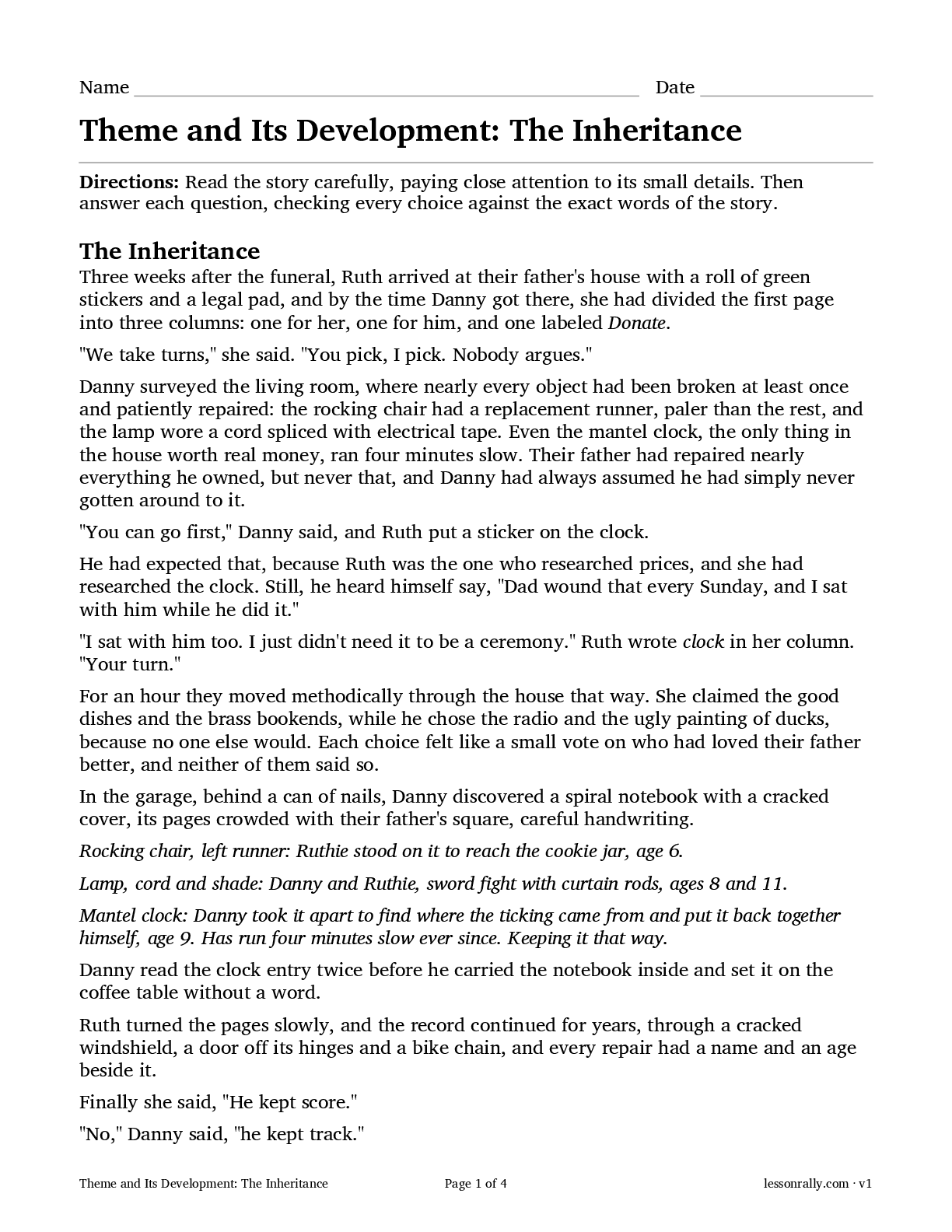
Read the story carefully, paying close attention to its small details. Then answer each question, checking every choice against the exact words of the story.

The Inheritance

Three weeks after the funeral, Ruth arrived at their father's house with a roll of green stickers and a legal pad, and by the time Danny got there, she had divided the first page into three columns: one for her, one for him, and one labeled Donate.

"We take turns," she said. "You pick, I pick. Nobody argues."

Danny surveyed the living room, where nearly every object had been broken at least once and patiently repaired: the rocking chair had a replacement runner, paler than the rest, and the lamp wore a cord spliced with electrical tape. Even the mantel clock, the only thing in the house worth real money, ran four minutes slow. Their father had repaired nearly everything he owned, but never that, and Danny had always assumed he had simply never gotten around to it.

"You can go first," Danny said, and Ruth put a sticker on the clock.

He had expected that, because Ruth was the one who researched prices, and she had researched the clock. Still, he heard himself say, "Dad wound that every Sunday, and I sat with him while he did it."

"I sat with him too. I just didn't need it to be a ceremony." Ruth wrote clock in her column. "Your turn."

For an hour they moved methodically through the house that way. She claimed the good dishes and the brass bookends, while he chose the radio and the ugly painting of ducks, because no one else would. Each choice felt like a small vote on who had loved their father better, and neither of them said so.

In the garage, behind a can of nails, Danny discovered a spiral notebook with a cracked cover, its pages crowded with their father's square, careful handwriting.

Rocking chair, left runner: Ruthie stood on it to reach the cookie jar, age 6.

Lamp, cord and shade: Danny and Ruthie, sword fight with curtain rods, ages 8 and 11.

Mantel clock: Danny took it apart to find where the ticking came from and put it back together himself, age 9. Has run four minutes slow ever since. Keeping it that way.

Danny read the clock entry twice before he carried the notebook inside and set it on the coffee table without a word.

Ruth turned the pages slowly, and the record continued for years, through a cracked windshield, a door off its hinges and a bike chain, and every repair had a name and an age beside it.

Finally she said, "He kept score."

"No," Danny said, "he kept track."

Ruth studied the green sticker on the mantel clock. Then she stood, crossed the room, peeled the sticker off, and did not put it anywhere else.

"We could keep this together," she said, holding up the notebook.

"You can go first," Danny said.

"No." She almost smiled. "Nobody picks."

Question 1

Which choice best summarizes "The Inheritance" objectively, covering its most important events in order without adding any opinions about the characters?

Choose one answer.

  • Weeks after their father's funeral, Ruth and Danny take turns claiming his belongings. After Danny discovers a notebook in which their father recorded his repairs, Ruth removes her sticker from the clock and suggests they keep the notebook together.
  • Ruth and Danny argue loudly over the valuable clock until Danny agrees to trade it to her in exchange for their father's notebook.
  • Ruth and Danny divide their father's dishes, radio, bookends and an ugly painting of ducks.
  • Ruth greedily grabs the most valuable things in the house until Danny's discovery of a notebook makes her ashamed of her selfishness.

Question 2

In the opening paragraphs, Ruth arrives with stickers and a legal pad, draws three columns before her brother even gets there, and announces the rule "Nobody argues." What do these details suggest about how she hopes the day will go?

Choose one answer.

  • She hopes a clear system will keep the dividing orderly and free of open conflict.
  • She intends to donate everything their father owned.
  • She expects Danny to make every decision about their father's belongings.
  • She expects a relaxed afternoon of sharing memories about their father.

Question 3

When Danny mentions sitting with their father while he wound the clock every Sunday, Ruth answers that she sat with him too and "just didn't need it to be a ceremony." What is Ruth doing with this reply?

Choose one answer.

  • She is refusing to let Danny's memory give him a stronger claim to the clock.
  • She is admitting that she never spent time with their father.
  • She is agreeing that Danny deserves to keep the clock.
  • She is reminding Danny how much money the clock is worth.

Question 4

Describing the hour the siblings spend moving through the house, the narrator says, "Each choice felt like a small vote on who had loved their father better, and neither of them said so." What does this sentence reveal about the turn-taking?

Choose one answer.

  • The siblings openly argue about which of them loved their father more.
  • The siblings choose hurriedly because they are eager to leave the house.
  • The siblings hold an actual vote to decide who keeps each object.
  • Beneath the calm system, each sibling is quietly competing to prove the deeper love.

Question 5

Early in the passage, Danny assumes that their father, who repaired nearly everything he owned, "had simply never gotten around to" fixing the slow clock. How does the notebook's entry about the clock change the meaning of that earlier detail?

Choose one answer.

  • It reveals that the clock is worth much less than Ruth believed.
  • It reveals that Ruth was responsible for making the clock run slow.
  • It reveals that their father never learned how to repair a clock.
  • It reveals that the clock has run slow since Danny rebuilt it as a boy, and that their father deliberately kept it that way.

Question 6

After paging through the notebook, Ruth remarks that their father "kept score" and Danny answers that he "kept track." What does Danny's correction suggest about the way he understands the notebook?

Choose one answer.

  • He regards it as a record of their father's attention, not a tally of their mistakes.
  • He agrees that their father was counting which child broke more things.
  • He suspects that Ruth has misread the ages written in it.
  • He believes their father wrote it to decide who would inherit each object.

Question 7

The story moves from Ruth's early rule "Nobody argues" to her final words, "Nobody picks." What is the effect of ending the story on this echo of its opening?

Choose one answer.

  • It shows that Ruth intends to give the notebook away.
  • It shows how far Ruth has moved, from organizing a careful division to refusing to divide the notebook at all.
  • It shows that the turn-taking system worked exactly as Ruth had planned.
  • It shows that the siblings are beginning to argue again.

Question 8

Which statement best expresses a theme of "The Inheritance" as the story develops it from the opening rules to the final line?

Choose one answer.

  • Dividing belongings by careful rules is the best way for a family to avoid conflict.
  • Old, repaired objects lose their value once the person who fixed them is gone.
  • What a parent leaves behind is worth most for the care and shared history it holds, not for its price.
  • The child who spent the most time with a parent deserves that parent's most meaningful possessions.

Question 9

Which two details develop the theme that a parent's belongings are worth most for the care and shared history they hold, rather than for their price? Select two.

Choose 2 answers.

  • The notebook was in the garage, behind a can of nails.
  • The notebook lists a name and an age beside every repair.
  • The painting Danny takes is a picture of ducks.
  • Ruth peels her sticker off the clock and does not put it anywhere else.
  • The bookends Ruth takes are made of brass.

Question 10

Why is the notebook, rather than the valuable clock, such a fitting object for the siblings to keep together instead of dividing?

Choose one answer.

  • It is small enough to carry easily from one house to another.
  • It is worth more money than anything else in the house.
  • It records both of their childhoods and their father's attention, so it belongs to neither of them alone.
  • It is the only object that neither of them particularly wants.

Reviews

No reviews yet.

Reviews come from teachers who assigned this activity to a class.

Sign in to write a review

Have a topic of your own? Make a printable worksheet and online quiz, free.

Create an activity

Answer key

Answer keys come with Premium

Print this worksheet with the correct answers marked. The key includes any explanations, sample answers, and rubrics supplied with the activity.

Answer keys aren't public: only teachers with Premium and the people who can edit an activity can download one, so students can't get a ready-to-print key from this page.

Premium includes:

  • No ads for you, and no ads for your students on the assignments you post.
  • Answer keys for printable worksheets, with the correct answers marked and any explanations, sample answers, and rubrics.
  • Create with AI: up to 100 activities a year (5 during the free trial), with every answer checked before you see the draft.

$29 a year, plus sales tax where it applies.

New Premium teachers can try it free for 7 days. A card or other payment method is needed to start. Unless you cancel before the trial ends, you are charged then and the plan renews every year.

Already have Premium or edit this activity? Sign in