Checks and Balances: Which Branch Can Do What?

10 questions · 13 points · Grade 8 · English · Preview the 10 questions

Made by Nathan Kessler · LessonRally (AI-assisted)

Digital classroom activity

What is a digital classroom activity?

Teachers who sign in can assign LessonRally activities to their Google Classroom classes: students open them in Classroom and answer online, and their grades go to the teacher's Classroom gradebook. Practice lets you try it first, the way students see it.

Free for teachers. Sign in to assign activities to your Google Classroom classes.

Printable worksheet

Students read short invented situations and decide which of the three branches of government can check another branch, and which power it uses: the veto, judicial review, a pardon, Senate approval of nominees and treaties, impeachment, the power of the purse, amendments and a veto override. A matching question ties four more powers to the official or group that holds each one.

Learning goal: Identify which branch of the U.S. government can check another in a given situation, and name the constitutional power it uses.

Estimated reading level 8.4

  1. Grade 6Hard
  2. Grade 7Stretch
  3. Grade 8On level
  4. Grade 9Easier
  5. Grade 10Easy
About this estimate

The estimate is halfway between the two middle scores of four readability formulas. Their scores run from 7.2 to 10.0.

  • Flesch-Kincaid GradeSentence length and syllables per word7.2
  • Gunning FogSentence length and words of three or more syllables10.0
  • Coleman-Liau Middle scoreLetters per word and sentences per 100 words9.4
  • Automated Readability Index Middle scoreCharacters per word and words per sentence7.3
Flesch Reading Ease
67.3 on a 0 to 100 scale where higher is easier: standard. Not part of the estimate.
Text measured
808 words, 29 sentences

Adapted from common readability formulas (Flesch-Kincaid, Gunning Fog, Coleman-Liau and ARI, plus SMOG for long texts), which look at sentence length and word length. Answer choices count toward word length only. Grades below the estimate will likely find the text harder, grades above it easier. It does not measure ideas, background knowledge or images.

Topic: Government and Citizenship Chosen by LessonRally

Question types: multiple choice, matching.

Student preview

The questions as students see them, without the answers.

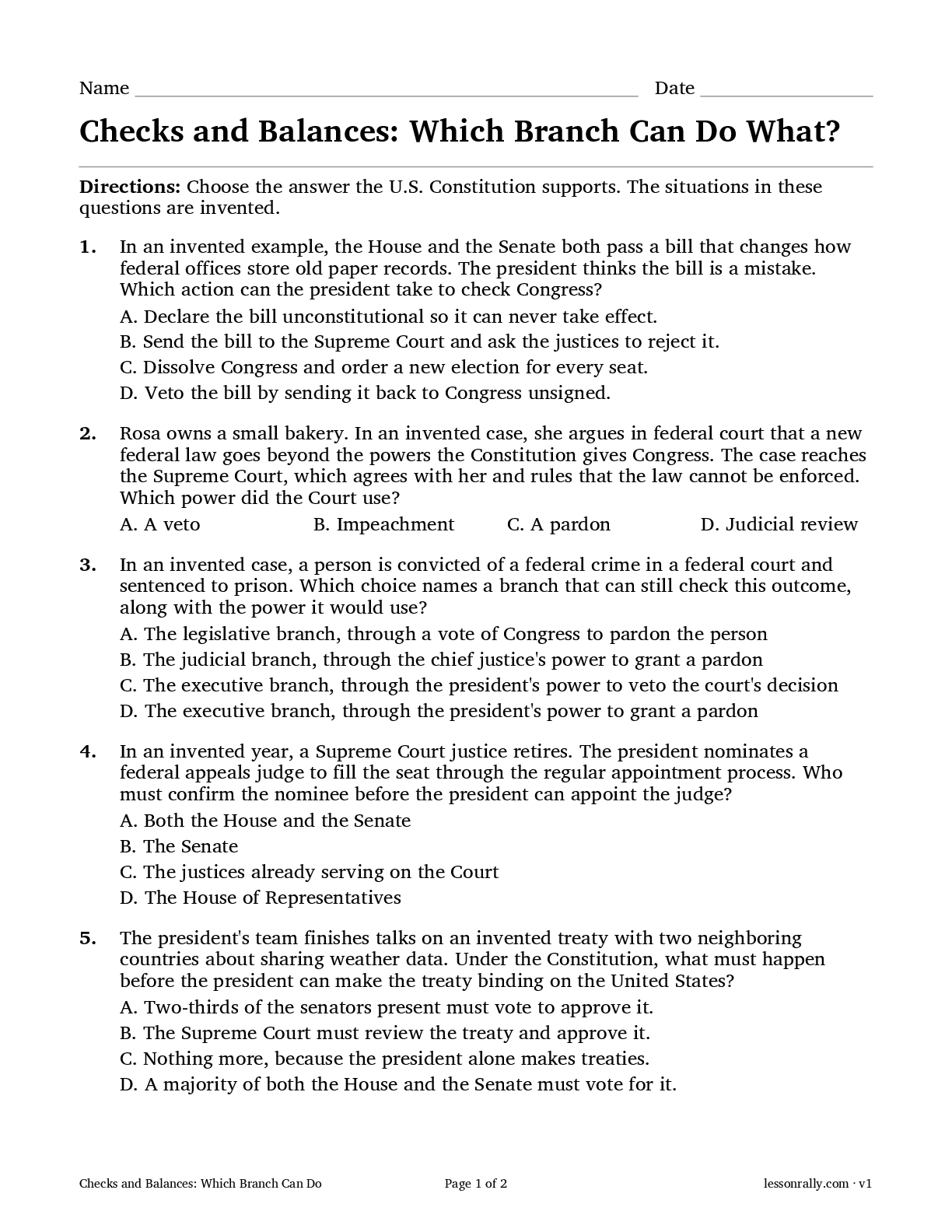
Choose the answer the U.S. Constitution supports. The situations in these questions are invented.

Question 1

In an invented example, the House and the Senate both pass a bill that changes how federal offices store old paper records. The president thinks the bill is a mistake. Which action can the president take to check Congress?

Choose one answer.

  • Veto the bill by sending it back to Congress unsigned.
  • Dissolve Congress and order a new election for every seat.
  • Send the bill to the Supreme Court and ask the justices to reject it.
  • Declare the bill unconstitutional so it can never take effect.
Question 2

Rosa owns a small bakery. In an invented case, she argues in federal court that a new federal law goes beyond the powers the Constitution gives Congress. The case reaches the Supreme Court, which agrees with her and rules that the law cannot be enforced. Which power did the Court use?

Choose one answer.

  • Impeachment
  • A pardon
  • Judicial review
  • A veto

Question 3

In an invented case, a person is convicted of a federal crime in a federal court and sentenced to prison. Which choice names a branch that can still check this outcome, along with the power it would use?

Choose one answer.

  • The executive branch, through the president's power to veto the court's decision
  • The judicial branch, through the chief justice's power to grant a pardon
  • The legislative branch, through a vote of Congress to pardon the person
  • The executive branch, through the president's power to grant a pardon

Question 4

In an invented year, a Supreme Court justice retires. The president nominates a federal appeals judge to fill the seat through the regular appointment process. Who must confirm the nominee before the president can appoint the judge?

Choose one answer.

  • The justices already serving on the Court
  • Both the House and the Senate
  • The House of Representatives
  • The Senate

Question 5

The president's team finishes talks on an invented treaty with two neighboring countries about sharing weather data. Under the Constitution, what must happen before the president can make the treaty binding on the United States?

Choose one answer.

  • Nothing more, because the president alone makes treaties.
  • The Supreme Court must review the treaty and approve it.
  • A majority of both the House and the Senate must vote for it.
  • Two-thirds of the senators present must vote to approve it.

Question 6

In an invented case, a federal judge is accused of taking bribes. The judge holds an office with no fixed term, and the president cannot fire the judge. Which choice describes how Congress could remove this judge from office?

Choose one answer.

  • The House holds a trial, and a majority vote of the House removes the judge.
  • The Supreme Court holds a trial, and then the Senate votes on removal.
  • The House votes to impeach the judge, and then the Senate holds a trial.
  • The Senate votes to impeach the judge, and then the House holds a trial.

Question 7

In an invented example, the president wants to build a new visitor center at a national park, but no money has been set aside for it. Under the Constitution, how can the money be made available?

Choose one answer.

  • The president can order the Treasury to pay for the project.
  • The Supreme Court can approve the spending if the project is legal.
  • Congress must pass a law that sets aside, or appropriates, the money.
  • The Senate alone can approve the spending with a two-thirds vote.

Question 8

In an invented case, the Supreme Court rules that a federal law about recycling goes against the Constitution. Many members of Congress still want the law's goal to stand. Which step could make that possible by changing the Constitution itself?

Choose one answer.

  • Ask the president to veto the Court's ruling so the law takes effect again.
  • Pass the same law again, since a court may strike down a law only once.
  • Propose a constitutional amendment for three-fourths of the states to ratify.
  • Vote to overrule the Court, with two-thirds of each chamber agreeing.

Question 9

In an invented example, the president vetoes a bill about highway signs. The House then votes 310 to 120 to pass it again, and the Senate votes 62 to 38. What happens to the bill?

Choose one answer.

  • It does not become law, because the Senate vote fell short of two-thirds.
  • It becomes law, because a majority of each chamber voted for it.
  • It goes to the Supreme Court, which decides between Congress and the president.
  • It becomes law, because more than two-thirds of all the votes in both chambers, counted together, were yes.

Question 10

Some powers in the Constitution tie one branch to another. Match each power to the person or group the Constitution gives it to.

Match each item to an option.

Items

  1. Vote in the Senate only when senators are tied
  2. Call Congress into a special session on an extraordinary occasion
  3. Preside over the Senate trial when a president is impeached
  4. Create federal courts below the Supreme Court

Options

  1. The president
  2. The chief justice
  3. Congress
  4. The Speaker of the House
  5. The vice president
  6. The secretary of state

Reviews

No reviews yet.

Reviews come from teachers who assigned this activity to a class.

Sign in to write a review

Have a topic of your own? Make a printable worksheet and online quiz, free.

Create an activity

Answer key

Answer keys come with Premium

Print this worksheet with the correct answers marked. The key includes any explanations, sample answers, and rubrics supplied with the activity.

Answer keys aren't public: only teachers with Premium and the people who can edit an activity can download one, so students can't get a ready-to-print key from this page.

Premium includes:

  • No ads for you, and no ads for your students on the assignments you post.
  • Answer keys for printable worksheets, with the correct answers marked and any explanations, sample answers, and rubrics.
  • Create with AI: up to 100 activities a year (5 during the free trial), with every answer checked before you see the draft.

$29 a year, plus sales tax where it applies.

New Premium teachers can try it free for 7 days. A card or other payment method is needed to start. Unless you cancel before the trial ends, you are charged then and the plan renews every year.

Already have Premium or edit this activity? Sign in