The Rise of Islam and Achievements of the Islamic Golden Age

11 questions · 12 points · Grade 7 · English · Preview the 11 questions

Made by Owen Brackwell · LessonRally (AI-assisted)

Digital classroom activity

What is a digital classroom activity?

Teachers who sign in can assign LessonRally activities to their Google Classroom classes: students open them in Classroom and answer online, and their grades go to the teacher's Classroom gradebook. Practice lets you try it first, the way students see it.

Free for teachers. Sign in to assign activities to your Google Classroom classes.

Printable worksheet

Students read about the rise of Islam, Baghdad and its House of Wisdom, then use a table of Golden Age scholars (al-Khwarizmi, Ibn al-Haytham and Ibn Sina) to answer questions about Muhammad and the Quran, the Hijrah, papermaking, translation, algebra, the digits 0 to 9, light and medicine. Includes central idea and objective summary questions.

Learning goal: Describe how Islam arose and spread, and explain achievements of scholars of the Islamic Golden Age and where their legacy can still be seen today.

Estimated reading level 8.1

  1. Grade 6Hard
  2. Grade 7Stretch
  3. Grade 8On level
  4. Grade 9Easier
  5. Grade 10Easy
About this estimate

The estimate is the middle score of five readability formulas. Their scores run from 5.9 to 9.9.

  • Flesch-Kincaid GradeSentence length and syllables per word6.7
  • Gunning FogSentence length and words of three or more syllables9.1
  • Coleman-Liau Middle scoreLetters per word and sentences per 100 words8.1
  • Automated Readability IndexCharacters per word and words per sentence5.9
  • SMOGWords of three or more syllables, for texts of 30 sentences or more9.9
Flesch Reading Ease
68.0 on a 0 to 100 scale where higher is easier: standard. Not part of the estimate.
Text measured
796 words, 39 sentences

Adapted from common readability formulas (Flesch-Kincaid, Gunning Fog, Coleman-Liau and ARI, plus SMOG for long texts), which look at sentence length and word length. Answer choices count toward word length only. Grades below the estimate will likely find the text harder, grades above it easier. It does not measure ideas, background knowledge or images.

Common Core

Closest anchor: CCRA.R.2 Determine central ideas or themes of a text and analyze their development; summarize the key supporting details and ideas.Anchor Standards for ReadingShow 1 matched standardHide matched standard

Matched standard

  • RH.6-8.2

    Determine the central ideas or information of a primary or secondary source; provide an accurate summary of the source distinct from prior knowledge or opinions.

    Student preview question 1

Matched independently by two AI models from this activity's questions.

© Copyright 2010. National Governors Association Center for Best Practices and Council of Chief State School Officers. All rights reserved.

Question types: multiple choice, select all that apply, fill in the blank.

Student preview

The questions as students see them, without the answers.

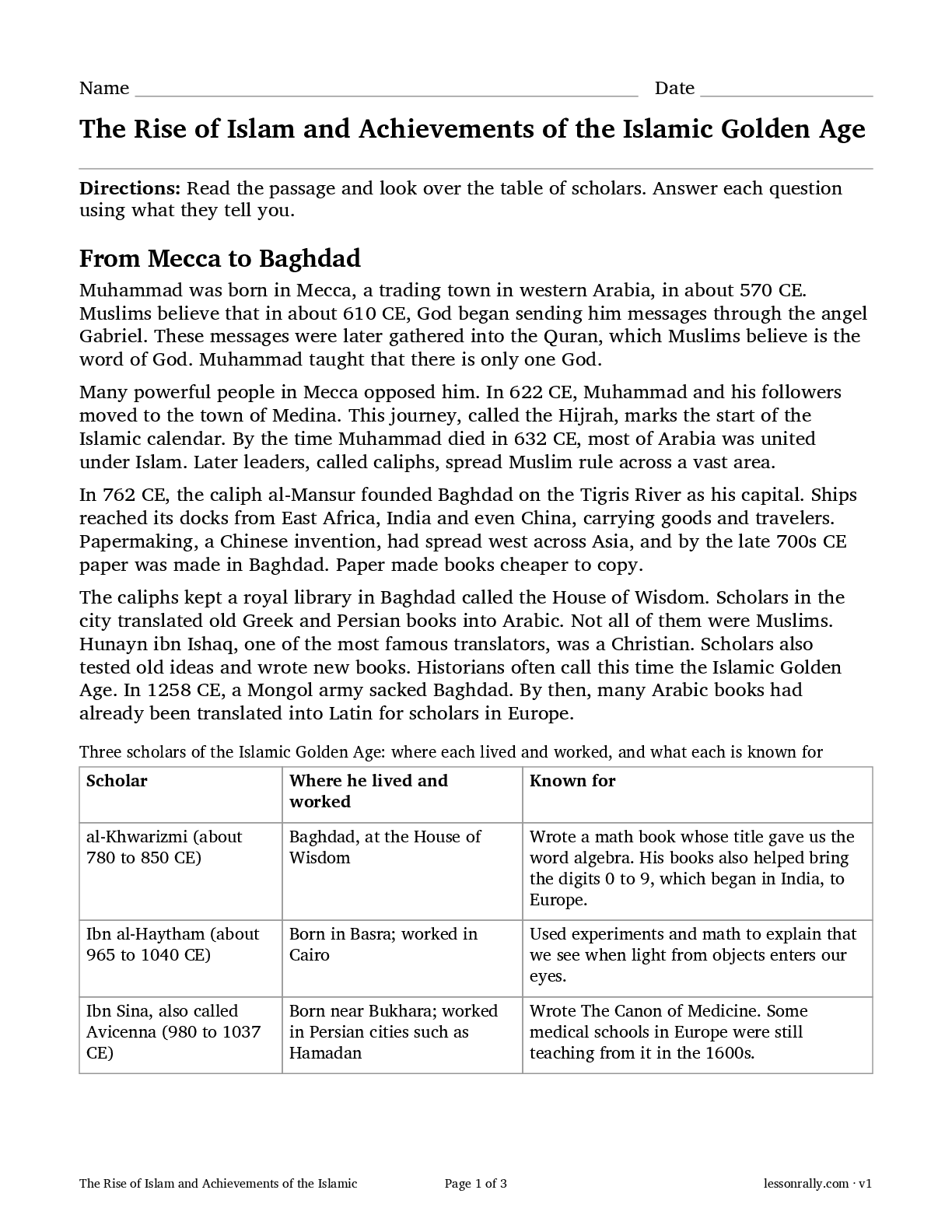
Read the passage and look over the table of scholars. Answer each question using what they tell you.

From Mecca to Baghdad

Muhammad was born in Mecca, a trading town in western Arabia, in about 570 CE. Muslims believe that in about 610 CE, God began sending him messages through the angel Gabriel. These messages were later gathered into the Quran, which Muslims believe is the word of God. Muhammad taught that there is only one God.

Many powerful people in Mecca opposed him. In 622 CE, Muhammad and his followers moved to the town of Medina. This journey, called the Hijrah, marks the start of the Islamic calendar. By the time Muhammad died in 632 CE, most of Arabia was united under Islam. Later leaders, called caliphs, spread Muslim rule across a vast area.

In 762 CE, the caliph al-Mansur founded Baghdad on the Tigris River as his capital. Ships reached its docks from East Africa, India and even China, carrying goods and travelers. Papermaking, a Chinese invention, had spread west across Asia, and by the late 700s CE paper was made in Baghdad. Paper made books cheaper to copy.

The caliphs kept a royal library in Baghdad called the House of Wisdom. Scholars in the city translated old Greek and Persian books into Arabic. Not all of them were Muslims. Hunayn ibn Ishaq, one of the most famous translators, was a Christian. Scholars also tested old ideas and wrote new books. Historians often call this time the Islamic Golden Age. In 1258 CE, a Mongol army sacked Baghdad. By then, many Arabic books had already been translated into Latin for scholars in Europe.


Three scholars of the Islamic Golden Age: where each lived and worked, and what each is known for
ScholarWhere he lived and workedKnown for
al-Khwarizmi (about 780 to 850 CE)Baghdad, at the House of WisdomWrote a math book whose title gave us the word algebra. His books also helped bring the digits 0 to 9, which began in India, to Europe.
Ibn al-Haytham (about 965 to 1040 CE)Born in Basra; worked in CairoUsed experiments and math to explain that we see when light from objects enters our eyes.
Ibn Sina, also called Avicenna (980 to 1037 CE)Born near Bukhara; worked in Persian cities such as HamadanWrote The Canon of Medicine. Some medical schools in Europe were still teaching from it in the 1600s.

Question 1

Which statement best expresses the central idea of this passage about Mecca and Baghdad?

Choose one answer.

  • The Mongols destroyed Baghdad in 1258 CE, so all of its learning was lost.
  • Muhammad was born in Mecca in about 570 CE.
  • Scholars in Baghdad copied old books but added no new ideas.
  • Islam spread from Arabia, and Baghdad grew into a center of learning whose books reached far beyond it.

Question 2

According to the passage, what do Muslims believe about the Quran?

Choose one answer.

  • It is a book of laws written by the caliph al-Mansur.
  • It is a history of the caliphs, written in Baghdad.
  • It is a collection of Greek books translated into Arabic.
  • It is the word of God, sent to Muhammad through the angel Gabriel.

Question 3

Why does the Islamic calendar begin in 622 CE?

Choose one answer.

  • That year the caliph al-Mansur founded Baghdad.
  • That year Muhammad was born in Mecca.
  • That year a Mongol army sacked Baghdad.
  • That year Muhammad and his followers moved from Mecca to Medina.

Question 4

According to the passage, where was papermaking first invented?

Choose one answer.

  • China
  • Baghdad
  • Egypt
  • Spain

Question 5

According to the passage, which is one way Baghdad's location helped the city?

Choose one answer.

  • Mountains around it kept travelers away.
  • Its place on the Tigris River let ships bring goods and travelers from distant lands.
  • It was the only city in the world that made paper.
  • It was the town where Muhammad was born.

Question 6

Which two statements about the scholars in Baghdad does the passage support? Select 2.

Choose 2 answers.

  • They all came from Mecca.
  • They translated old Greek and Persian books into Arabic.
  • They included people of more than one faith.
  • They used only books first written in Arabic.
  • They were not allowed to write new books.

Question 7

Use the table of Golden Age scholars to complete the sentences.

Fill in each blank.

The word blank 1 comes from the title of a math book by al-Khwarizmi. Ibn al-Haytham was born in Basra and later worked in the city of blank 2.

Word bank

  • Medina
  • alphabet
  • algebra
  • Cairo

Question 8

Science classes today teach that we see objects because light from them enters our eyes. According to the table, which scholar explained seeing this way?

Choose one answer.

  • Ibn al-Haytham
  • al-Mansur
  • Ibn Sina
  • al-Khwarizmi

Question 9

According to the table, what part did al-Khwarizmi play in the history of the digits 0 to 9?

Choose one answer.

  • He replaced the digits with Roman numerals.
  • He learned the digits from scholars in Europe.
  • His books helped bring the digits, which began in India, to Europe.
  • He invented the digits at the House of Wisdom.

Question 10

Ibn Sina died in 1037 CE. According to the table, what shows that his work still mattered in Europe centuries later?

Choose one answer.

  • Some medical schools in Europe were still teaching from his book in the 1600s.
  • He explained how light from objects lets us see.
  • His math book gave us the word algebra.
  • He founded the city of Baghdad on the Tigris River.

Question 11

Which sentence is an opinion that would not belong in an objective summary of this passage about Mecca and Baghdad?

Choose one answer.

  • Baghdad was founded on the Tigris River in 762 CE.
  • A Mongol army sacked Baghdad in 1258 CE.
  • The scholars of Baghdad were the smartest people who ever lived.
  • Hunayn ibn Ishaq translated books into Arabic.

Reviews

No reviews yet.

Reviews come from teachers who assigned this activity to a class.

Sign in to write a review

Have a topic of your own? Make a printable worksheet and online quiz, free.

Create an activity

Answer key

Answer keys come with Premium

Print this worksheet with the correct answers marked. The key includes any explanations, sample answers, and rubrics supplied with the activity.

Answer keys aren't public: only teachers with Premium and the people who can edit an activity can download one, so students can't get a ready-to-print key from this page.

Premium includes:

  • No ads for you, and no ads for your students on the assignments you post.
  • Answer keys for printable worksheets, with the correct answers marked and any explanations, sample answers, and rubrics.
  • Create with AI: up to 100 activities a year (5 during the free trial), with every answer checked before you see the draft.

$29 a year, plus sales tax where it applies.

New Premium teachers can try it free for 7 days. A card or other payment method is needed to start. Unless you cancel before the trial ends, you are charged then and the plan renews every year.

Already have Premium or edit this activity? Sign in