Question 1
A light panel on a robot shows the binary number 1100. What regular number does the binary number 1100 stand for?
Enter a number.


Teachers who sign in can assign LessonRally activities to their Google Classroom classes: students open them in Classroom and answer online, and their grades go to the teacher's Classroom gradebook. Practice lets you try it first, the way students see it.
Free for teachers. Sign in to assign activities to your Google Classroom classes.
 (opens in a new tab)
1 page · Student copy, no answers
Print worksheet (opens in a new tab)Answer keyPremiumStudents find the value of binary numbers using place values of 1, 2, 4, 8, 16 and up, write a regular number as a binary number, count in binary, read binary number cards, and trace a doubling method from left to right. Shows how computers store numbers with bits and bytes. Every answer is an exact whole number.
Learning goal: Find the value of a binary number using place values, write a regular number as a binary number, and count in binary.
The estimate is halfway between the two middle scores of four readability formulas. Their scores run from 2.4 to 8.7.
Adapted from common readability formulas (Flesch-Kincaid, Gunning Fog, Coleman-Liau and ARI, plus SMOG for long texts), which look at sentence length and word length. Answer choices count toward word length only. Grades below the estimate will likely find the text harder, grades above it easier. It does not measure ideas, background knowledge or images.
Topic: Computers and Networks Chosen by LessonRally
Question types: number answer, multiple choice, matching.
The questions as students see them, without the answers.
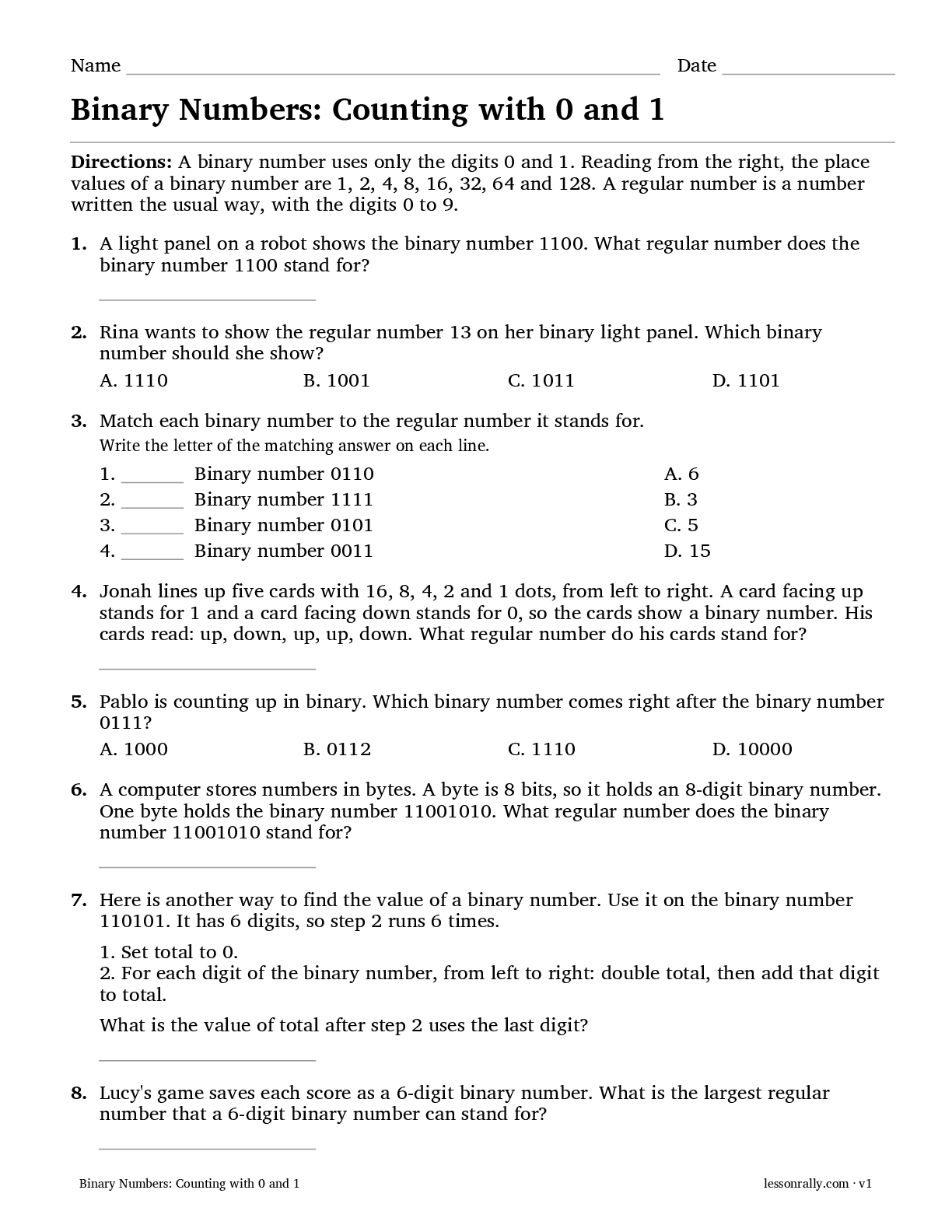
A binary number uses only the digits 0 and 1. Reading from the right, the place values of a binary number are 1, 2, 4, 8, 16, 32, 64 and 128. A regular number is a number written the usual way, with the digits 0 to 9.
A light panel on a robot shows the binary number 1100. What regular number does the binary number 1100 stand for?
Enter a number.
Rina wants to show the regular number 13 on her binary light panel. Which binary number should she show?
Choose one answer.
Match each binary number to the regular number it stands for.
Match each item to an option.
Items
Options
Jonah lines up five cards with 16, 8, 4, 2 and 1 dots, from left to right. A card facing up stands for 1 and a card facing down stands for 0, so the cards show a binary number. His cards read: up, down, up, up, down. What regular number do his cards stand for?
Enter a number.
Pablo is counting up in binary. Which binary number comes right after the binary number 0111?
Choose one answer.
A computer stores numbers in bytes. A byte is 8 bits, so it holds an 8-digit binary number. One byte holds the binary number 11001010. What regular number does the binary number 11001010 stand for?
Enter a number.
Here is another way to find the value of a binary number. Use it on the binary number 110101. It has 6 digits, so step 2 runs 6 times.
What is the value of total after step 2 uses the last digit?
Enter a number.
Lucy's game saves each score as a 6-digit binary number. What is the largest regular number that a 6-digit binary number can stand for?
Enter a number.
No reviews yet.
Reviews come from teachers who assigned this activity to a class.
Have a topic of your own? Make a printable worksheet and online quiz, free.
Create an activityCommon Core RI.6.6
Made by Aisha Varrick · LessonRally (AI-assisted)
Made by Aisha Varrick · LessonRally (AI-assisted)
Made by Aisha Varrick · LessonRally (AI-assisted)
Made by Aisha Varrick · LessonRally (AI-assisted)