Fossils: Clues to Long Ago

8 questions · 9 points · Grade 3 · English · Preview the 8 questions

Made by Wes Calloway · LessonRally (AI-assisted)

Digital classroom activity

What is a digital classroom activity?

Teachers who sign in can assign LessonRally activities to their Google Classroom classes: students open them in Classroom and answer online, and their grades go to the teacher's Classroom gradebook. Practice lets you try it first, the way students see it.

Free for teachers. Sign in to assign activities to your Google Classroom classes.

Printable worksheet

Students read about fish fossils found in rock in a dry desert and explain what fossils tell us about living things and places long ago. Questions cover what the fish fossils show, how a shell becomes a fossil, why most living things never become fossils, and what palm fossils in the far north, a trilobite, and a dinosaur footprint each tell scientists.

Learning goal: Use fossils as evidence of the living things and environments of long ago, and explain why most living things never become fossils.

Estimated reading level 4.7

  1. Grade 2Hard
  2. Grade 3Stretch
  3. Grade 4On level
  4. Grade 5Easier
  5. Grade 6Easy
About this estimate

The estimate is the middle score of five readability formulas. Their scores run from 2.9 to 5.8.

  • Flesch-Kincaid GradeSentence length and syllables per word3.5
  • Gunning Fog Middle scoreSentence length and words of three or more syllables4.7
  • Coleman-LiauLetters per word and sentences per 100 words5.5
  • Automated Readability IndexCharacters per word and words per sentence2.9
  • SMOGWords of three or more syllables, for texts of 30 sentences or more5.8
Flesch Reading Ease
86.7 on a 0 to 100 scale where higher is easier: easy. Not part of the estimate.
Text measured
538 words, 32 sentences

Adapted from common readability formulas (Flesch-Kincaid, Gunning Fog, Coleman-Liau and ARI, plus SMOG for long texts), which look at sentence length and word length. Answer choices count toward word length only. Grades below the estimate will likely find the text harder, grades above it easier. It does not measure ideas, background knowledge or images.

Common Core

Closest anchor: CCRA.R.1 Read closely to determine what the text says explicitly and to make logical inferences from it; cite specific textual evidence when writing or speaking to support conclusions drawn from the text.Anchor Standards for ReadingShow 1 matched standardHide matched standard

Matched standard

  • RI.3.1

    Ask and answer questions to demonstrate understanding of a text, referring explicitly to the text as the basis for the answers.

    Student preview questions 1, 2

Matched independently by two AI models from this activity's questions.

© Copyright 2010. National Governors Association Center for Best Practices and Council of Chief State School Officers. All rights reserved.

Topic: Evolution and Natural Selection Chosen by LessonRally

Question types: multiple choice, fill in the blank.

Student preview

The questions as students see them, without the answers.

Read about Mateo's trip. Then answer each question.

Fish in the Desert

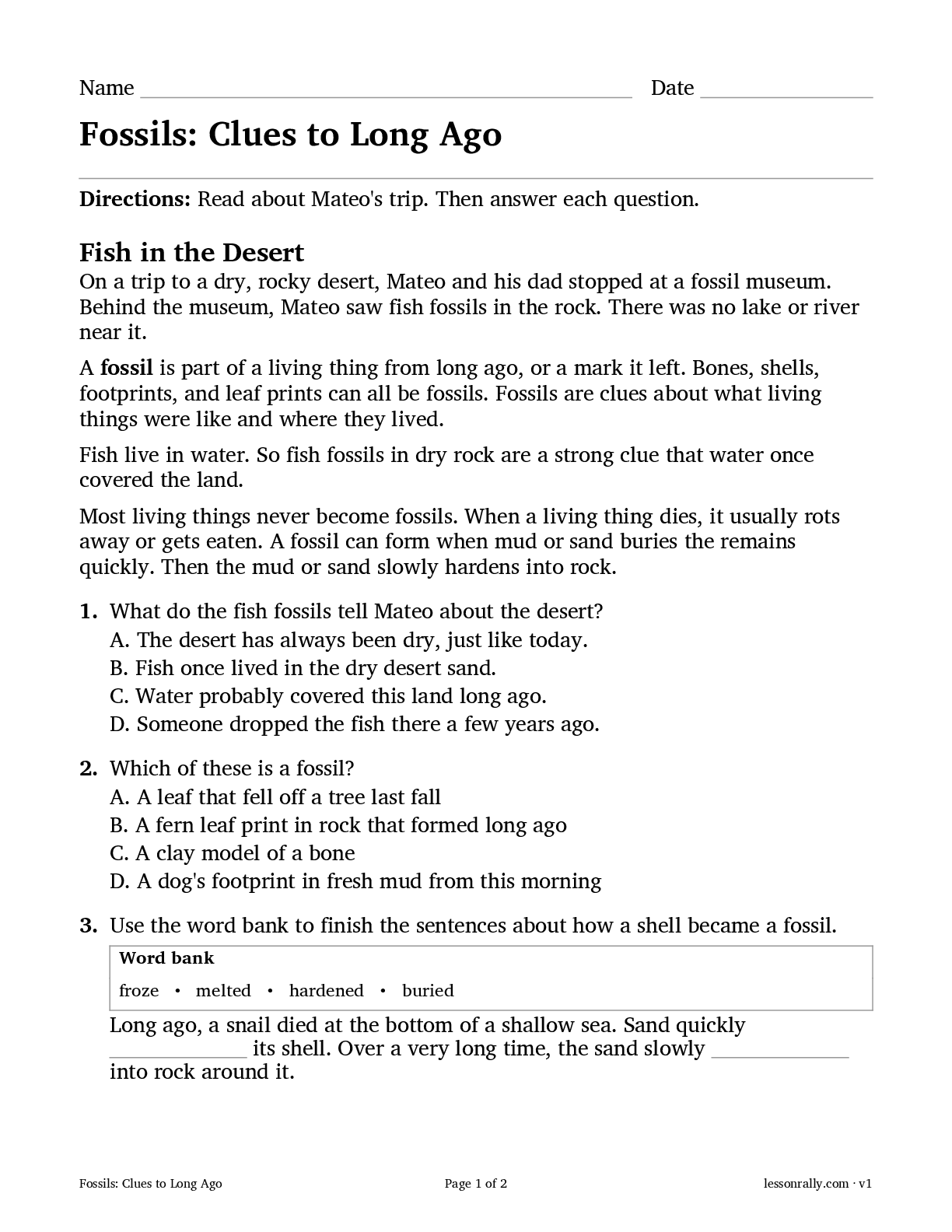
On a trip to a dry, rocky desert, Mateo and his dad stopped at a fossil museum. Behind the museum, Mateo saw fish fossils in the rock. There was no lake or river near it.

A fossil is part of a living thing from long ago, or a mark it left. Bones, shells, footprints, and leaf prints can all be fossils. Fossils are clues about what living things were like and where they lived.

Fish live in water. So fish fossils in dry rock are a strong clue that water once covered the land.

Most living things never become fossils. When a living thing dies, it usually rots away or gets eaten. A fossil can form when mud or sand buries the remains quickly. Then the mud or sand slowly hardens into rock.


Question 1

What do the fish fossils tell Mateo about the desert?

Choose one answer.

  • Someone dropped the fish there a few years ago.
  • Fish once lived in the dry desert sand.
  • The desert has always been dry, just like today.
  • Water probably covered this land long ago.

Question 2

Which of these is a fossil?

Choose one answer.

  • A fern leaf print in rock that formed long ago
  • A dog's footprint in fresh mud from this morning
  • A clay model of a bone
  • A leaf that fell off a tree last fall

Question 3

Use the word bank to finish the sentences about how a shell became a fossil.

Fill in each blank.

Long ago, a snail died at the bottom of a shallow sea. Sand quickly blank 1 its shell. Over a very long time, the sand slowly blank 2 into rock around it.

Word bank

  • melted
  • hardened
  • buried
  • froze

Question 4

Most palm trees grow in warm places. Scientists found palm fossils far in the north, where it is very cold now. What do these fossils suggest?

Choose one answer.

  • People planted palm trees there last summer.
  • Palm trees grow best in snow and ice.
  • Those places have always been cold.
  • Those places were probably much warmer long ago.

Question 5

Trilobites were sea creatures that lived long ago. None are alive today. We know about them from their fossils. What does a trilobite fossil show?

Choose one answer.

  • All living things from long ago are still alive.
  • They still live in the desert today.
  • They lived on dry land, not in the sea.
  • Some kinds of living things from long ago have died out.

Question 6

A dinosaur footprint is a fossil, but no part of the body is in it. What does the footprint tell scientists?

Choose one answer.

  • A dinosaur walked there long ago, on soft mud or sand.
  • Its bones are hidden inside the footprint.
  • The dinosaur is still alive.
  • Its feet pressed into solid rock.

Question 7

Mateo says, "All living things became fossils." Which sentence from the passage shows he is wrong?

Choose one answer.

  • There was no lake or river near it.
  • Most living things never become fossils.
  • Bones, shells, footprints, and leaf prints can all be fossils.
  • Fish live in water.

Question 8

What would happen if a bird died on the forest floor and no mud or sand covered it?

Choose one answer.

  • It would probably rot away or get eaten, not turn into a fossil.
  • It would turn into rock right away.
  • It would turn into a fossil in a few weeks.
  • It would sink into the solid ground and harden.

Reviews

No reviews yet.

Reviews come from teachers who assigned this activity to a class.

Sign in to write a review

Have a topic of your own? Make a printable worksheet and online quiz, free.

Create an activity

Answer key

Answer keys come with Premium

Print this worksheet with the correct answers marked. The key includes any explanations, sample answers, and rubrics supplied with the activity.

Answer keys aren't public: only teachers with Premium and the people who can edit an activity can download one, so students can't get a ready-to-print key from this page.

Premium includes:

  • No ads for you, and no ads for your students on the assignments you post.
  • Answer keys for printable worksheets, with the correct answers marked and any explanations, sample answers, and rubrics.
  • Create with AI: up to 100 activities a year (5 during the free trial), with every answer checked before you see the draft.

$29 a year, plus sales tax where it applies.

New Premium teachers can try it free for 7 days. A card or other payment method is needed to start. Unless you cancel before the trial ends, you are charged then and the plan renews every year.

Already have Premium or edit this activity? Sign in