Question 1
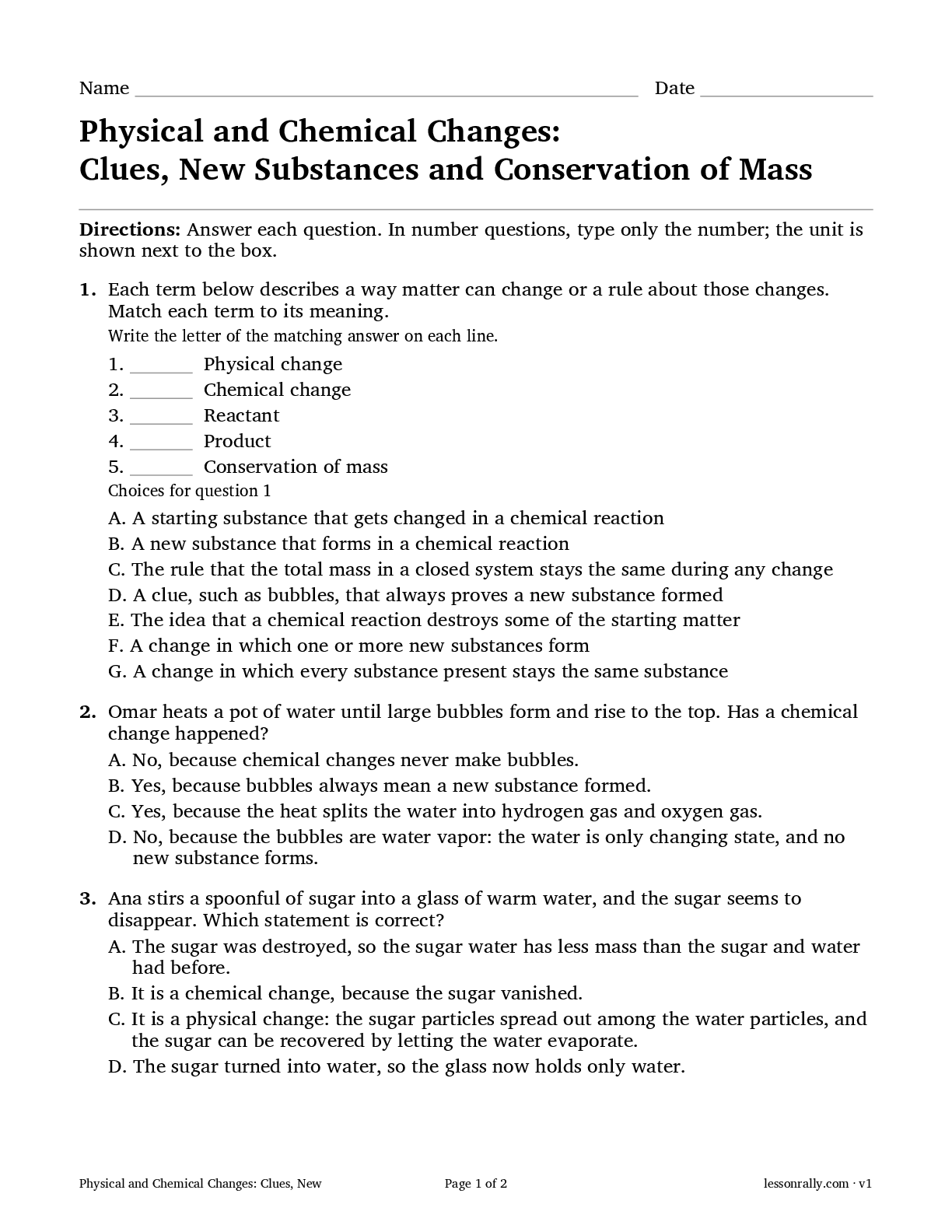
Each term below describes a way matter can change or a rule about those changes. Match each term to its meaning.
Match each item to an option.
Items
- Physical change
- Chemical change
- Reactant
- Product
- Conservation of mass
Options


Teachers who sign in can assign LessonRally activities to their Google Classroom classes: students open them in Classroom and answer online, and their grades go to the teacher's Classroom gradebook. Practice lets you try it first, the way students see it.
Free for teachers. Sign in to assign activities to your Google Classroom classes.
 (opens in a new tab)
2 pages · Student copy, no answers
Print worksheet (opens in a new tab)Answer keyPremiumStudents match key terms for changes in matter, then decide whether boiling, dissolving, rusting, burning and heating sugar form new substances, use properties before and after a change as evidence, and explain why mass stays the same in a closed container. Questions take on the ideas that bubbles, a color change or a temperature change always prove a chemical change and that a reaction destroys matter.
Learning goal: Tell physical and chemical changes apart by asking whether a new substance forms, use properties before and after a change as evidence, and explain why mass is conserved in a closed system.
The estimate is halfway between the two middle scores of four readability formulas. Their scores run from 5.7 to 8.3.
Adapted from common readability formulas (Flesch-Kincaid, Gunning Fog, Coleman-Liau and ARI, plus SMOG for long texts), which look at sentence length and word length. Answer choices count toward word length only. Grades below the estimate will likely find the text harder, grades above it easier. It does not measure ideas, background knowledge or images.
Topic: Chemical Reactions Chosen by LessonRally
Question types: matching, multiple choice, select all that apply, number answer.
The questions as students see them, without the answers.
Answer each question. In number questions, type only the number; the unit is shown next to the box.
Each term below describes a way matter can change or a rule about those changes. Match each term to its meaning.
Match each item to an option.
Items
Options
Omar heats a pot of water until large bubbles form and rise to the top. Has a chemical change happened?
Choose one answer.
Ana stirs a spoonful of sugar into a glass of warm water, and the sugar seems to disappear. Which statement is correct?
Choose one answer.
Which two of these changes are chemical changes?
Choose 2 answers.
Kai mixes baking soda with vinegar. The mixture fizzes, makes bubbles and gets a little colder. Which observation is the best evidence that a new substance formed?
Choose one answer.
Before heating, a sample of table sugar is made of white crystals that dissolve easily in water. After strong heating, what is left is a black solid that does not dissolve in water. What does this comparison of properties show?
Choose one answer.
A computer simulation shows vinegar and a small cup of baking soda inside a sealed, rigid container that nothing can enter or leave. The container and everything in it have a mass of 312 grams. In the simulation, the baking soda spills into the vinegar, and the mixture fizzes until it stops. What is the total mass now?
Enter a number.
g
When baking soda and vinegar are mixed in an open cup on a scale, the scale reading drops as the mixture fizzes. Why?
Choose one answer.
No reviews yet.
Reviews come from teachers who assigned this activity to a class.
Have a topic of your own? Make a printable worksheet and online quiz, free.
Create an activityCommon Core RST.6-8.7
Made by Theo Nakamura · LessonRally (AI-assisted)
Common Core RST.6-8.4
Made by Myra Jefferson · LessonRally (AI-assisted)
Made by Theo Nakamura · LessonRally (AI-assisted)
Common Core RST.6-8.4
Made by Myra Jefferson · LessonRally (AI-assisted)