Question 1
Use the passage about Mesopotamia to complete the sentences.
Fill in each blank.
The name Mesopotamia is Greek for "between blank 1." Most of Mesopotamia lies in today's blank 2.
Word bank
- rivers
- Egypt
- mountains
- Iraq


Teachers who sign in can assign LessonRally activities to their Google Classroom classes: students open them in Classroom and answer online, and their grades go to the teacher's Classroom gradebook. Practice lets you try it first, the way students see it.
Free for teachers. Sign in to assign activities to your Google Classroom classes.
 (opens in a new tab)
2 pages · Student copy, no answers
Print worksheet (opens in a new tab)Answer keyPremiumStudents read a short passage about Mesopotamia and Sumer, then answer questions on how the Tigris and Euphrates rivers shaped farming, irrigation canals and building, what Sumerian city-states and ziggurats were, and how cuneiform, one of the earliest writing systems, began and changed. Two questions ask students to cite evidence from the passage.
Learning goal: Explain how the Tigris and Euphrates rivers shaped life in Mesopotamia, and describe Sumerian city-states, ziggurats and cuneiform writing using evidence from a passage.
The estimate is the middle score of five readability formulas. Their scores run from 5.9 to 9.2.
Adapted from common readability formulas (Flesch-Kincaid, Gunning Fog, Coleman-Liau and ARI, plus SMOG for long texts), which look at sentence length and word length. Answer choices count toward word length only. Grades below the estimate will likely find the text harder, grades above it easier. It does not measure ideas, background knowledge or images.
Topic: Ancient Civilizations Chosen by LessonRally
Question types: fill in the blank, multiple choice, select all that apply.
The questions as students see them, without the answers.
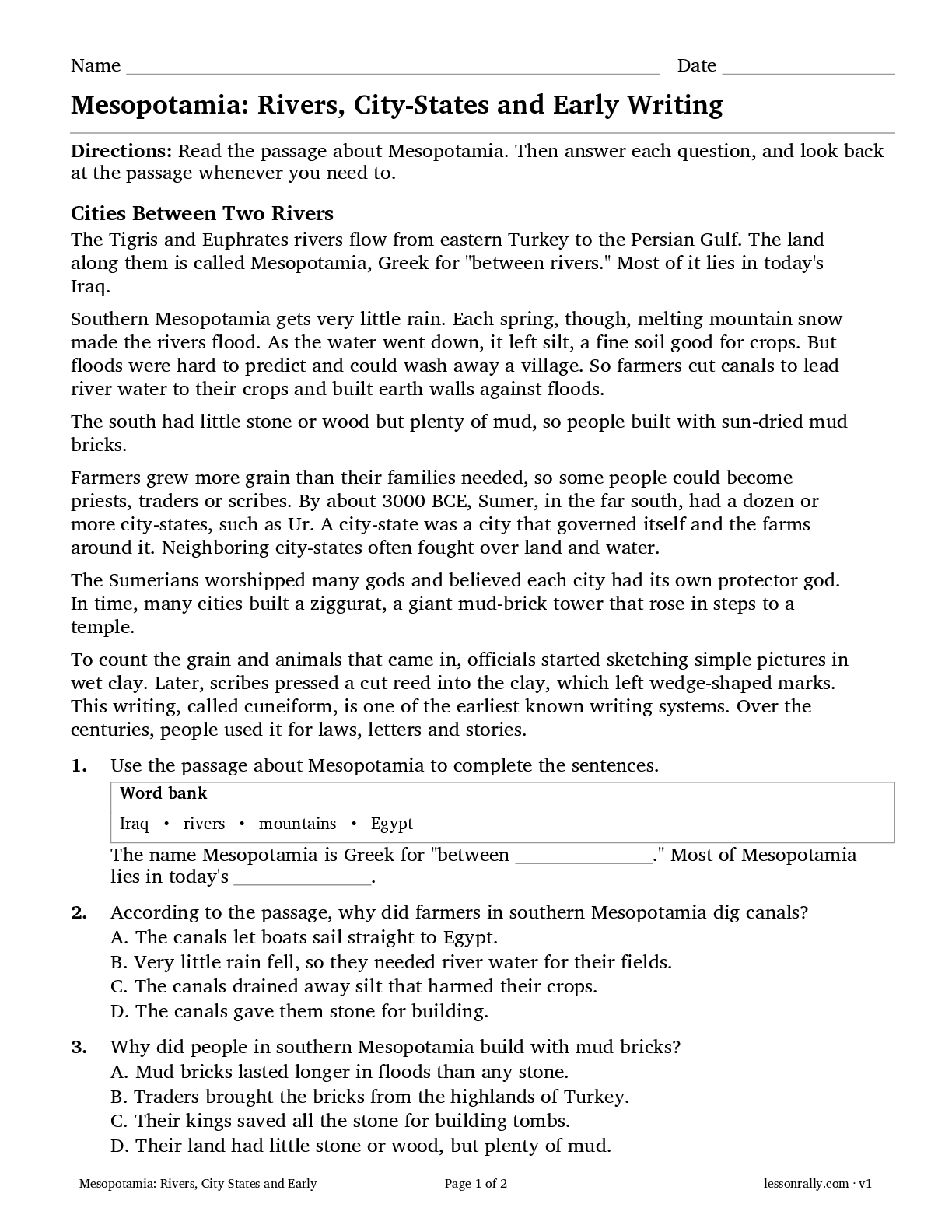
Read the passage about Mesopotamia. Then answer each question, and look back at the passage whenever you need to.
The Tigris and Euphrates rivers flow from eastern Turkey to the Persian Gulf. The land along them is called Mesopotamia, Greek for "between rivers." Most of it lies in today's Iraq.
Southern Mesopotamia gets very little rain. Each spring, though, melting mountain snow made the rivers flood. As the water went down, it left silt, a fine soil good for crops. But floods were hard to predict and could wash away a village. So farmers cut canals to lead river water to their crops and built earth walls against floods.
The south had little stone or wood but plenty of mud, so people built with sun-dried mud bricks.
Farmers grew more grain than their families needed, so some people could become priests, traders or scribes. By about 3000 BCE, Sumer, in the far south, had a dozen or more city-states, such as Ur. A city-state was a city that governed itself and the farms around it. Neighboring city-states often fought over land and water.
The Sumerians worshipped many gods and believed each city had its own protector god. In time, many cities built a ziggurat, a giant mud-brick tower that rose in steps to a temple.
To count the grain and animals that came in, officials started sketching simple pictures in wet clay. Later, scribes pressed a cut reed into the clay, which left wedge-shaped marks. This writing, called cuneiform, is one of the earliest known writing systems. Over the centuries, people used it for laws, letters and stories.
Use the passage about Mesopotamia to complete the sentences.
Fill in each blank.
The name Mesopotamia is Greek for "between blank 1." Most of Mesopotamia lies in today's blank 2.
Word bank
According to the passage, why did farmers in southern Mesopotamia dig canals?
Choose one answer.
Why did people in southern Mesopotamia build with mud bricks?
Choose one answer.
What does the passage mean by a city-state?
Choose one answer.
Which sentence from the passage best supports the idea that Sumer's city-states were rivals?
Choose one answer.
Which description of a ziggurat matches the passage?
Choose one answer.
Which two statements about life in Sumer does the passage support? Select 2.
Choose 2 answers.
What first led officials in Sumer to start making marks in clay?
Choose one answer.
Which sentence from the passage best shows that early writing in Sumer changed over time?
Choose one answer.
The passage says that over the centuries, people used cuneiform for laws, letters and stories. What does this detail show?
Choose one answer.
No reviews yet.
Reviews come from teachers who assigned this activity to a class.
Have a topic of your own? Make a printable worksheet and online quiz, free.
Create an activityMade by Owen Brackwell · LessonRally (AI-assisted)
Made by Owen Brackwell · LessonRally (AI-assisted)
Common Core RH.6-8.4
Made by Owen Brackwell · LessonRally (AI-assisted)
Made by Owen Brackwell · LessonRally (AI-assisted)