Teachers who sign in can assign LessonRally activities to their Google Classroom classes: students open them in Classroom and answer online, and their grades go to the teacher's Classroom gradebook. Practice lets you try it first, the way students see it.
Students review how substances cross the cell membrane by passive transport (simple diffusion, facilitated diffusion and osmosis) and active transport, predict how cells respond to hypotonic, hypertonic and isotonic solutions, and interpret a table of potato core data.
Learning goal: Explain how substances cross the cell membrane and predict the effect of hypotonic, hypertonic and isotonic solutions on cells.
Estimated reading level8.0
Grade 6Hard
Grade 7Stretch
Grade 8On level
Grade 9Easier
Grade 10Easy
About this estimate
The estimate is halfway between the two middle scores of four readability formulas. Their scores run from 7.5 to 10.6.
Flesch-Kincaid GradeSentence length and syllables per word7.5
Gunning FogSentence length and words of three or more syllables10.6
Coleman-Liau Middle scoreLetters per word and sentences per 100 words8.3
Automated Readability Index Middle scoreCharacters per word and words per sentence7.7
Grade 181216
Flesch Reading Ease
69.4 on a 0 to 100 scale where higher is easier: standard. Not part of the estimate.
Text measured
1,014 words, 29 sentences
Adapted from common readability formulas (Flesch-Kincaid, Gunning Fog, Coleman-Liau and ARI, plus SMOG for long texts), which look at sentence length and word length. Answer choices count toward word length only. Grades below the estimate will likely find the text harder, grades above it easier. It does not measure ideas, background knowledge or images.
Common Core
Press Ctrl+C or Command+C to copy.
Closest anchor:CCRA.R.7Integrate and evaluate content presented in diverse media and formats, including visually and quantitatively, as well as in words.Anchor Standards for ReadingShow 1 matched standardHide matched standard
Translate quantitative or technical information expressed in words in a text into visual form (e.g., a table or chart) and translate information expressed visually or mathematically (e.g., in an equation) into words.
Question types: multiple choice, select all that apply, fill in the blank, matching.
Student preview
The questions as students see them, without the answers.
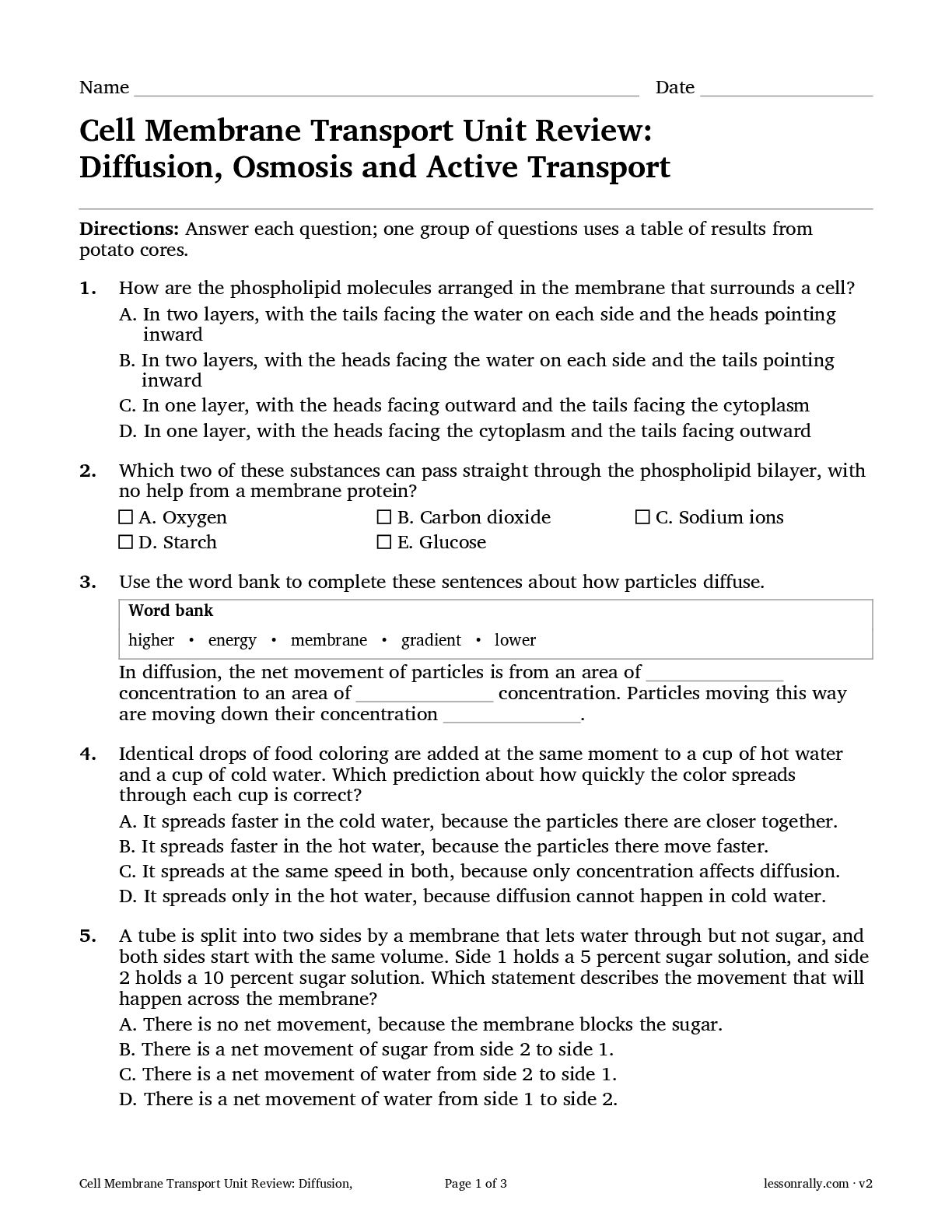
Answer each question; one group of questions uses a table of results from potato cores.
Question 1
How are the phospholipid molecules arranged in the membrane that surrounds a cell?
Choose one answer.
In two layers, with the tails facing the water on each side and the heads pointing inward
In two layers, with the heads facing the water on each side and the tails pointing inward
In one layer, with the heads facing the cytoplasm and the tails facing outward
In one layer, with the heads facing outward and the tails facing the cytoplasm
Question 2
Which two of these substances can pass straight through the phospholipid bilayer, with no help from a membrane protein?
Choose 2 answers.
Sodium ions
Starch
Carbon dioxide
Glucose
Oxygen
Question 3
Use the word bank to complete these sentences about how particles diffuse.
Fill in each blank.
In diffusion, the net movement of particles is from an area of blank 1 concentration to an area of blank 2 concentration. Particles moving this way are moving down their concentration blank 3.
Word bank
membrane
lower
energy
gradient
higher
Question 4
Identical drops of food coloring are added at the same moment to a cup of hot water and a cup of cold water. Which prediction about how quickly the color spreads through each cup is correct?
Choose one answer.
It spreads faster in the cold water, because the particles there are closer together.
It spreads at the same speed in both, because only concentration affects diffusion.
It spreads faster in the hot water, because the particles there move faster.
It spreads only in the hot water, because diffusion cannot happen in cold water.
Question 5
A tube is split into two sides by a membrane that lets water through but not sugar, and both sides start with the same volume. Side 1 holds a 5 percent sugar solution, and side 2 holds a 10 percent sugar solution. Which statement describes the movement that will happen across the membrane?
Choose one answer.
There is a net movement of sugar from side 2 to side 1.
There is a net movement of water from side 1 to side 2.
There is a net movement of water from side 2 to side 1.
There is no net movement, because the membrane blocks the sugar.
Question 6
Match each part of the cell membrane to the job it does there.
Match each item to an option.
Items
Channel protein
Carrier protein
Cholesterol (in animal cells)
Carbohydrate chain on the outer surface
Options
Binds a particular molecule and changes shape to move it across
Serves as a marker that helps cells recognize each other
Stores the instructions for making the cell's proteins
Forms a tunnel that lets certain ions or water molecules pass
Helps keep the membrane from getting too fluid or too stiff
Question 7
Glucose, which is more concentrated in the blood than inside a red blood cell, enters the cell through a carrier protein, and the cell spends no ATP to move it. Which kind of membrane transport is this?
Choose one answer.
Facilitated diffusion
Active transport
Osmosis
Simple diffusion
Question 8
Sodium ions are far more concentrated outside a nerve cell than inside it, yet a membrane pump moves still more sodium ions out of the cell. Why must the pump use energy from ATP to do this?
Choose one answer.
Every membrane protein uses ATP to move particles.
It moves sodium ions against their concentration gradient.
Sodium ions are too large to pass through a channel protein.
It moves sodium ions down their concentration gradient.
Question 9
Limp lettuce leaves turn crisp after soaking in a bowl of tap water, which is hypotonic to the leaf cells. Which statement explains what happens inside the leaf cells as they soak?
Choose one answer.
Water enters by osmosis, and each cell swells and presses against its wall.
Water leaves by osmosis, and the empty cell walls stiffen the leaf.
Water enters by osmosis, and the cells burst and flood the leaf.
Salt enters by diffusion, and the extra salt makes each cell stiff.
Question 10
A paramecium is a single-celled organism that lives in pond water, which is hypotonic to its cytoplasm. Its contractile vacuoles collect water and squeeze it out of the cell, over and over. What would most likely happen if its contractile vacuoles stopped working?
Choose one answer.
Water would keep leaving by osmosis, and the cell would shrink and could collapse.
Nothing would change, because pond water and the cytoplasm are in balance.
Water would keep entering by osmosis, and the cell would swell and could burst.
Salt would keep entering by diffusion, and the cell would shrink and could collapse.
Potato Cores in Salt Solutions
In an investigation, 30 potato cores of the same size were cut from one potato. Five cores were placed in each of six salt solutions, 100 mL each, at room temperature. After 24 hours, the cores were blotted dry and weighed again, and the results are shown in the table.
Total mass of five potato cores before and after 24 hours in each salt solution
Salt in solution (g per 100 mL)
Mass before (g)
Mass after 24 hours (g)
Change in mass (%)
0 (distilled water)
12.50
14.15
+13.2
0.5
12.40
13.09
+5.6
1.0
12.60
12.35
−2.0
2.0
12.45
11.16
−10.4
3.0
12.55
10.46
−16.7
4.0
12.50
9.95
−20.4
Question 11
According to the table, which of these salt solutions was hypotonic to the potato cells?
Choose one answer.
2.0 g of salt per 100 mL
0.5 g of salt per 100 mL
4.0 g of salt per 100 mL
1.0 g of salt per 100 mL
Question 12
A salt solution that is isotonic to these potato cells would cause no change in their mass. Based on the table, in which range does that salt concentration most likely fall?
Choose one answer.
Between 0.5 and 1.0 g per 100 mL
Between 0 and 0.5 g per 100 mL
Between 3.0 and 4.0 g per 100 mL
Between 1.0 and 2.0 g per 100 mL
Question 13
Which explanation fits the result for the cores in the 3.0 g per 100 mL solution?
Choose one answer.
The solution was hypertonic, so salt moved out of the cells by osmosis.
The solution was hypotonic, so water moved out of the cells by osmosis.
The solution was isotonic, so the cells pumped water out using ATP.
The solution was hypertonic, so water moved out of the cells by osmosis.
Question 14
Which claim about the potato cores in this investigation do the results support?
Choose one answer.
Cores from any plant would show these same changes in mass.
Each step up in salt concentration gave a lower percent change in mass, from +13.2 to −20.4.
The cores lost mass in every solution that contained any salt.
Solutions stronger than 1.0 g of salt per 100 mL killed the potato cells.