Reform Movements: Abolition, Women's Rights and the Seneca Falls Convention

10 questions · 13 points · Grade 8 · English · Preview the 10 questions

Made by Monica Ellison · LessonRally (AI-assisted)

Digital classroom activity

What is a digital classroom activity?

Teachers who sign in can assign LessonRally activities to their Google Classroom classes: students open them in Classroom and answer online, and their grades go to the teacher's Classroom gradebook. Practice lets you try it first, the way students see it.

Free for teachers. Sign in to assign activities to your Google Classroom classes.

Printable worksheet

Students read a passage about reform movements before the Civil War, then find the central idea and summarize how abolitionists worked to end slavery and how the women's rights movement grew out of that work. Questions cover William Lloyd Garrison, Frederick Douglass, Harriet Tubman, Lucretia Mott, Elizabeth Cady Stanton and the 1848 Seneca Falls Convention, all summarized in plain words with no quotations.

Learning goal: Determine the central idea of a passage about abolition and women's rights, and summarize how the two reform movements were connected.

Estimated reading level 9.4

  1. Grade 7Hard
  2. Grade 8Stretch
  3. Grade 9On level
  4. Grade 10Easier
  5. Grade 11Easy
About this estimate

The estimate is the middle score of five readability formulas. Their scores run from 7.3 to 11.0.

  • Flesch-Kincaid GradeSentence length and syllables per word7.7
  • Gunning FogSentence length and words of three or more syllables11.0
  • Coleman-Liau Middle scoreLetters per word and sentences per 100 words9.4
  • Automated Readability IndexCharacters per word and words per sentence7.3
  • SMOGWords of three or more syllables, for texts of 30 sentences or more10.7
Flesch Reading Ease
61.3 on a 0 to 100 scale where higher is easier: standard. Not part of the estimate.
Text measured
1,111 words, 54 sentences

Adapted from common readability formulas (Flesch-Kincaid, Gunning Fog, Coleman-Liau and ARI, plus SMOG for long texts), which look at sentence length and word length. Answer choices count toward word length only. Grades below the estimate will likely find the text harder, grades above it easier. It does not measure ideas, background knowledge or images.

Common Core

Closest anchor: CCRA.R.2 Determine central ideas or themes of a text and analyze their development; summarize the key supporting details and ideas.Anchor Standards for ReadingShow 1 matched standardHide matched standard

Matched standard

  • RH.6-8.2

    Determine the central ideas or information of a primary or secondary source; provide an accurate summary of the source distinct from prior knowledge or opinions.

    Student preview questions 1, 6

Matched independently by two AI models from this activity's questions.

© Copyright 2010. National Governors Association Center for Best Practices and Council of Chief State School Officers. All rights reserved.

Question types: multiple choice, matching, fill in the blank, select all that apply.

Student preview

The questions as students see them, without the answers.

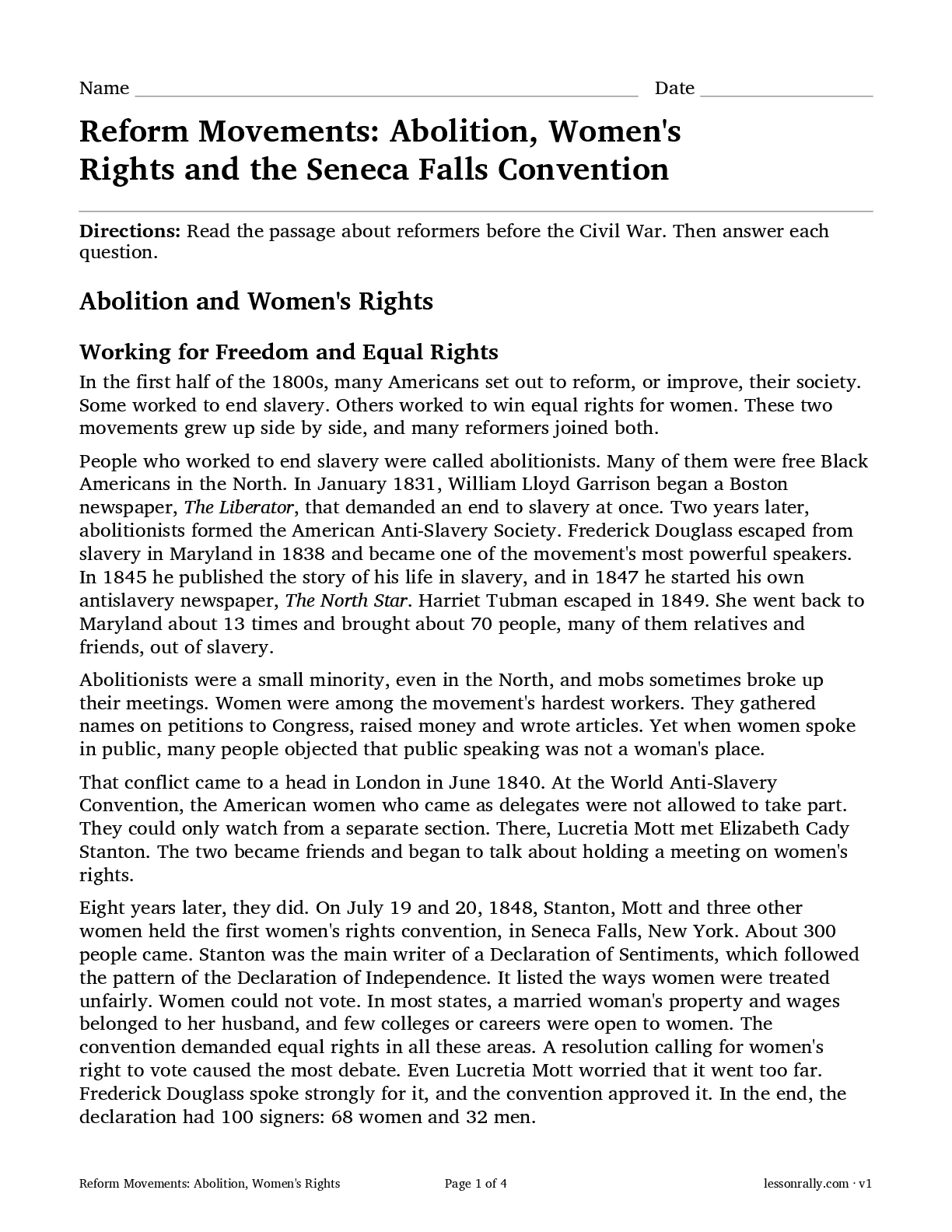
Read the passage about reformers before the Civil War. Then answer each question.

Abolition and Women's Rights

Working for Freedom and Equal Rights

In the first half of the 1800s, many Americans set out to reform, or improve, their society. Some worked to end slavery. Others worked to win equal rights for women. These two movements grew up side by side, and many reformers joined both.

People who worked to end slavery were called abolitionists. Many of them were free Black Americans in the North. In January 1831, William Lloyd Garrison began a Boston newspaper, The Liberator, that demanded an end to slavery at once. Two years later, abolitionists formed the American Anti-Slavery Society. Frederick Douglass escaped from slavery in Maryland in 1838 and became one of the movement's most powerful speakers. In 1845 he published the story of his life in slavery, and in 1847 he started his own antislavery newspaper, The North Star. Harriet Tubman escaped in 1849. She went back to Maryland about 13 times and brought about 70 people, many of them relatives and friends, out of slavery.

Abolitionists were a small minority, even in the North, and mobs sometimes broke up their meetings. Women were among the movement's hardest workers. They gathered names on petitions to Congress, raised money and wrote articles. Yet when women spoke in public, many people objected that public speaking was not a woman's place.

That conflict came to a head in London in June 1840. At the World Anti-Slavery Convention, the American women who came as delegates were not allowed to take part. They could only watch from a separate section. There, Lucretia Mott met Elizabeth Cady Stanton. The two became friends and began to talk about holding a meeting on women's rights.

Eight years later, they did. On July 19 and 20, 1848, Stanton, Mott and three other women held the first women's rights convention, in Seneca Falls, New York. About 300 people came. Stanton was the main writer of a Declaration of Sentiments, which followed the pattern of the Declaration of Independence. It listed the ways women were treated unfairly. Women could not vote. In most states, a married woman's property and wages belonged to her husband, and few colleges or careers were open to women. The convention demanded equal rights in all these areas. A resolution calling for women's right to vote caused the most debate. Even Lucretia Mott worried that it went too far. Frederick Douglass spoke strongly for it, and the convention approved it. In the end, the declaration had 100 signers: 68 women and 32 men.

Seneca Falls is often seen as the start of the organized women's rights movement in the United States, and more conventions soon followed. The two movements won their goals at very different times. Slavery ended with the 13th Amendment in 1865. Women won the right to vote across the nation only in 1920, with the 19th Amendment.


Question 1

Which choice gives the central idea of the whole passage, not just one part of it?

Choose one answer.

  • In 1848, the Seneca Falls Convention won American women the right to vote in national elections.
  • William Lloyd Garrison started The Liberator, a Boston newspaper that called for an end to slavery at once.
  • Reformers worked to end slavery and to win equal rights for women, and the fight against slavery helped start the women's rights movement.
  • By 1840, most Northerners had joined the abolitionists, so mobs no longer broke up their meetings.

Question 2

Which sentence is the most accurate summary of what the passage says about Frederick Douglass?

Choose one answer.

  • He started The Liberator in Boston and formed the American Anti-Slavery Society.
  • He wrote the Declaration of Sentiments and organized the meeting at Seneca Falls.
  • He escaped from slavery, spoke and wrote against it, and started his own newspaper.
  • He escaped from slavery and then went back to Maryland about 13 times to free others.

Question 3

Match each reformer to one thing the passage says that person did.

Match each item to an option.

Items

  1. Elizabeth Cady Stanton
  2. William Lloyd Garrison
  3. Harriet Tubman

Options

  1. Began a Boston newspaper that called for ending slavery at once
  2. Went back to Maryland many times to lead people out of slavery
  3. Wrote the antislavery novel Uncle Tom's Cabin
  4. Ran the 1840 antislavery meeting in London
  5. Was the main writer of the Declaration of Sentiments

Question 4

Which event does the passage give as the start of Mott and Stanton's plan to hold a women's rights meeting?

Choose one answer.

  • Slavery ended everywhere in the United States.
  • Women delegates could not take part in an antislavery meeting in London.
  • Frederick Douglass asked them to start an antislavery newspaper for women readers.
  • Congress passed a new law that took away the property of every married woman.

Question 5

Pick the term from the word bank that fits each sentence about the two movements.

Fill in each blank.

People who worked to end slavery were called blank 1. At Seneca Falls, the blank 2 listed the ways women were treated unfairly.

Word bank

  • abolitionists
  • Declaration of Sentiments
  • Declaration of Independence
  • Underground Railroad
  • delegates

Question 6

Which is the best summary of the passage's description of the Seneca Falls Convention?

Choose one answer.

  • Frederick Douglass wrote a declaration at Seneca Falls and was the only person to sign it.
  • About 300 people met in 1848, listed women's unfair treatment and demanded equal rights.
  • The Seneca Falls meeting was held to plan an end to slavery in the state of New York.
  • In 1848, women won the right to vote at a two-day meeting in Seneca Falls, New York.

Question 7

According to the passage, which demand made at Seneca Falls caused the most debate?

Choose one answer.

  • Higher wages for women in the textile mills
  • The right of women to attend college
  • A ban on selling enslaved people in the nation's capital
  • The right of women to vote

Question 8

The passage names one thing that followed from the Seneca Falls Convention. What was it?

Choose one answer.

  • Slavery ended in the Northern states.
  • Women were allowed to speak at the 1840 convention in London.
  • Women won the right to vote that same year.
  • More women's rights conventions soon followed.

Question 9

The passage describes women's work in the abolition movement. Which two statements match that description?

Choose 2 answers.

  • They gathered names on petitions and raised money.
  • Many people objected when they spoke in public.
  • They ran most of the abolitionist newspapers.
  • They were allowed to vote at the London convention.
  • They were not allowed to sign petitions to Congress.

Question 10

The passage says "The two movements won their goals at very different times." Which details support this statement?

Choose one answer.

  • Garrison's newspaper began in 1831, and Douglass's began in 1847.
  • Douglass escaped from slavery in 1838, and Tubman escaped in 1849.
  • The London convention met in 1840, and the Seneca Falls Convention met in 1848.
  • Slavery ended in 1865, but women won the vote across the nation only in 1920.

Reviews

No reviews yet.

Reviews come from teachers who assigned this activity to a class.

Sign in to write a review

Have a topic of your own? Make a printable worksheet and online quiz, free.

Create an activity

Answer key

Answer keys come with Premium

Print this worksheet with the correct answers marked. The key includes any explanations, sample answers, and rubrics supplied with the activity.

Answer keys aren't public: only teachers with Premium and the people who can edit an activity can download one, so students can't get a ready-to-print key from this page.

Premium includes:

  • No ads for you, and no ads for your students on the assignments you post.
  • Answer keys for printable worksheets, with the correct answers marked and any explanations, sample answers, and rubrics.
  • Create with AI: up to 100 activities a year (5 during the free trial), with every answer checked before you see the draft.

$29 a year, plus sales tax where it applies.

New Premium teachers can try it free for 7 days. A card or other payment method is needed to start. Unless you cancel before the trial ends, you are charged then and the plan renews every year.

Already have Premium or edit this activity? Sign in