Teachers who sign in can assign LessonRally activities to their Google Classroom classes: students open them in Classroom and answer online, and their grades go to the teacher's Classroom gradebook. Practice lets you try it first, the way students see it.
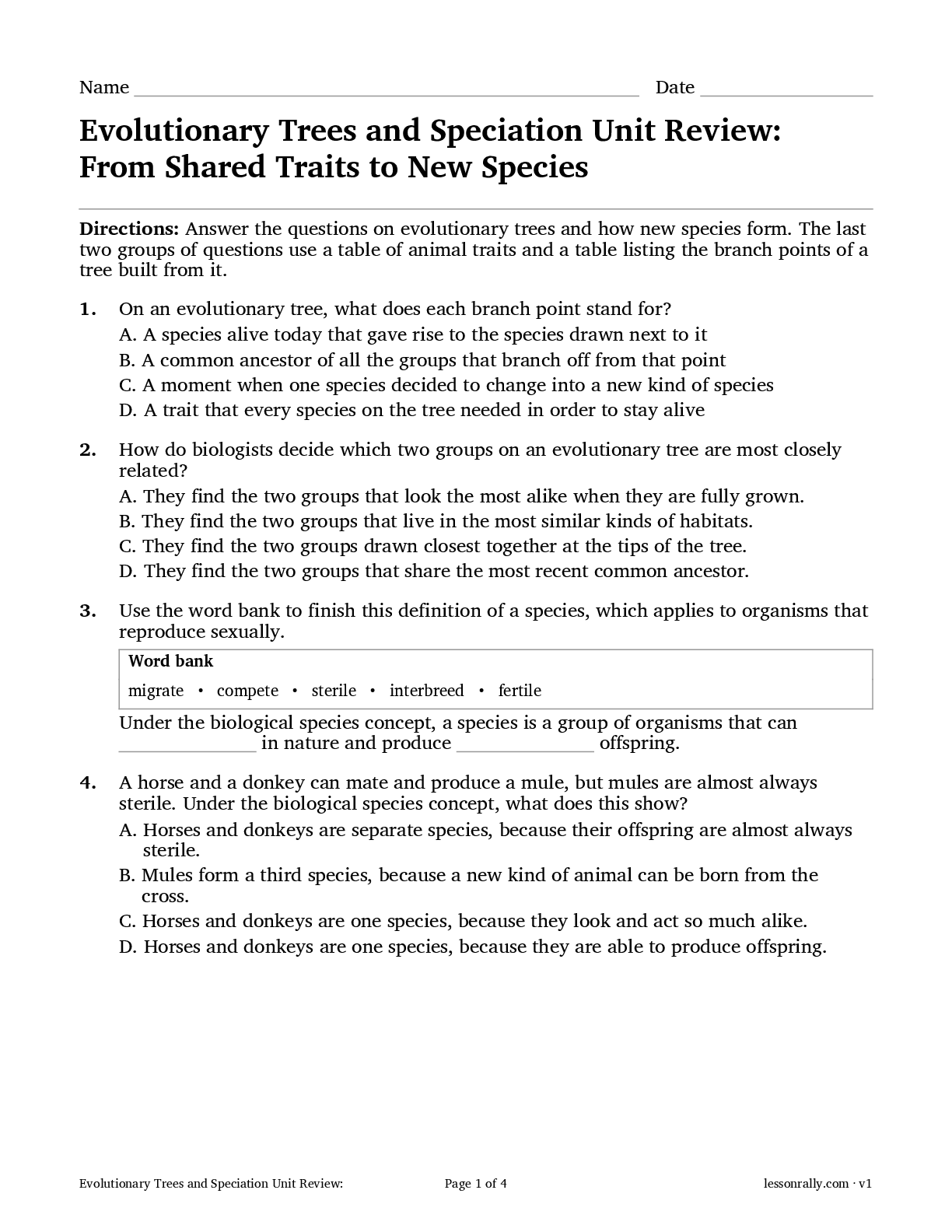
Students review evolutionary trees (cladograms) and speciation: what branch points stand for, how relatedness is judged, the biological species concept, mules, speciation after a split, geographic, behavioral and temporal isolation, why the species concept does not fit bacteria, and then building and reading a tree from a table of traits in seven animals.
Learning goal: Build and read an evolutionary tree from a table of traits, judge relatedness by common ancestors, and explain how reproductive isolation leads to new species.
Estimated reading level8.2
Grade 6Hard
Grade 7Stretch
Grade 8On level
Grade 9Easier
Grade 10Easy
About this estimate
The estimate is halfway between the two middle scores of four readability formulas. Their scores run from 7.0 to 9.4.
Flesch-Kincaid GradeSentence length and syllables per word7.0
Gunning FogSentence length and words of three or more syllables9.4
Coleman-Liau Middle scoreLetters per word and sentences per 100 words8.7
Automated Readability Index Middle scoreCharacters per word and words per sentence7.7
Grade 181216
Flesch Reading Ease
73.8 on a 0 to 100 scale where higher is easier: fairly easy. Not part of the estimate.
Text measured
1,038 words, 29 sentences
Adapted from common readability formulas (Flesch-Kincaid, Gunning Fog, Coleman-Liau and ARI, plus SMOG for long texts), which look at sentence length and word length. Answer choices count toward word length only. Grades below the estimate will likely find the text harder, grades above it easier. It does not measure ideas, background knowledge or images.
Question types: multiple choice, fill in the blank, matching.
Student preview
The questions as students see them, without the answers.
Answer the questions on evolutionary trees and how new species form. The last two groups of questions use a table of animal traits and a table listing the branch points of a tree built from it.
Question 1
On an evolutionary tree, what does each branch point stand for?
Choose one answer.
A species alive today that gave rise to the species drawn next to it
A trait that every species on the tree needed in order to stay alive
A moment when one species decided to change into a new kind of species
A common ancestor of all the groups that branch off from that point
Question 2
How do biologists decide which two groups on an evolutionary tree are most closely related?
Choose one answer.
They find the two groups that live in the most similar kinds of habitats.
They find the two groups drawn closest together at the tips of the tree.
They find the two groups that share the most recent common ancestor.
They find the two groups that look the most alike when they are fully grown.
Question 3
Use the word bank to finish this definition of a species, which applies to organisms that reproduce sexually.
Fill in each blank.
Under the biological species concept, a species is a group of organisms that can blank 1 in nature and produce blank 2 offspring.
Word bank
migrate
compete
interbreed
sterile
fertile
Question 4
A horse and a donkey can mate and produce a mule, but mules are almost always sterile. Under the biological species concept, what does this show?
Choose one answer.
Horses and donkeys are one species, because they are able to produce offspring.
Horses and donkeys are separate species, because their offspring are almost always sterile.
Mules form a third species, because a new kind of animal can be born from the cross.
Horses and donkeys are one species, because they look and act so much alike.
Question 5
Over a very long time, a river cuts a deep canyon that splits a population of squirrels into two groups. After many generations apart, squirrels from the two sides are brought together, and they no longer produce fertile young. What has most likely happened?
Choose one answer.
The groups are still one species, since they share a common ancestor.
The canyon changed each squirrel's genes during its own lifetime.
The squirrels chose to stop mating so that each group could adapt.
The two groups have become separate species after evolving apart.
Question 6
Match each example to the kind of reproductive isolation it shows.
Match each item to an option.
Items
Two kinds of flowering plants grow side by side, but one flowers in early spring and the other in late summer.
A river changes course and splits a population of beetles into two groups that can no longer reach each other.
Two kinds of frogs share a pond, but each female responds only to the mating call of males of her own kind.
Options
Behavioral isolation
Hybrid sterility
Temporal isolation
Geographic isolation
Question 7
Why is the biological species concept hard to use for bacteria?
Choose one answer.
Bacteria never change over time, so they cannot form new species.
Bacteria interbreed freely with every other kind of living organism.
Bacteria are far too small to belong to any species of living thing.
Most bacteria reproduce asexually, so there is no interbreeding to test.
Building a Tree from Traits
The table shows which of six traits seven animals have. The lancelet is a small, fishlike sea animal, the lamprey is an eel-shaped fish, and the lungfish is a fish that can breathe air. In a tree built from such a table, animals that share a trait are grouped as descendants of a common ancestor that had it.
Traits of seven animals (Yes means the animal has the trait; an amnion is a fluid-filled sac around a developing embryo, inside an egg or inside the mother)
Animal
Backbone
Jaws
Lungs
Four legs
Embryo in an amnion
Hair
Frog
Yes
Yes
Yes
Yes
No
No
Lamprey
Yes
No
No
No
No
No
Mouse
Yes
Yes
Yes
Yes
Yes
Yes
Perch
Yes
Yes
No
No
No
No
Lungfish
Yes
Yes
Yes
No
No
No
Lancelet
No
No
No
No
No
No
Lizard
Yes
Yes
Yes
Yes
Yes
No
Question 8
In a tree built from this table, which animal branches off first, at the branch point closest to the root?
Choose one answer.
Mouse
Perch
Lancelet
Lamprey
Question 9
In a tree built from this table, which option lists all of the animals that descend from the earliest common ancestor that had four legs?
Choose one answer.
The frog, lizard and mouse
The lungfish, frog, lizard and mouse
The perch, lungfish and frog
The lizard and mouse only
Question 10
In a tree built from this table, each of these traits first appears at a different branch point. Put the traits in order from the root of the tree toward the mouse, labeling each one First, Second, Third or Fourth.
Match each item to an option.
Items
Lungs
Embryo in an amnion
Jaws
Four legs
Options
Second
Third
First
Fourth
Reading the Tree
This table lists the branch points of the tree built from the trait table. Each branch point stands for a common ancestor, and each animal descends from every branch point whose row lists it. Higher-numbered branch points are more recent ancestors.
Branch points of a tree built from the trait table, each listed with all of the animals that descend from that common ancestor (branch point 1 is the root)
Traits of seven animals (Yes means the animal has the trait; an amnion is a fluid-filled sac around a developing embryo, inside an egg or inside the mother)
Animal
Backbone
Jaws
Lungs
Four legs
Embryo in an amnion
Hair
Frog
Yes
Yes
Yes
Yes
No
No
Lamprey
Yes
No
No
No
No
No
Mouse
Yes
Yes
Yes
Yes
Yes
Yes
Perch
Yes
Yes
No
No
No
No
Lungfish
Yes
Yes
Yes
No
No
No
Lancelet
No
No
No
No
No
No
Lizard
Yes
Yes
Yes
Yes
Yes
No
Question 11
Which branch point stands for the most recent common ancestor of the frog and the mouse?
Choose one answer.
Branch point 5
Branch point 1
Branch point 4
Branch point 6
Question 12
Is the lungfish more closely related to the frog or to the perch, and why?
Choose one answer.
To the frog: the lungfish shares a more recent common ancestor with the frog than with the perch
To the perch, because neither the lungfish nor the perch has four legs, while the frog does have them
To the perch, because the lungfish and the perch are both fish that spend their whole lives in water
Equally to both, because the lungfish, the frog and the perch all have both jaws and a backbone
Question 13
One drawing of this tree lists its tips from left to right as: lancelet, lamprey, perch, mouse, lizard, frog, lungfish. In that drawing the mouse sits next to the perch. What does this tell you about how closely the mouse and the perch are related?
Choose one answer.
Nothing: tips can be rotated at branch points, and the mouse's closest relative is still the lizard.
The mouse and the perch share the most recent common ancestor of any two of the animals shown in the drawing.
The mouse is more closely related to the perch than to the lizard, since the two of them sit side by side.
The drawing must be wrong, since the tips of a tree can be listed in only one correct order from left to right.
Question 14
Using both tables, which traits did the common ancestor at branch point 5 most likely have?