Extended Metaphor in a Poem: Moving Day

10 questions · 10 points · Grades 9–10 · English · Preview the 10 questions

Made by Eleanor Wrenfield · LessonRally (AI-assisted)

Digital classroom activity

What is a digital classroom activity?

Teachers who sign in can assign LessonRally activities to their Google Classroom classes: students open them in Classroom and answer online, and their grades go to the teacher's Classroom gradebook. Practice lets you try it first, the way students see it.

Free for teachers. Sign in to assign activities to your Google Classroom classes.

Printable worksheet

Students read an original poem about a family leaving its house and analyze an extended metaphor that compares the house to a body. Questions cover how the metaphor develops across the stanzas, what its images suggest, and where the metaphor turns. Practice with extended metaphors, metaphor, figurative language, imagery and poetry.

Learning goal: Analyze how an extended metaphor develops across the stanzas of a poem, what its images suggest and how a turn in the metaphor shapes the poem's meaning.

Estimated reading level 7.6

  1. Grade 5Hard
  2. Grade 6Stretch
  3. Grade 7On level
  4. Grade 8Easier
  5. Grade 9Easy
About this estimate

The estimate is halfway between the two middle scores of four readability formulas. Their scores run from 7.2 to 9.6.

  • Flesch-Kincaid GradeSentence length and syllables per word7.2
  • Gunning FogSentence length and words of three or more syllables9.6
  • Coleman-Liau Middle scoreLetters per word and sentences per 100 words7.4
  • Automated Readability Index Middle scoreCharacters per word and words per sentence7.8
Flesch Reading Ease
76.9 on a 0 to 100 scale where higher is easier: fairly easy. Not part of the estimate.
Text measured
1,083 words, 29 sentences

Adapted from common readability formulas (Flesch-Kincaid, Gunning Fog, Coleman-Liau and ARI, plus SMOG for long texts), which look at sentence length and word length. Answer choices count toward word length only. Grades below the estimate will likely find the text harder, grades above it easier. It does not measure ideas, background knowledge or images.

Common Core

Closest anchor: CCRA.R.4 Interpret words and phrases as they are used in a text, including determining technical, connotative, and figurative meanings, and analyze how specific word choices shape meaning or tone.Anchor Standards for ReadingShow 1 matched standardHide matched standard

Matched standard

  • RL.9-10.4

    Determine the meaning of words and phrases as they are used in the text, including figurative and connotative meanings; analyze the cumulative impact of specific word choices on meaning and tone (e.g., how the language evokes a sense of time and place; how it sets a formal or informal tone).

    Student preview questions 1, 2, 3, 4, 5, 7, 8, 9, 10

Matched independently by two AI models from this activity's questions.

© Copyright 2010. National Governors Association Center for Best Practices and Council of Chief State School Officers. All rights reserved.

Topic: Figurative Language Chosen by LessonRally

Question types: multiple choice, select all that apply.

Student preview

The questions as students see them, without the answers.

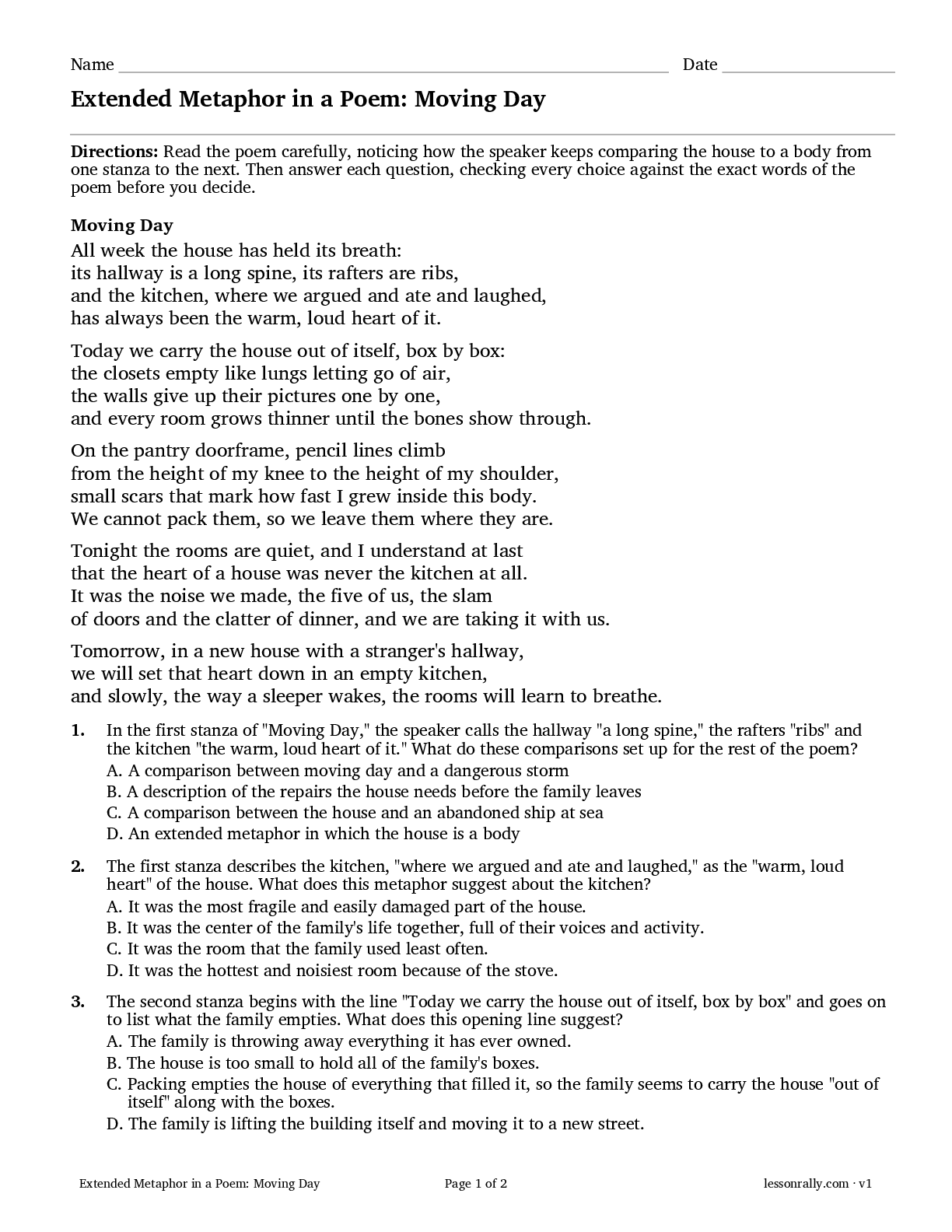
Read the poem carefully, noticing how the speaker keeps comparing the house to a body from one stanza to the next. Then answer each question, checking every choice against the exact words of the poem before you decide.

Moving Day

All week the house has held its breath:
its hallway is a long spine, its rafters are ribs,
and the kitchen, where we argued and ate and laughed,
has always been the warm, loud heart of it.

Today we carry the house out of itself, box by box:
the closets empty like lungs letting go of air,
the walls give up their pictures one by one,
and every room grows thinner until the bones show through.

On the pantry doorframe, pencil lines climb
from the height of my knee to the height of my shoulder,
small scars that mark how fast I grew inside this body.
We cannot pack them, so we leave them where they are.

Tonight the rooms are quiet, and I understand at last
that the heart of a house was never the kitchen at all.
It was the noise we made, the five of us, the slam
of doors and the clatter of dinner, and we are taking it with us.

Tomorrow, in a new house with a stranger's hallway,
we will set that heart down in an empty kitchen,
and slowly, the way a sleeper wakes, the rooms will learn to breathe.


Question 1

In the first stanza of "Moving Day," the speaker calls the hallway "a long spine," the rafters "ribs" and the kitchen "the warm, loud heart of it." What do these comparisons set up for the rest of the poem?

Choose one answer.

  • An extended metaphor in which the house is a body
  • A comparison between the house and an abandoned ship at sea
  • A comparison between moving day and a dangerous storm
  • A description of the repairs the house needs before the family leaves

Question 2

The first stanza describes the kitchen, "where we argued and ate and laughed," as the "warm, loud heart" of the house. What does this metaphor suggest about the kitchen?

Choose one answer.

  • It was the center of the family's life together, full of their voices and activity.
  • It was the most fragile and easily damaged part of the house.
  • It was the hottest and noisiest room because of the stove.
  • It was the room that the family used least often.

Question 3

The second stanza begins with the line "Today we carry the house out of itself, box by box" and goes on to list what the family empties. What does this opening line suggest?

Choose one answer.

  • The family is lifting the building itself and moving it to a new street.
  • The house is too small to hold all of the family's boxes.
  • The family is throwing away everything it has ever owned.
  • Packing empties the house of everything that filled it, so the family seems to carry the house "out of itself" along with the boxes.

Question 4

Which two images show the house being emptied as if it were a body? Select two.

Choose 2 answers.

  • "every room grows thinner until the bones show through"
  • "the closets empty like lungs letting go of air"
  • "its hallway is a long spine, its rafters are ribs"
  • "small scars that mark how fast I grew inside this body"
  • "the rooms will learn to breathe"

Question 5

In the third stanza, the pencil lines on the pantry doorframe become "small scars that mark how fast I grew inside this body." What does the speaker's choice to call the pencil lines "scars" suggest?

Choose one answer.

  • The speaker was physically injured while living in the house.
  • The speaker is embarrassed about having grown so quickly.
  • The pencil lines are ugly and should have been erased long ago.
  • The lines are lasting marks that the speaker's years of growing up have left on the house.

Question 6

The third stanza ends, "We cannot pack them, so we leave them where they are." What does this line suggest about moving away from a home?

Choose one answer.

  • Some marks of the family's past belong to the house itself and must stay behind.
  • The family accidentally forgot to pack the pencil lines in the rush.
  • The speaker wants to forget everything about growing up in the house.
  • The new owners have asked the family to leave the doorframe alone.

Question 7

In the fourth stanza, the speaker says that "the heart of a house was never the kitchen at all." How does this line change the direction of the extended metaphor?

Choose one answer.

  • It shows that the speaker never liked spending time in the kitchen.
  • It reveals that the house never had a heart, so the metaphor was a mistake.
  • It moves the heart from a room in the house to the family's life together, which is something they can take with them.
  • It shows that the family plans to bring the old kitchen to the new house.

Question 8

In the last stanza, the family will be "in a new house with a stranger's hallway" by tomorrow. Since the first stanza called the hallway the house's "long spine," what does this phrase suggest about the new house?

Choose one answer.

  • The family will be sharing the new house with several strangers.
  • The new house is dangerous because a stranger is living in it.
  • It does not yet feel like the family's own; its spine, the hallway, still feels unfamiliar to them.
  • The new house has no hallway or entrance at all.

Question 9

The last stanza says that "we will set that heart down in an empty kitchen," in the new house. What does this image suggest about the family's life there?

Choose one answer.

  • The family will leave all of its feelings behind in the old house.
  • The speaker will keep the old kitchen's heart in a box and never unpack it.
  • The family's life together, the heart they carried from the old house, will become the center of the new one.
  • The new kitchen will stay empty because the family will not use it.

Question 10

"Moving Day" begins with a house that "has held its breath" and ends with new rooms that "will learn to breathe." What does this pairing of the opening and closing lines suggest?

Choose one answer.

  • Both houses are sick and struggling to breathe.
  • The poem moves from an old house waiting to be emptied to a new one whose rooms will slowly learn to breathe, which suggests that a house's life comes from the people living in it.
  • The family hopes to return to the old house once the new one is ready.
  • The move happens so quickly that no one has time to breathe.

Reviews

No reviews yet.

Reviews come from teachers who assigned this activity to a class.

Sign in to write a review

Have a topic of your own? Make a printable worksheet and online quiz, free.

Create an activity

Answer key

Answer keys come with Premium

Print this worksheet with the correct answers marked. The key includes any explanations, sample answers, and rubrics supplied with the activity.

Answer keys aren't public: only teachers with Premium and the people who can edit an activity can download one, so students can't get a ready-to-print key from this page.

Premium includes:

  • No ads for you, and no ads for your students on the assignments you post.
  • Answer keys for printable worksheets, with the correct answers marked and any explanations, sample answers, and rubrics.
  • Create with AI: up to 100 activities a year (5 during the free trial), with every answer checked before you see the draft.

$29 a year, plus sales tax where it applies.

New Premium teachers can try it free for 7 days. A card or other payment method is needed to start. Unless you cancel before the trial ends, you are charged then and the plan renews every year.

Already have Premium or edit this activity? Sign in