Question 1
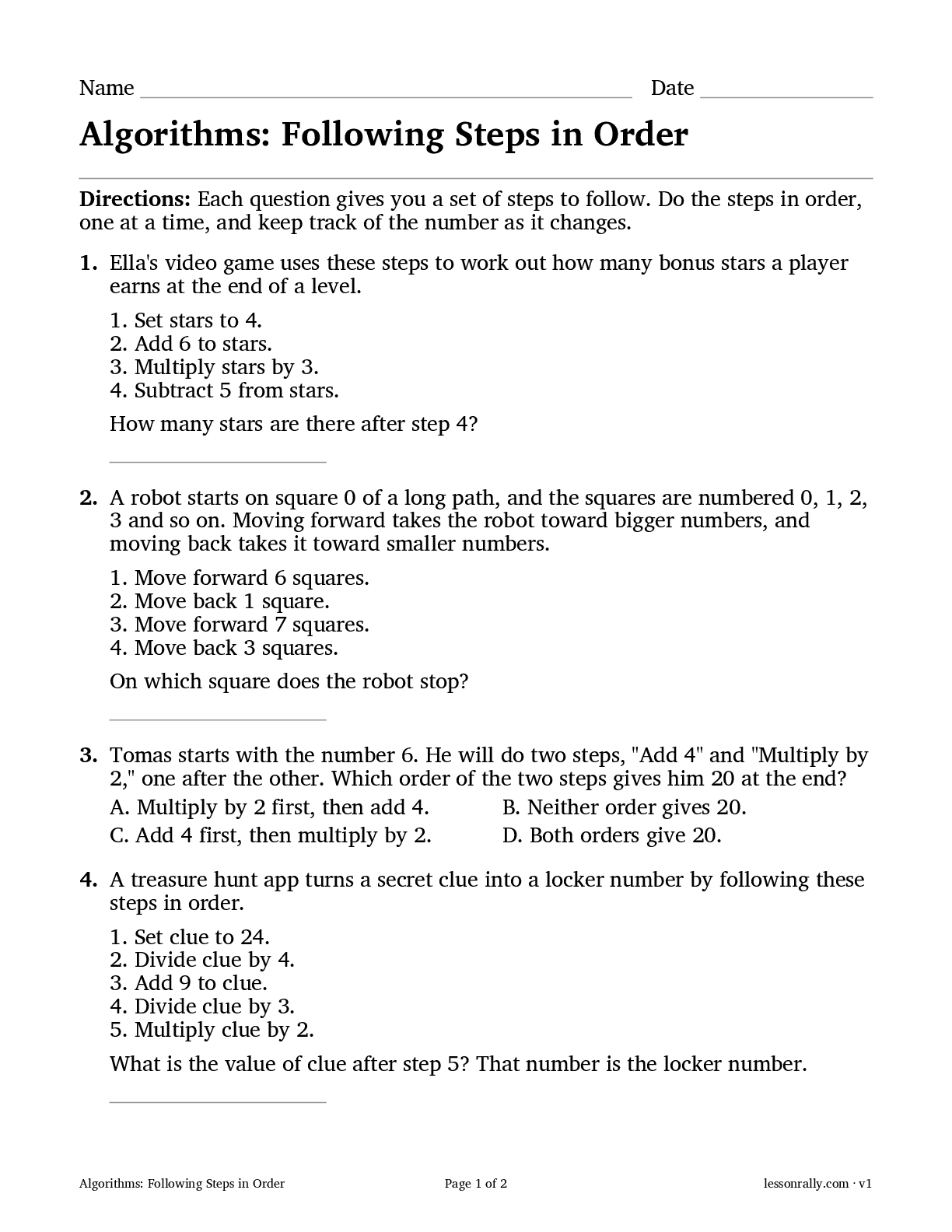
Ella's video game uses these steps to work out how many bonus stars a player earns at the end of a level.
- Set stars to 4.
- Add 6 to stars.
- Multiply stars by 3.
- Subtract 5 from stars.
How many stars are there after step 4?
Enter a number.


Teachers who sign in can assign LessonRally activities to their Google Classroom classes: students open them in Classroom and answer online, and their grades go to the teacher's Classroom gradebook. Practice lets you try it first, the way students see it.
Free for teachers. Sign in to assign activities to your Google Classroom classes.
 (opens in a new tab)
2 pages · Student copy, no answers
Print worksheet (opens in a new tab)Answer keyPremiumStudents trace short algorithms written as numbered steps and keep track of a number as it changes. They see how the order of steps changes the result, find a missing step, and follow simple loops. Coding practice in plain-language steps, with sequencing and loops.
Learning goal: Trace an algorithm written as numbered steps to find its exact result, and recognize how changing the order of the steps can change the result.
The estimate is the middle score of five readability formulas. Their scores run from 0.3 to 5.8.
Adapted from common readability formulas (Flesch-Kincaid, Gunning Fog, Coleman-Liau and ARI, plus SMOG for long texts), which look at sentence length and word length. Answer choices count toward word length only. Grades below the estimate will likely find the text harder, grades above it easier. It does not measure ideas, background knowledge or images.
Topic: Programming and Algorithms Chosen by LessonRally
Question types: number answer, multiple choice.
The questions as students see them, without the answers.
Each question gives you a set of steps to follow. Do the steps in order, one at a time, and keep track of the number as it changes.
Ella's video game uses these steps to work out how many bonus stars a player earns at the end of a level.
How many stars are there after step 4?
Enter a number.
A robot starts on square 0 of a long path, and the squares are numbered 0, 1, 2, 3 and so on. Moving forward takes the robot toward bigger numbers, and moving back takes it toward smaller numbers.
On which square does the robot stop?
Enter a number.
Tomas starts with the number 6. He will do two steps, "Add 4" and "Multiply by 2," one after the other. Which order of the two steps gives him 20 at the end?
Choose one answer.
A treasure hunt app turns a secret clue into a locker number by following these steps in order.
What is the value of clue after step 5? That number is the locker number.
Enter a number.
Jamal is writing steps that should finish with total equal to 20, but he forgot to write step 2.
Which step should go in the place of step 2?
Choose one answer.
Sofia wrote a program that counts beads for a bracelet pattern, and it follows these steps.
What is the value of beads after step 3?
Enter a number.
These steps use two numbers named red and blue. In these steps, "Add red to blue" changes only blue, and "Multiply red by blue" changes only red.
What is the value of red after step 4?
Enter a number.
A watering robot decides how many cups of water a plant gets by following these steps. Step 3 checks the value of cups every time, right after step 2 runs.
What is the value of cups after step 4?
Enter a number.
No reviews yet.
Reviews come from teachers who assigned this activity to a class.
Have a topic of your own? Make a printable worksheet and online quiz, free.
Create an activityMade by Aisha Varrick · LessonRally (AI-assisted)
Made by Aisha Varrick · LessonRally (AI-assisted)
Made by Aisha Varrick · LessonRally (AI-assisted)
Made by Aisha Varrick · LessonRally (AI-assisted)