A Complex Character with Conflicting Motives: The Scholarship Interview

10 questions · 10 points · Grades 9–10 · English · Preview the 10 questions

Made by Eleanor Wrenfield · LessonRally (AI-assisted)

Digital classroom activity

What is a digital classroom activity?

Teachers who sign in can assign LessonRally activities to their Google Classroom classes: students open them in Classroom and answer online, and their grades go to the teacher's Classroom gradebook. Practice lets you try it first, the way students see it.

Free for teachers. Sign in to assign activities to your Google Classroom classes.

Printable worksheet

Students read an original short story passage about a student's scholarship interview and analyze a complex character with conflicting motives. Through characterization questions, students trace how each motive shows through her actions, her words and what other characters notice, and how her conflict moves the plot and develops a theme.

Learning goal: Analyze how a complex character's conflicting motivations develop through action, speech and other characters' reactions, and how they advance the plot and develop a theme.

Estimated reading level 8.8

  1. Grade 6Hard
  2. Grade 7Stretch
  3. Grade 8On level
  4. Grade 9Easier
  5. Grade 10Easy
About this estimate

The estimate is the middle score of five readability formulas. Their scores run from 6.8 to 9.6.

  • Flesch-Kincaid GradeSentence length and syllables per word6.8
  • Gunning FogSentence length and words of three or more syllables9.6
  • Coleman-Liau Middle scoreLetters per word and sentences per 100 words8.8
  • Automated Readability IndexCharacters per word and words per sentence7.7
  • SMOGWords of three or more syllables, for texts of 30 sentences or more9.4
Flesch Reading Ease
74.8 on a 0 to 100 scale where higher is easier: fairly easy. Not part of the estimate.
Text measured
1,299 words, 50 sentences

Adapted from common readability formulas (Flesch-Kincaid, Gunning Fog, Coleman-Liau and ARI, plus SMOG for long texts), which look at sentence length and word length. Answer choices count toward word length only. Grades below the estimate will likely find the text harder, grades above it easier. It does not measure ideas, background knowledge or images.

Common Core

Closest anchor: CCRA.R.3 Analyze how and why individuals, events, or ideas develop and interact over the course of a text.Anchor Standards for ReadingShow 2 matched standardsHide matched standards

Matched standards

  • RL.9-10.3

    Analyze how complex characters (e.g., those with multiple or conflicting motivations) develop over the course of a text, interact with other characters, and advance the plot or develop the theme.

    Student preview questions 1, 4, 5, 6, 9

  • RL.9-10.2

    Determine a theme or central idea of a text and analyze in detail its development over the course of the text, including how it emerges and is shaped and refined by specific details; provide an objective summary of the text.

    Student preview question 10

Matched independently by two AI models from this activity's questions.

© Copyright 2010. National Governors Association Center for Best Practices and Council of Chief State School Officers. All rights reserved.

Topic: Characterization Chosen by LessonRally

Question types: multiple choice, select all that apply.

Student preview

The questions as students see them, without the answers.

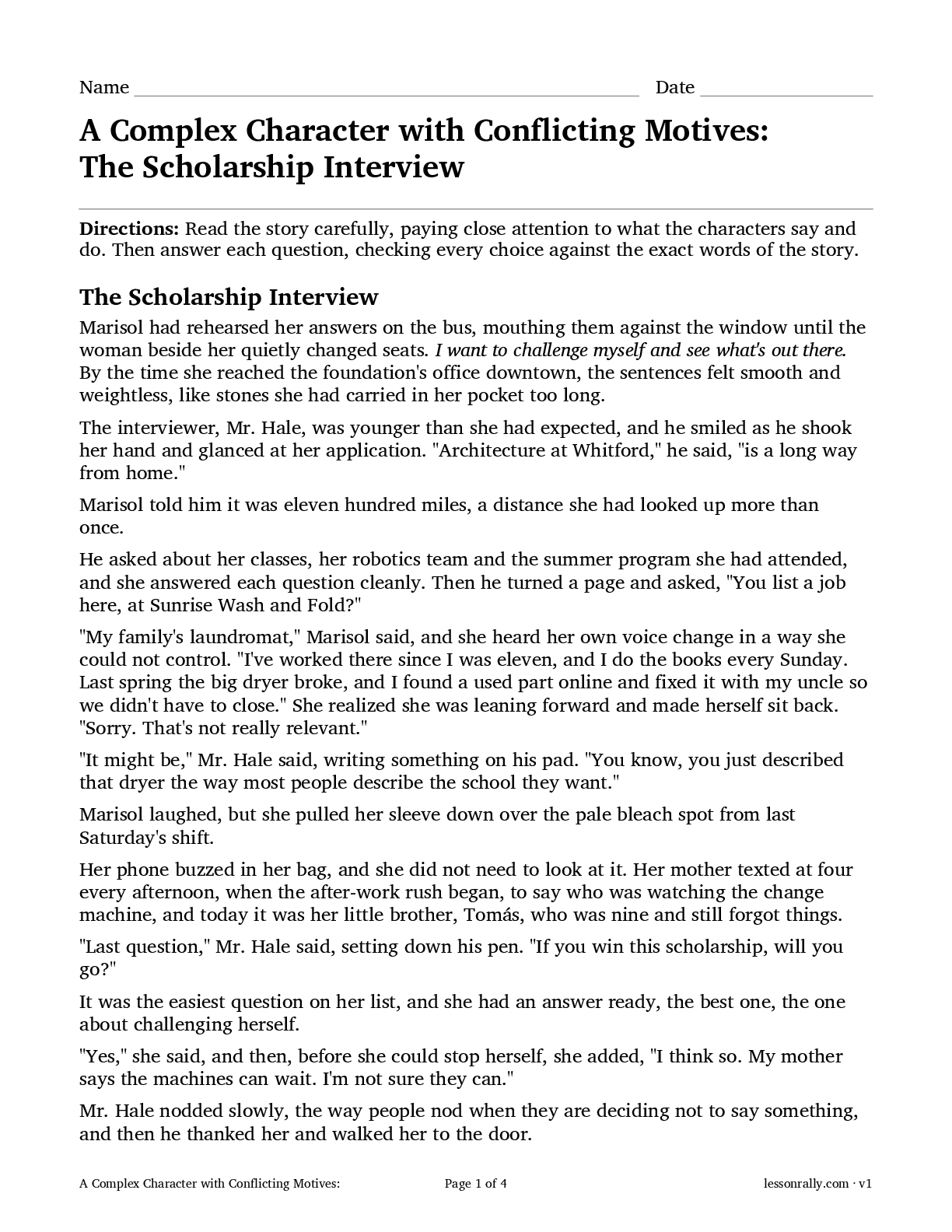
Read the story carefully, paying close attention to what the characters say and do. Then answer each question, checking every choice against the exact words of the story.

The Scholarship Interview

Marisol had rehearsed her answers on the bus, mouthing them against the window until the woman beside her quietly changed seats. I want to challenge myself and see what's out there. By the time she reached the foundation's office downtown, the sentences felt smooth and weightless, like stones she had carried in her pocket too long.

The interviewer, Mr. Hale, was younger than she had expected, and he smiled as he shook her hand and glanced at her application. "Architecture at Whitford," he said, "is a long way from home."

Marisol told him it was eleven hundred miles, a distance she had looked up more than once.

He asked about her classes, her robotics team and the summer program she had attended, and she answered each question cleanly. Then he turned a page and asked, "You list a job here, at Sunrise Wash and Fold?"

"My family's laundromat," Marisol said, and she heard her own voice change in a way she could not control. "I've worked there since I was eleven, and I do the books every Sunday. Last spring the big dryer broke, and I found a used part online and fixed it with my uncle so we didn't have to close." She realized she was leaning forward and made herself sit back. "Sorry. That's not really relevant."

"It might be," Mr. Hale said, writing something on his pad. "You know, you just described that dryer the way most people describe the school they want."

Marisol laughed, but she pulled her sleeve down over the pale bleach spot from last Saturday's shift.

Her phone buzzed in her bag, and she did not need to look at it. Her mother texted at four every afternoon, when the after-work rush began, to say who was watching the change machine, and today it was her little brother, Tomás, who was nine and still forgot things.

"Last question," Mr. Hale said, setting down his pen. "If you win this scholarship, will you go?"

It was the easiest question on her list, and she had an answer ready, the best one, the one about challenging herself.

"Yes," she said, and then, before she could stop herself, she added, "I think so. My mother says the machines can wait. I'm not sure they can."

Mr. Hale nodded slowly, the way people nod when they are deciding not to say something, and then he thanked her and walked her to the door.

On the bus home, she finally took out her phone and read her mother's message: Change machine jammed, but Tomás fixed it. He says he watched you do it last week.

Marisol read the message three times before she opened her browser, typed Whitford, and looked at a photo of its library until her stop.


Question 1

Which choice best identifies the two wishes that pull Marisol in opposite directions throughout "The Scholarship Interview"?

Choose one answer.

  • She wants to repair machines for a living, and she also wants to study architecture.
  • She wants to win the scholarship and leave for Whitford, and she also wants to keep looking after her family's laundromat.
  • She wants to impress Mr. Hale, and she also wants the interview to end as quickly as possible.
  • She wants to study architecture, but her mother insists that she stay home and run the laundromat.

Question 2

By the time Marisol reaches the foundation's office, her practiced sentences feel "smooth and weightless, like stones she had carried in her pocket too long." What does this comparison suggest about her rehearsed answers?

Choose one answer.

  • She has forgotten most of what she planned to say.
  • She carries a few stones to calm her nerves before interviews.
  • They feel heavy, and she dreads having to say them aloud.
  • Repeating them so often has made them easy to say but empty of meaning for her.

Question 3

After hearing about the broken dryer, Mr. Hale observes that Marisol "just described that dryer the way most people describe the school they want." What does his observation reveal about her?

Choose one answer.

  • She has not yet chosen a school to attend.
  • Her tie to the laundromat runs deeper than her prepared answers let on.
  • She would be happier studying engineering than architecture.
  • She has wasted interview time on a story that does not matter.

Question 4

While describing the dryer, Marisol catches herself leaning forward and "made herself sit back." After Mr. Hale's comment, she pulls her sleeve down over a bleach spot from last Saturday's shift. What do these two actions have in common?

Choose one answer.

  • Both show that she has grown bored with Mr. Hale's questions.
  • Both try to keep the laundromat's hold on her out of view.
  • Both show that she is cold in the foundation's office.
  • Both are meant to draw Mr. Hale's attention to her work.

Question 5

Which two details show that the laundromat stays on Marisol's mind even in the middle of the interview? Select two.

Choose 2 answers.

  • She knows without looking that the buzz in her bag is her mother's four o'clock text.
  • She notices that Mr. Hale is younger than she expected.
  • She answers questions about her classes and her robotics team.
  • She thinks about her nine-year-old brother, who forgets things, watching the change machine.
  • Mr. Hale shakes her hand and glances at her application.

Question 6

When Mr. Hale asks whether she will go if she wins, Marisol says "Yes," but then she adds that her mother says the machines can wait and that she herself is "not sure they can." What does her full answer reveal about her?

Choose one answer.

  • She wants to go, but she doubts that the laundromat can manage without her.
  • She is repeating her mother's view because she agrees with it.
  • She has already decided to turn down the scholarship.
  • She is certain that the laundromat will close if she leaves.

Question 7

Just before Marisol answers, the narrator calls this "the easiest question on her list" and mentions that she had an answer ready. Why is this detail placed right before her answer?

Choose one answer.

  • It shows that Mr. Hale saved his hardest question for last.
  • It suggests that Marisol has stopped caring about the interview.
  • It sets up a contrast: the question she was most prepared for is where her real doubt breaks through.
  • It proves that Marisol answers exactly as she rehearsed.

Question 8

After Marisol's answer, Mr. Hale "nodded slowly, the way people nod when they are deciding not to say something," and then he walks her to the door. What does this reaction add to the scene?

Choose one answer.

  • It shows that he plans to call her mother after the interview.
  • It reveals that he has already chosen her for the scholarship.
  • It shows that her honest answer registers with him, while leaving the outcome of the interview uncertain.
  • It shows that he was not listening to her answer.

Question 9

On the bus home, Marisol reads that her brother fixed the jammed change machine and says he watched her do it last week, and then she looks at a photo of Whitford's library. How does this ending move her conflict forward?

Choose one answer.

  • It hints that the laundromat may manage without her, and it turns her thoughts back toward Whitford.
  • It reveals that her mother is angry that she missed a shift.
  • It proves that the laundromat cannot run unless she is there.
  • It shows that she has decided to turn down the scholarship.

Question 10

Which idea does Marisol's conflict between leaving and staying help "The Scholarship Interview" explore?

Choose one answer.

  • Honest answers always cost people the things they want most.
  • Reaching for your own future can pull against loyalty to the people who rely on you.
  • Families are happiest when their children stay close to home.
  • People who rehearse what they will say cannot be trusted.

Reviews

No reviews yet.

Reviews come from teachers who assigned this activity to a class.

Sign in to write a review

Have a topic of your own? Make a printable worksheet and online quiz, free.

Create an activity

Answer key

Answer keys come with Premium

Print this worksheet with the correct answers marked. The key includes any explanations, sample answers, and rubrics supplied with the activity.

Answer keys aren't public: only teachers with Premium and the people who can edit an activity can download one, so students can't get a ready-to-print key from this page.

Premium includes:

  • No ads for you, and no ads for your students on the assignments you post.
  • Answer keys for printable worksheets, with the correct answers marked and any explanations, sample answers, and rubrics.
  • Create with AI: up to 100 activities a year (5 during the free trial), with every answer checked before you see the draft.

$29 a year, plus sales tax where it applies.

New Premium teachers can try it free for 7 days. A card or other payment method is needed to start. Unless you cancel before the trial ends, you are charged then and the plan renews every year.

Already have Premium or edit this activity? Sign in