Question 1
Complete the sentence about where the citizens of Athens met.
Fill in each blank.
Citizens met in the blank 1 on a hillside called the blank 2.
Word bank
- Pnyx
- Senate
- Assembly
- Forum


Teachers who sign in can assign LessonRally activities to their Google Classroom classes: students open them in Classroom and answer online, and their grades go to the teacher's Classroom gradebook. Practice lets you try it first, the way students see it.
Free for teachers. Sign in to assign activities to your Google Classroom classes.
 (opens in a new tab)
2 pages · Student copy, no answers
Print worksheet (opens in a new tab)Answer keyPremiumStudents read an original passage about the democracy that began in Athens in about 508 BCE: the Assembly on the Pnyx, officials chosen by lottery, elected generals, and the limits that left women, enslaved people and foreign residents out. A three-column table compares Athens with most democracies today, using only general claims about today, and several questions ask students to connect the table with the passage.
Learning goal: Explain how direct democracy worked in ancient Athens and who was left out, and compare it with representative democracy today using a passage and a table.
The estimate is the middle score of five readability formulas. Their scores run from 6.5 to 10.5.
Adapted from common readability formulas (Flesch-Kincaid, Gunning Fog, Coleman-Liau and ARI, plus SMOG for long texts), which look at sentence length and word length. Answer choices count toward word length only. Grades below the estimate will likely find the text harder, grades above it easier. It does not measure ideas, background knowledge or images.
Topics: Ancient Civilizations, Government and Citizenship Chosen by LessonRally
Question types: fill in the blank, multiple choice, select all that apply.
The questions as students see them, without the answers.
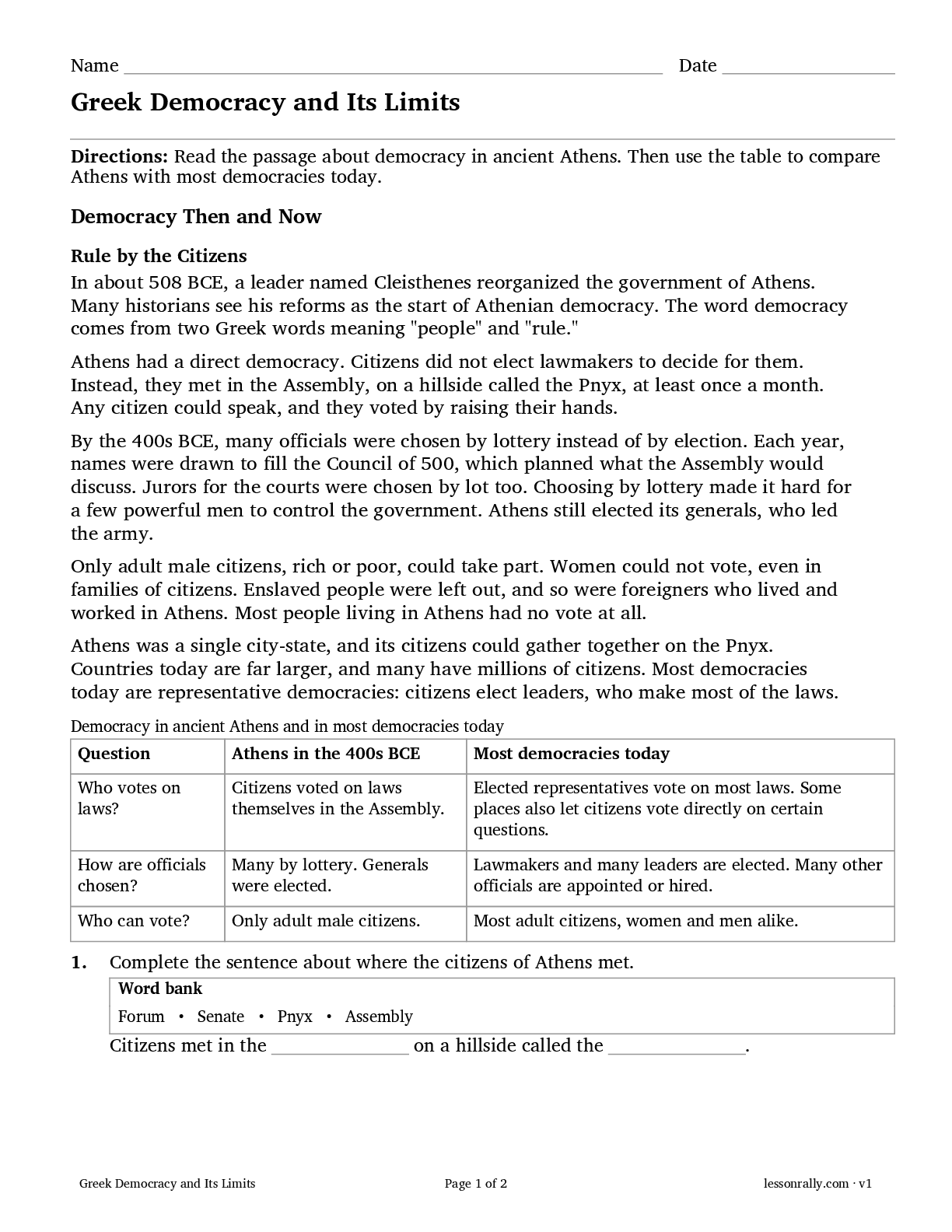
Read the passage about democracy in ancient Athens. Then use the table to compare Athens with most democracies today.
Rule by the Citizens
In about 508 BCE, a leader named Cleisthenes reorganized the government of Athens. Many historians see his reforms as the start of Athenian democracy. The word democracy comes from two Greek words meaning "people" and "rule."
Athens had a direct democracy. Citizens did not elect lawmakers to decide for them. Instead, they met in the Assembly, on a hillside called the Pnyx, at least once a month. Any citizen could speak, and they voted by raising their hands.
By the 400s BCE, many officials were chosen by lottery instead of by election. Each year, names were drawn to fill the Council of 500, which planned what the Assembly would discuss. Jurors for the courts were chosen by lot too. Choosing by lottery made it hard for a few powerful men to control the government. Athens still elected its generals, who led the army.
Only adult male citizens, rich or poor, could take part. Women could not vote, even in families of citizens. Enslaved people were left out, and so were foreigners who lived and worked in Athens. Most people living in Athens had no vote at all.
Athens was a single city-state, and its citizens could gather together on the Pnyx. Countries today are far larger, and many have millions of citizens. Most democracies today are representative democracies: citizens elect leaders, who make most of the laws.
| Question | Athens in the 400s BCE | Most democracies today |
|---|---|---|
| Who votes on laws? | Citizens voted on laws themselves in the Assembly. | Elected representatives vote on most laws. Some places also let citizens vote directly on certain questions. |
| How are officials chosen? | Many by lottery. Generals were elected. | Lawmakers and many leaders are elected. Many other officials are appointed or hired. |
| Who can vote? | Only adult male citizens. | Most adult citizens, women and men alike. |
Complete the sentence about where the citizens of Athens met.
Fill in each blank.
Citizens met in the blank 1 on a hillside called the blank 2.
Word bank
What happened in Athens in about 508 BCE?
Choose one answer.
According to the table, how were many officials chosen in Athens?
Choose one answer.
Why did Athens choose many of its officials by lottery?
Choose one answer.
Which Athenian officials were elected instead of chosen by lottery?
Choose one answer.
Which three groups could NOT take part in the democracy of Athens?
Choose 3 answers.
According to the table, how is voting in most democracies today different from voting in ancient Athens?
Choose one answer.
In most democracies today, who votes on most laws?
Choose one answer.
Based on the passage, why would a direct democracy like the one in Athens be hard to run in a large country today?
Choose one answer.
Why might some people today say that Athens was not a full democracy?
Choose one answer.
No reviews yet.
Reviews come from teachers who assigned this activity to a class.
Have a topic of your own? Make a printable worksheet and online quiz, free.
Create an activityMade by Owen Brackwell · LessonRally (AI-assisted)
Made by Owen Brackwell · LessonRally (AI-assisted)
Common Core RH.6-8.4
Made by Owen Brackwell · LessonRally (AI-assisted)
Made by Owen Brackwell · LessonRally (AI-assisted)