Hammurabi's Code and Early Laws

10 questions · 11 points · Grade 6 · English · Preview the 10 questions

Made by Owen Brackwell · LessonRally (AI-assisted)

Digital classroom activity

What is a digital classroom activity?

Teachers who sign in can assign LessonRally activities to their Google Classroom classes: students open them in Classroom and answer online, and their grades go to the teacher's Classroom gradebook. Practice lets you try it first, the way students see it.

Free for teachers. Sign in to assign activities to your Google Classroom classes.

Printable worksheet

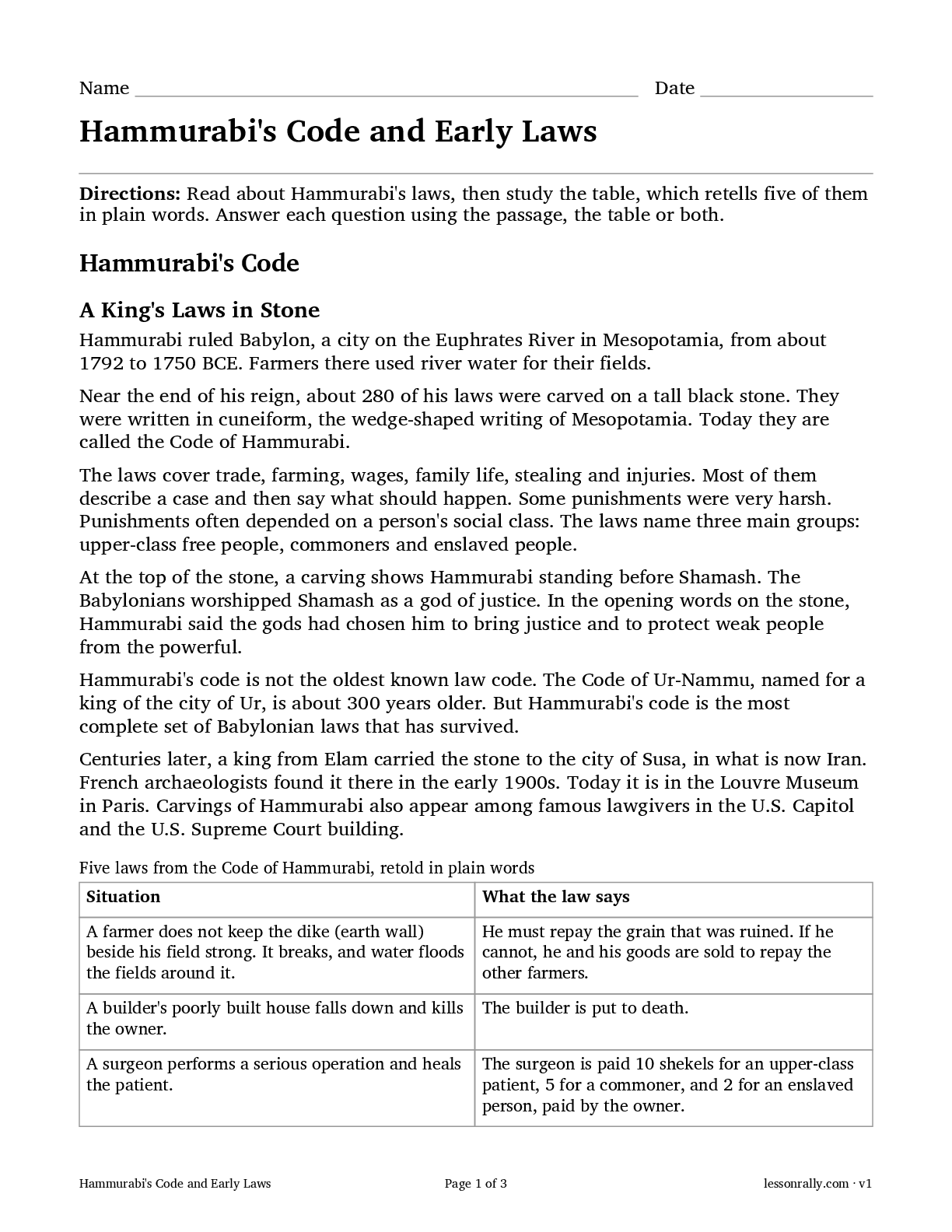
Students read an original passage about Hammurabi, king of Babylon, and the laws carved on a tall black stone near the end of his reign. A table retells five of the laws in plain words. Questions ask students to connect the table with the passage, see how outcomes depended on social class, show that older law codes existed, and explain why Hammurabi is still honored as a lawgiver.

Learning goal: Describe the Code of Hammurabi and how its punishments depended on social class, and explain why the code is still remembered, using a passage and a table.

Estimated reading level 7.7

  1. Grade 5Hard
  2. Grade 6Stretch
  3. Grade 7On level
  4. Grade 8Easier
  5. Grade 9Easy
About this estimate

The estimate is the middle score of five readability formulas. Their scores run from 5.7 to 9.4.

  • Flesch-Kincaid GradeSentence length and syllables per word6.2
  • Gunning FogSentence length and words of three or more syllables8.4
  • Coleman-Liau Middle scoreLetters per word and sentences per 100 words7.7
  • Automated Readability IndexCharacters per word and words per sentence5.7
  • SMOGWords of three or more syllables, for texts of 30 sentences or more9.4
Flesch Reading Ease
72.3 on a 0 to 100 scale where higher is easier: fairly easy. Not part of the estimate.
Text measured
721 words, 36 sentences

Adapted from common readability formulas (Flesch-Kincaid, Gunning Fog, Coleman-Liau and ARI, plus SMOG for long texts), which look at sentence length and word length. Answer choices count toward word length only. Grades below the estimate will likely find the text harder, grades above it easier. It does not measure ideas, background knowledge or images.

Common Core

Closest anchor: CCRA.R.7 Integrate and evaluate content presented in diverse media and formats, including visually and quantitatively, as well as in words.Anchor Standards for ReadingShow 1 matched standardHide matched standard

Matched standard

  • RH.6-8.7

    Integrate visual information (e.g., in charts, graphs, photographs, videos, or maps) with other information in print and digital texts.

    Student preview question 1

Matched independently by two AI models from this activity's questions.

© Copyright 2010. National Governors Association Center for Best Practices and Council of Chief State School Officers. All rights reserved.

Topic: Ancient Civilizations Chosen by LessonRally

Question types: multiple choice, select all that apply, fill in the blank.

Student preview

The questions as students see them, without the answers.

Read about Hammurabi's laws, then study the table, which retells five of them in plain words. Answer each question using the passage, the table or both.

Hammurabi's Code

A King's Laws in Stone

Hammurabi ruled Babylon, a city on the Euphrates River in Mesopotamia, from about 1792 to 1750 BCE. Farmers there used river water for their fields.

Near the end of his reign, about 280 of his laws were carved on a tall black stone. They were written in cuneiform, the wedge-shaped writing of Mesopotamia. Today they are called the Code of Hammurabi.

The laws cover trade, farming, wages, family life, stealing and injuries. Most of them describe a case and then say what should happen. Some punishments were very harsh. Punishments often depended on a person's social class. The laws name three main groups: upper-class free people, commoners and enslaved people.

At the top of the stone, a carving shows Hammurabi standing before Shamash. The Babylonians worshipped Shamash as a god of justice. In the opening words on the stone, Hammurabi said the gods had chosen him to bring justice and to protect weak people from the powerful.

Hammurabi's code is not the oldest known law code. The Code of Ur-Nammu, named for a king of the city of Ur, is about 300 years older. But Hammurabi's code is the most complete set of Babylonian laws that has survived.

Centuries later, a king from Elam carried the stone to the city of Susa, in what is now Iran. French archaeologists found it there in the early 1900s. Today it is in the Louvre Museum in Paris. Carvings of Hammurabi also appear among famous lawgivers in the U.S. Capitol and the U.S. Supreme Court building.


Five laws from the Code of Hammurabi, retold in plain words
SituationWhat the law says
A farmer does not keep the dike (earth wall) beside his field strong. It breaks, and water floods the fields around it.He must repay the grain that was ruined. If he cannot, he and his goods are sold to repay the other farmers.
A builder's poorly built house falls down and kills the owner.The builder is put to death.
A surgeon performs a serious operation and heals the patient.The surgeon is paid 10 shekels for an upper-class patient, 5 for a commoner, and 2 for an enslaved person, paid by the owner.
An upper-class man puts out another person's eye.If the victim is upper-class, the attacker's own eye is put out. If the victim is a commoner, he pays a fine. If the victim is enslaved, he pays the owner half the person's price.
A man hires a worker to farm his field for a year.The law sets how much grain the worker must be paid for the year.

Question 1

Babylon's farmers used water from the Euphrates River. Which law in the table deals with keeping that water under control?

Choose one answer.

  • The law about a worker hired for a year
  • The law about a surgeon's pay
  • The law about a builder whose house falls down
  • The law about a farmer whose dike breaks

Question 2

In what kind of writing were Hammurabi's laws carved?

Choose one answer.

  • Hieroglyphs, the picture signs of ancient Egypt
  • Chinese characters
  • Cuneiform, the wedge-shaped writing of Mesopotamia
  • The Greek alphabet

Question 3

What was the Code of Hammurabi?

Choose one answer.

  • A set of prayers to Shamash written on papyrus
  • A collection of about 280 laws carved on a tall stone
  • A list of the kings who ruled Babylon
  • A map of the canals along the Euphrates River

Question 4

Which two rows of the table show that the outcome of a case could depend on social class?

Choose 2 answers.

  • The builder whose house falls down
  • The worker hired for a year
  • The man who puts out another person's eye
  • The surgeon who heals a patient
  • The farmer whose dike breaks

Question 5

Look at the surgeon row. How much was a surgeon paid for healing a commoner?

Choose one answer.

  • 5 shekels
  • 10 shekels
  • Nothing at all
  • 2 shekels

Question 6

Based on the builder law in the table, what was that law most likely meant to do?

Choose one answer.

  • Push builders to make houses strong and safe
  • Let builders set their own prices
  • Protect builders from angry owners
  • Allow only upper-class men to build houses

Question 7

Which sentence from the passage shows that law codes existed before Hammurabi's?

Choose one answer.

  • The Code of Ur-Nammu, named for a king of the city of Ur, is about 300 years older.
  • Most of them describe a case and then say what should happen.
  • Near the end of his reign, about 280 of his laws were carved on a tall black stone.
  • Today it is in the Louvre Museum in Paris.

Question 8

A carving at the top of the stone shows Hammurabi standing before Shamash. What does this carving most likely suggest?

Choose one answer.

  • Hammurabi wanted people to connect his laws with the god of justice.
  • The stone was carved to mark a tomb.
  • The laws were meant only for priests.
  • Shamash, not Hammurabi, was the king of Babylon.

Question 9

Complete the sentences about the journey of Hammurabi's stone.

Fill in each blank.

Centuries after Hammurabi, a king from Elam carried the stone to blank 1. Today the stone is kept in a museum in blank 2.

Word bank

  • Babylon
  • Ur
  • Paris
  • Susa

Question 10

Why do carvings of Hammurabi appear in the U.S. Capitol and the U.S. Supreme Court building?

Choose one answer.

  • He is honored as one of history's famous lawgivers.
  • His stone is kept in Washington, D.C.
  • U.S. courts still follow his laws today.
  • He wrote the oldest known law code.

Reviews

No reviews yet.

Reviews come from teachers who assigned this activity to a class.

Sign in to write a review

Have a topic of your own? Make a printable worksheet and online quiz, free.

Create an activity

Answer key

Answer keys come with Premium

Print this worksheet with the correct answers marked. The key includes any explanations, sample answers, and rubrics supplied with the activity.

Answer keys aren't public: only teachers with Premium and the people who can edit an activity can download one, so students can't get a ready-to-print key from this page.

Premium includes:

  • No ads for you, and no ads for your students on the assignments you post.
  • Answer keys for printable worksheets, with the correct answers marked and any explanations, sample answers, and rubrics.
  • Create with AI: up to 100 activities a year (5 during the free trial), with every answer checked before you see the draft.

$29 a year, plus sales tax where it applies.

New Premium teachers can try it free for 7 days. A card or other payment method is needed to start. Unless you cancel before the trial ends, you are charged then and the plan renews every year.

Already have Premium or edit this activity? Sign in