War of 1812: Causes and Effects

8 questions · 15 points · Grade 8 · English · Preview the 8 questions

Made by Monica Ellison · LessonRally (AI-assisted)

Digital classroom activity

What is a digital classroom activity?

Teachers who sign in can assign LessonRally activities to their Google Classroom classes: students open them in Classroom and answer online, and their grades go to the teacher's Classroom gradebook. Practice lets you try it first, the way students see it.

Free for teachers. Sign in to assign activities to your Google Classroom classes.

Printable worksheet

Students read a short passage about the War of 1812, match each cause to its effect in two matching sets, and cite evidence from the text to explain why the war began and what it changed. Topics include impressment, Tecumseh, the War Hawks, the Treaty of Ghent, the Battle of New Orleans and the growth of national pride.

Learning goal: Cite evidence from a passage to explain the causes and effects of the War of 1812.

Estimated reading level 8.8

  1. Grade 6Hard
  2. Grade 7Stretch
  3. Grade 8On level
  4. Grade 9Easier
  5. Grade 10Easy
About this estimate

The estimate is the middle score of five readability formulas. Their scores run from 7.5 to 10.3.

  • Flesch-Kincaid GradeSentence length and syllables per word7.5
  • Gunning Fog Middle scoreSentence length and words of three or more syllables8.8
  • Coleman-LiauLetters per word and sentences per 100 words10.3
  • Automated Readability IndexCharacters per word and words per sentence7.7
  • SMOGWords of three or more syllables, for texts of 30 sentences or more8.9
Flesch Reading Ease
63.5 on a 0 to 100 scale where higher is easier: standard. Not part of the estimate.
Text measured
823 words, 39 sentences

Adapted from common readability formulas (Flesch-Kincaid, Gunning Fog, Coleman-Liau and ARI, plus SMOG for long texts), which look at sentence length and word length. Answer choices count toward word length only. Grades below the estimate will likely find the text harder, grades above it easier. It does not measure ideas, background knowledge or images.

Common Core

Closest anchor: CCRA.R.1 Read closely to determine what the text says explicitly and to make logical inferences from it; cite specific textual evidence when writing or speaking to support conclusions drawn from the text.Anchor Standards for ReadingShow 1 matched standardHide matched standard

Matched standard

  • RH.6-8.1

    Cite specific textual evidence to support analysis of primary and secondary sources.

    Student preview questions 5, 7

Matched independently by two AI models from this activity's questions.

© Copyright 2010. National Governors Association Center for Best Practices and Council of Chief State School Officers. All rights reserved.

Topic: Early Republic Chosen by LessonRally

Question types: matching, fill in the blank, multiple choice, select all that apply.

Student preview

The questions as students see them, without the answers.

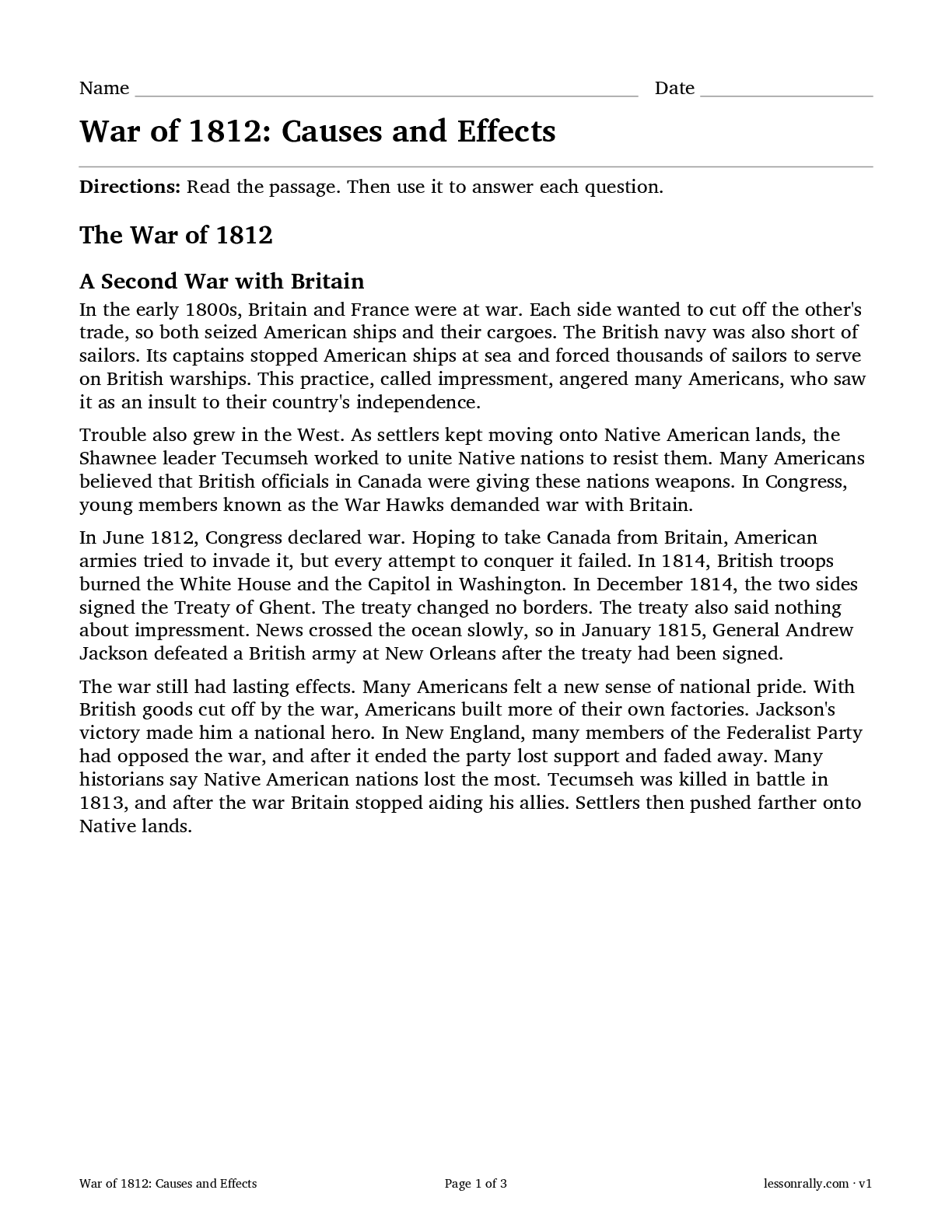
Read the passage. Then use it to answer each question.

The War of 1812

A Second War with Britain

In the early 1800s, Britain and France were at war. Each side wanted to cut off the other's trade, so both seized American ships and their cargoes. The British navy was also short of sailors. Its captains stopped American ships at sea and forced thousands of sailors to serve on British warships. This practice, called impressment, angered many Americans, who saw it as an insult to their country's independence.

Trouble also grew in the West. As settlers kept moving onto Native American lands, the Shawnee leader Tecumseh worked to unite Native nations to resist them. Many Americans believed that British officials in Canada were giving these nations weapons. In Congress, young members known as the War Hawks demanded war with Britain.

In June 1812, Congress declared war. Hoping to take Canada from Britain, American armies tried to invade it, but every attempt to conquer it failed. In 1814, British troops burned the White House and the Capitol in Washington. In December 1814, the two sides signed the Treaty of Ghent. The treaty changed no borders. The treaty also said nothing about impressment. News crossed the ocean slowly, so in January 1815, General Andrew Jackson defeated a British army at New Orleans after the treaty had been signed.

The war still had lasting effects. Many Americans felt a new sense of national pride. With British goods cut off by the war, Americans built more of their own factories. Jackson's victory made him a national hero. In New England, many members of the Federalist Party had opposed the war, and after it ended the party lost support and faded away. Many historians say Native American nations lost the most. Tecumseh was killed in battle in 1813, and after the war Britain stopped aiding his allies. Settlers then pushed farther onto Native lands.


Question 1

These events happened before and during the War of 1812. Match each cause to its effect, as the passage describes them.

Match each item to an option.

Items

  1. Britain and France each wanted to cut off the other's trade
  2. The British navy was short of sailors
  3. Settlers kept moving onto Native American lands
  4. The United States hoped to take Canada from Britain

Options

  1. Britain gave Canada to the United States
  2. British captains forced sailors from American ships to serve on warships
  3. Both nations seized American ships and cargoes
  4. American armies tried to invade Canada
  5. Tecumseh worked to unite Native nations to resist

Question 2

The war also had lasting effects. Match each cause to its effect, as the passage describes them.

Match each item to an option.

Items

  1. British goods were cut off by the war
  2. Jackson defeated a British army at New Orleans
  3. Many Federalists had opposed the war
  4. Tecumseh was killed, and Britain stopped aiding his allies

Options

  1. Britain gained new land in the United States
  2. The Federalist Party lost support and faded away
  3. Jackson became a national hero
  4. Settlers pushed farther onto Native American lands
  5. Americans built more of their own factories

Question 3

Complete the sentences with terms from the word bank.

Fill in each blank.

The British practice of forcing sailors from American ships to serve on British warships was called blank 1. The young members of Congress who demanded war with Britain were known as the blank 2.

Word bank

  • Loyalists
  • War Hawks
  • embargo
  • Federalists
  • impressment

Question 4

Why did many Americans blame Britain for the trouble with Native American nations in the West?

Choose one answer.

  • British settlers were taking Native American lands in the West.
  • Britain had sold the Louisiana Territory to Native nations.
  • The British navy had forced Native Americans to serve on its warships.
  • They believed British officials in Canada were giving weapons to Native nations.

Question 5

Which sentence from the passage best shows how many Americans felt about impressment?

Choose one answer.

  • "Trouble also grew in the West."
  • "Its captains stopped American ships at sea and forced thousands of sailors to serve on British warships."
  • "The British navy was also short of sailors."
  • "This practice, called impressment, angered many Americans, who saw it as an insult to their country's independence."

Question 6

According to the passage, why was the Battle of New Orleans fought after the peace treaty had been signed?

Choose one answer.

  • Jackson refused to obey the Treaty of Ghent.
  • News of the treaty crossed the ocean slowly.
  • Britain broke the treaty by sending a new army.
  • The treaty said the war would last until spring.

Question 7

Which two sentences from the passage best support the claim that the Treaty of Ghent left things much as they had been before the war?

Choose 2 answers.

  • "Jackson's victory made him a national hero."
  • "The treaty changed no borders."
  • "The treaty also said nothing about impressment."
  • "In June 1812, Congress declared war."
  • "In 1814, British troops burned the White House and the Capitol in Washington."

Question 8

The passage describes how the war changed the way many Americans felt about their country. What was that change?

Choose one answer.

  • Many decided the nation should stop trading with other countries.
  • Many felt a new sense of national pride.
  • Many lost faith in the nation and wanted a king.
  • Many wanted to rejoin the British Empire.

Reviews

No reviews yet.

Reviews come from teachers who assigned this activity to a class.

Sign in to write a review

Have a topic of your own? Make a printable worksheet and online quiz, free.

Create an activity

Answer key

Answer keys come with Premium

Print this worksheet with the correct answers marked. The key includes any explanations, sample answers, and rubrics supplied with the activity.

Answer keys aren't public: only teachers with Premium and the people who can edit an activity can download one, so students can't get a ready-to-print key from this page.

Premium includes:

  • No ads for you, and no ads for your students on the assignments you post.
  • Answer keys for printable worksheets, with the correct answers marked and any explanations, sample answers, and rubrics.
  • Create with AI: up to 100 activities a year (5 during the free trial), with every answer checked before you see the draft.

$29 a year, plus sales tax where it applies.

New Premium teachers can try it free for 7 days. A card or other payment method is needed to start. Unless you cancel before the trial ends, you are charged then and the plan renews every year.

Already have Premium or edit this activity? Sign in