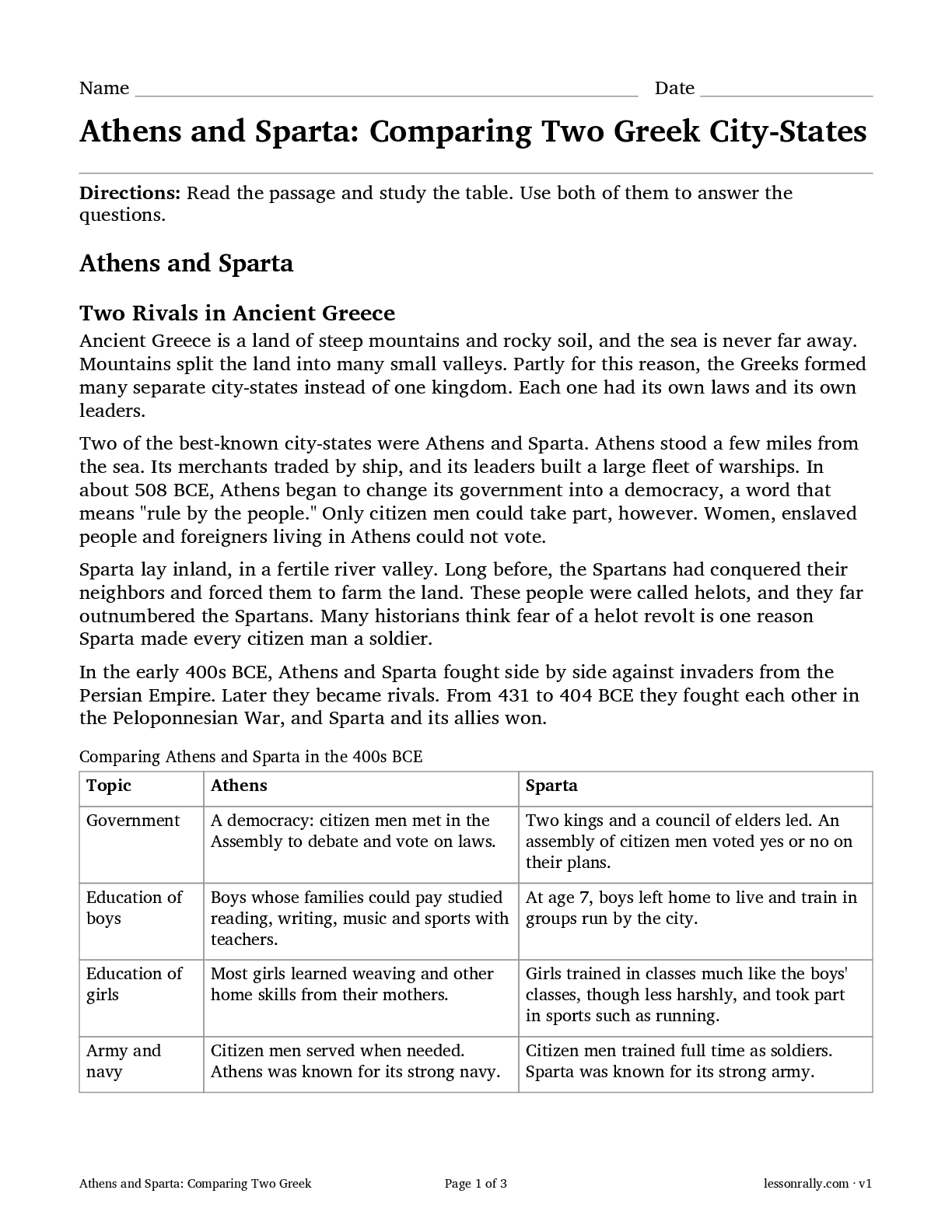
Ancient Greece is a land of steep mountains and rocky soil, and the sea is never far away. Mountains split the land into many small valleys. Partly for this reason, the Greeks formed many separate city-states instead of one kingdom. Each one had its own laws and its own leaders.
Two of the best-known city-states were Athens and Sparta. Athens stood a few miles from the sea. Its merchants traded by ship, and its leaders built a large fleet of warships. In about 508 BCE, Athens began to change its government into a democracy, a word that means "rule by the people." Only citizen men could take part, however. Women, enslaved people and foreigners living in Athens could not vote.
Sparta lay inland, in a fertile river valley. Long before, the Spartans had conquered their neighbors and forced them to farm the land. These people were called helots, and they far outnumbered the Spartans. Many historians think fear of a helot revolt is one reason Sparta made every citizen man a soldier.
In the early 400s BCE, Athens and Sparta fought side by side against invaders from the Persian Empire. Later they became rivals. From 431 to 404 BCE they fought each other in the Peloponnesian War, and Sparta and its allies won.