

Math
Grade 3 Math
Open a standard to see the worksheets and online quizzes matched to it.
Grade 3 Math activities
- MathFeatured
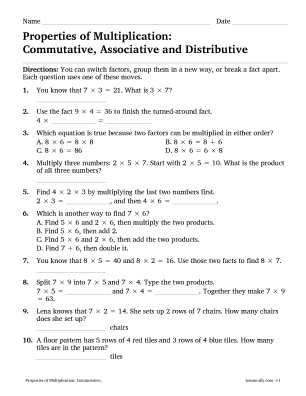
Properties of Multiplication: Commutative, Associative and Distributive (opens in a new tab)
- Grade 3
- 10 questions
Common Core 3.OA.B.5
Made by Luis Carmona · LessonRally (AI-assisted)
- MathFeatured
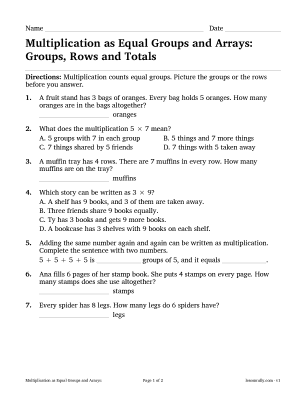
Multiplication as Equal Groups and Arrays: Groups, Rows and Totals (opens in a new tab)
- Grade 3
- 10 questions
Common Core 3.OA.A.3
Made by Luis Carmona · LessonRally (AI-assisted)
- MathFeatured
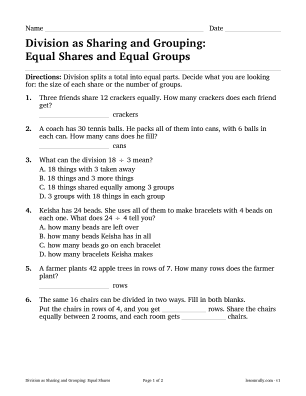
Division as Sharing and Grouping: Equal Shares and Equal Groups (opens in a new tab)
- Grade 3
- 10 questions
Common Core 3.OA.A.2
Made by Luis Carmona · LessonRally (AI-assisted)
Counts updated 14 minutes ago.
Operations and Algebraic Thinking
3.OA.A Represent and solve problems involving multiplication and division.
3.OA.A.1 1 activity
Interpret products of whole numbers, e.g., interpret 5 × 7 as the total number of objects in 5 groups of 7 objects each. For example, describe a context in which a total number of objects can be expressed as 5 × 7.
3.OA.A.2 1 activity
Interpret whole-number quotients of whole numbers, e.g., interpret 56 ÷ 8 as the number of objects in each share when 56 objects are partitioned equally into 8 shares, or as a number of shares when 56 objects are partitioned into equal shares of 8 objects each. For example, describe a context in which a number of shares or a number of groups can be expressed as 56 ÷ 8.
3.OA.A.3 6 activities
Use multiplication and division within 100 to solve word problems in situations involving equal groups, arrays, and measurement quantities, e.g., by using drawings and equations with a symbol for the unknown number to represent the problem.
3.OA.A.4 2 activities
Determine the unknown whole number in a multiplication or division equation relating three whole numbers. For example, determine the unknown number that makes the equation true in each of the equations 8 × ? = 48, 5 = _ ÷ 3, 6 × 6 = ?
3.OA.B Understand properties of multiplication and the relationship between multiplication and division.
3.OA.B.5 2 activities
Apply properties of operations as strategies to multiply and divide. Examples: If 6 × 4 = 24 is known, then 4 × 6 = 24 is also known. (Commutative property of multiplication.) 3 × 5 × 2 can be found by 3 × 5 = 15, then 15 × 2 = 30, or by 5 × 2 = 10, then 3 × 10 = 30. (Associative property of multiplication.) Knowing that 8 × 5 = 40 and 8 × 2 = 16, one can find 8 × 7 as 8 × (5 + 2) = (8 × 5) + (8 × 2) = 40 + 16 = 56. (Distributive property.)
3.OA.B.6 1 activity
Understand division as an unknown-factor problem. For example, find 32 ÷ 8 by finding the number that makes 32 when multiplied by 8.
3.OA.C Multiply and divide within 100.
3.OA.C.7 1 activity
Fluently multiply and divide within 100, using strategies such as the relationship between multiplication and division (e.g., knowing that 8 × 5 = 40, one knows 40 ÷ 5 = 8) or properties of operations. By the end of Grade 3, know from memory all products of two one-digit numbers.
3.OA.D Solve problems involving the four operations, and identify and explain patterns in arithmetic.
3.OA.D.8 4 activities
Solve two-step word problems using the four operations. Represent these problems using equations with a letter standing for the unknown quantity. Assess the reasonableness of answers using mental computation and estimation strategies including rounding.
Identify arithmetic patterns (including patterns in the addition table or multiplication table), and explain them using properties of operations. For example, observe that 4 times a number is always even, and explain why 4 times a number can be decomposed into two equal addends.
Number and Operations in Base Ten
3.NBT.A Use place value understanding and properties of operations to perform multi-digit arithmetic.
3.NBT.A.1 2 activities
Use place value understanding to round whole numbers to the nearest 10 or 100.
3.NBT.A.2 1 activity
Fluently add and subtract within 1000 using strategies and algorithms based on place value, properties of operations, and/or the relationship between addition and subtraction.
3.NBT.A.3 1 activity
Multiply one-digit whole numbers by multiples of 10 in the range 10-90 (e.g., 9 × 80, 5 × 60) using strategies based on place value and properties of operations.
Number and Operations—Fractions
3.NF.A Develop understanding of fractions as numbers.
3.NF.A.1 1 activity
Understand a fraction 1/b as the quantity formed by 1 part when a whole is partitioned into b equal parts; understand a fraction a/b as the quantity formed by a parts of size 1/b.
Understand a fraction as a number on the number line; represent fractions on a number line diagram.
Parts of 3.NF.A.2 (2)
- 3.NF.A.2a Represent a fraction 1/b on a number line diagram by defining the interval from 0 to 1 as the whole and partitioning it into b equal parts. Recognize that each part has size 1/b and that the endpoint of the part based at 0 locates the number 1/b on the number line.
- 3.NF.A.2b Represent a fraction a/b on a number line diagram by marking off a lengths 1/b from 0. Recognize that the resulting interval has size a/b and that its endpoint locates the number a/b on the number line.
3.NF.A.3 1 activity
Explain equivalence of fractions in special cases, and compare fractions by reasoning about their size.
Parts of 3.NF.A.3 (4)
- 3.NF.A.3a Understand two fractions as equivalent (equal) if they are the same size, or the same point on a number line.
- 3.NF.A.3b Recognize and generate simple equivalent fractions, e.g., 1/2 = 2/4, 4/6 = 2/3. Explain why the fractions are equivalent, e.g., by using a visual fraction model.
- 3.NF.A.3c Express whole numbers as fractions, and recognize fractions that are equivalent to whole numbers. Examples: Express 3 in the form 3 = 3/1; recognize that 6/1 = 6; locate 4/4 and 1 at the same point of a number line diagram.
- 3.NF.A.3d Compare two fractions with the same numerator or the same denominator by reasoning about their size. Recognize that comparisons are valid only when the two fractions refer to the same whole. Record the results of comparisons with the symbols >, =, or <, and justify the conclusions, e.g., by using a visual fraction model.
Measurement and Data
3.MD.A Solve problems involving measurement and estimation of intervals of time, liquid volumes, and masses of objects.
Tell and write time to the nearest minute and measure time intervals in minutes. Solve word problems involving addition and subtraction of time intervals in minutes, e.g., by representing the problem on a number line diagram.
Measure and estimate liquid volumes and masses of objects using standard units of grams (g), kilograms (kg), and liters (l). Add, subtract, multiply, or divide to solve one-step word problems involving masses or volumes that are given in the same units, e.g., by using drawings (such as a beaker with a measurement scale) to represent the problem.
3.MD.B Represent and interpret data.
Draw a scaled picture graph and a scaled bar graph to represent a data set with several categories. Solve one- and two-step "how many more" and "how many less" problems using information presented in scaled bar graphs. For example, draw a bar graph in which each square in the bar graph might represent 5 pets.
Generate measurement data by measuring lengths using rulers marked with halves and fourths of an inch. Show the data by making a line plot, where the horizontal scale is marked off in appropriate units— whole numbers, halves, or quarters.
3.MD.C Geometric measurement: understand concepts of area and relate area to multiplication and to addition.
Recognize area as an attribute of plane figures and understand concepts of area measurement.
Measure areas by counting unit squares (square cm, square m, square in, square ft, and improvised units).
3.MD.C.7 1 activity
Relate area to the operations of multiplication and addition.
3.MD.C.7b, 1 activity 3.MD.C.7d, 1 activity
Parts of 3.MD.C.7 (4)
- 3.MD.C.7a Find the area of a rectangle with whole-number side lengths by tiling it, and show that the area is the same as would be found by multiplying the side lengths.
- 3.MD.C.7b Multiply side lengths to find areas of rectangles with whole-number side lengths in the context of solving real world and mathematical problems, and represent whole-number products as rectangular areas in mathematical reasoning.
- 3.MD.C.7c Use tiling to show in a concrete case that the area of a rectangle with whole-number side lengths a and b + c is the sum of a × b and a × c. Use area models to represent the distributive property in mathematical reasoning.
- 3.MD.C.7d Recognize area as additive. Find areas of rectilinear figures by decomposing them into non-overlapping rectangles and adding the areas of the non-overlapping parts, applying this technique to solve real world problems.
3.MD.D Geometric measurement: recognize perimeter as an attribute of plane figures and distinguish between linear and area measures.
3.MD.D.8 1 activity
Solve real world and mathematical problems involving perimeters of polygons, including finding the perimeter given the side lengths, finding an unknown side length, and exhibiting rectangles with the same perimeter and different areas or with the same area and different perimeters.
Geometry
Show 2 standards in Geometry
3.G.A Reason with shapes and their attributes.
Understand that shapes in different categories (e.g., rhombuses, rectangles, and others) may share attributes (e.g., having four sides), and that the shared attributes can define a larger category (e.g., quadrilaterals). Recognize rhombuses, rectangles, and squares as examples of quadrilaterals, and draw examples of quadrilaterals that do not belong to any of these subcategories.
Partition shapes into parts with equal areas. Express the area of each part as a unit fraction of the whole. For example, partition a shape into 4 parts with equal area, and describe the area of each part as 1/4 of the area of the shape.
How matching works
LessonRally matches each shared activity to the Common Core standards its questions require, using AI after the activity passes review. Every standard shown in Browse was chosen independently by two AI models, or by LessonRally.
© Copyright 2010. National Governors Association Center for Best Practices and Council of Chief State School Officers. All rights reserved.
Don't see the standard you need?
Build it yourself or start from your AI chat. Your draft stays private until you publish it.