Question 1
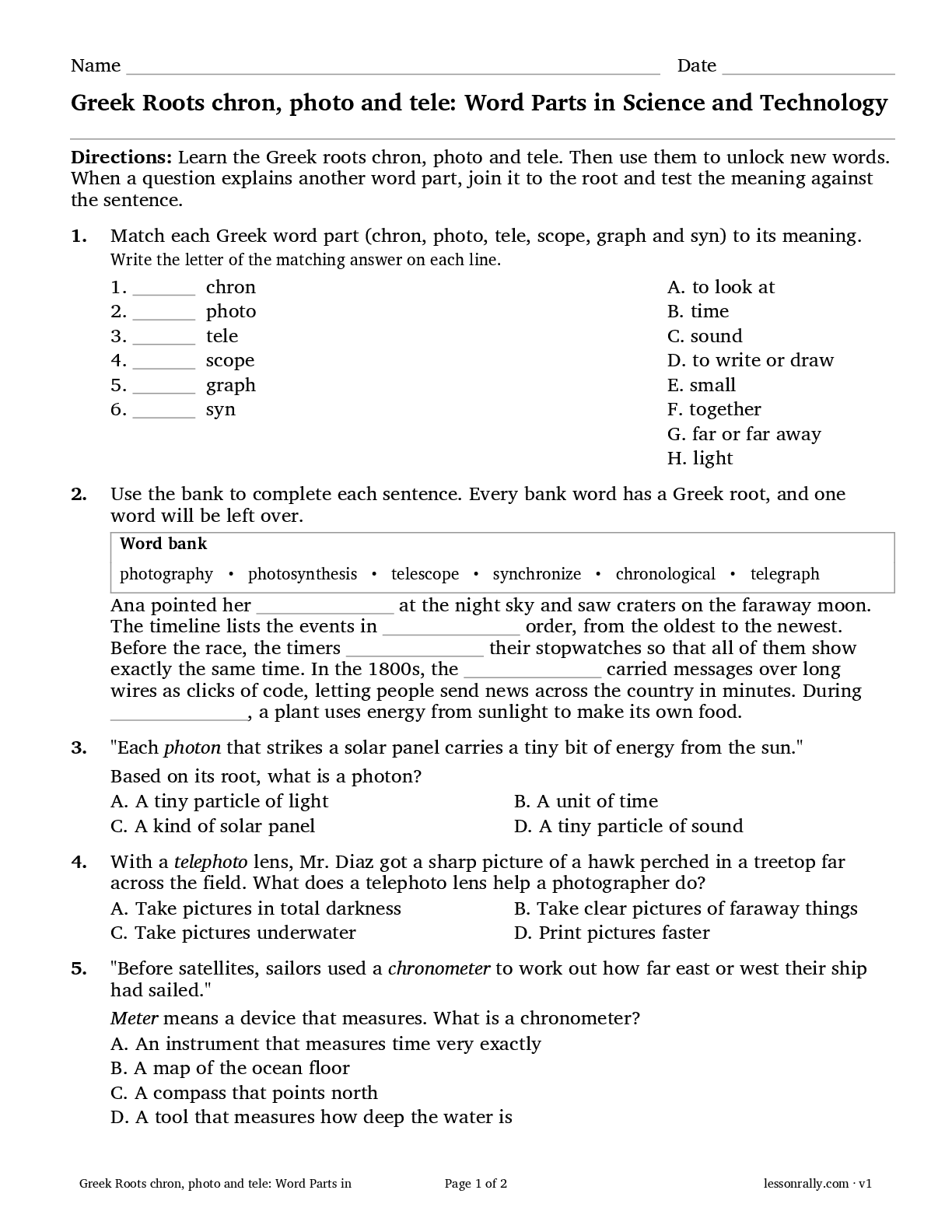
Match each Greek word part (chron, photo, tele, scope, graph and syn) to its meaning.
Match each item to an option.
Items
- chron
- photo
- tele
- scope
- graph
- syn
Options


Teachers who sign in can assign LessonRally activities to their Google Classroom classes: students open them in Classroom and answer online, and their grades go to the teacher's Classroom gradebook. Practice lets you try it first, the way students see it.
Free for teachers. Sign in to assign activities to your Google Classroom classes.
 (opens in a new tab)
2 pages · Student copy, no answers
Print worksheet (opens in a new tab)Answer keyPremiumStudents learn the Greek roots chron, photo and tele, along with scope, graph and syn. They match each word part to its meaning, complete sentences with root words from a word bank, then use a root and context clues to decode unfamiliar words from science, history and technology. The set explains why the root photo means light even though photo alone is short for photograph.
Learning goal: Use the Greek roots chron, photo and tele, along with context clues, to determine the meanings of unfamiliar words.
The estimate is the middle score of five readability formulas. Their scores run from 5.3 to 8.8.
Adapted from common readability formulas (Flesch-Kincaid, Gunning Fog, Coleman-Liau and ARI, plus SMOG for long texts), which look at sentence length and word length. Answer choices count toward word length only. Grades below the estimate will likely find the text harder, grades above it easier. It does not measure ideas, background knowledge or images.
© Copyright 2010. National Governors Association Center for Best Practices and Council of Chief State School Officers. All rights reserved.
Topic: Prefixes, Suffixes and Roots Chosen by LessonRally
Question types: matching, fill in the blank, multiple choice.
The questions as students see them, without the answers.
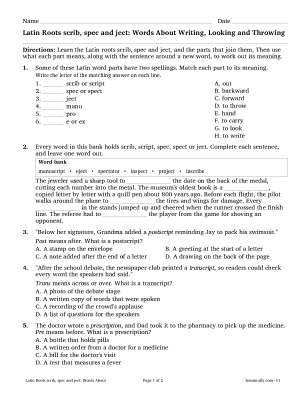
Learn the Greek roots chron, photo and tele. Then use them to unlock new words. When a question explains another word part, join it to the root and test the meaning against the sentence.
Match each Greek word part (chron, photo, tele, scope, graph and syn) to its meaning.
Match each item to an option.
Items
Options
Use the bank to complete each sentence. Every bank word has a Greek root, and one word will be left over.
Fill in each blank.
Ana pointed her blank 1 at the night sky and saw craters on the faraway moon. The timeline lists the events in blank 2 order, from the oldest to the newest. Before the race, the timers blank 3 their stopwatches so that all of them show exactly the same time. In the 1800s, the blank 4 carried messages over long wires as clicks of code, letting people send news across the country in minutes. During blank 5, a plant uses energy from sunlight to make its own food.
Word bank
"Each photon that strikes a solar panel carries a tiny bit of energy from the sun."
Based on its root, what is a photon?
Choose one answer.
With a telephoto lens, Mr. Diaz got a sharp picture of a hawk perched in a treetop far across the field. What does a telephoto lens help a photographer do?
Choose one answer.
"Before satellites, sailors used a chronometer to work out how far east or west their ship had sailed."
Meter means a device that measures. What is a chronometer?
Choose one answer.
In the fantasy novel, the twins could share secret plans by telepathy, without saying a single word. Pathy comes from a Greek word for feeling. What is telepathy?
Choose one answer.
"In the movie about ancient Rome, a soldier wearing a wristwatch was an anachronism."
Ana can mean against or backward. What is an anachronism?
Choose one answer.
"Because of phototropism, the houseplant on the windowsill slowly bent its stems toward the glass."
Trop comes from a Greek word meaning turn. What is phototropism?
Choose one answer.
"The pioneer's diary is a chronicle of her family's journey west by covered wagon, written day by day."
What is a chronicle?
Choose one answer.
"Some eyeglasses have photosensitive lenses that turn darker outdoors in bright sunshine."
What does photosensitive mean?
Choose one answer.
Because the scientists worked on three different continents, they held a teleconference once a week. What is a teleconference?
Choose one answer.
The word photo by itself is short for photograph, but the root photo means light. In which of these does photo mean light?
Choose one answer.
No reviews yet.
Reviews come from teachers who assigned this activity to a class.
Have a topic of your own? Make a printable worksheet and online quiz, free.
Create an activityCommon Core L.7.4b
Made by Simone Thornbury · LessonRally (AI-assisted)
Common Core L.7.4b
Made by Simone Thornbury · LessonRally (AI-assisted)
Common Core L.7.4a
Made by Simone Thornbury · LessonRally (AI-assisted)
Common Core L.7.5a
Made by Claire Fenwood · LessonRally (AI-assisted)