Comparing Two Characters and Theme: The Twins' Science Fair

7 questions · 7 points · Grade 5 · English · Preview the 7 questions

Made by Andre Whitaker · LessonRally (AI-assisted)

Digital classroom activity

What is a digital classroom activity?

Teachers who sign in can assign LessonRally activities to their Google Classroom classes: students open them in Classroom and answer online, and their grades go to the teacher's Classroom gradebook. Practice lets you try it first, the way students see it.

Free for teachers. Sign in to assign activities to your Google Classroom classes.

Printable worksheet

Students read an original short story about twins who work on a science fair project in very different ways. They choose the theme, answer three questions that compare the twins, choose the detail the story gives for each of two ideas and select two details that show how the twins react to a judge. Grade 5 reading comprehension practice on comparing and contrasting two characters in a story.

Learning goal: Compare and contrast two characters in a story, drawing on specific details such as how they act and interact.

Estimated reading level 4.8

  1. Grade 2Hard
  2. Grade 3Stretch
  3. Grade 4On level
  4. Grade 5Easier
  5. Grade 6Easy
About this estimate

The estimate is the middle score of five readability formulas. Their scores run from 2.8 to 6.0.

  • Flesch-Kincaid GradeSentence length and syllables per word3.1
  • Gunning Fog Middle scoreSentence length and words of three or more syllables4.8
  • Coleman-LiauLetters per word and sentences per 100 words5.5
  • Automated Readability IndexCharacters per word and words per sentence2.8
  • SMOGWords of three or more syllables, for texts of 30 sentences or more6.0
Flesch Reading Ease
88.5 on a 0 to 100 scale where higher is easier: easy. Not part of the estimate.
Text measured
644 words, 41 sentences

Adapted from common readability formulas (Flesch-Kincaid, Gunning Fog, Coleman-Liau and ARI, plus SMOG for long texts), which look at sentence length and word length. Answer choices count toward word length only. Grades below the estimate will likely find the text harder, grades above it easier. It does not measure ideas, background knowledge or images.

Common Core

Closest anchor: CCRA.R.3 Analyze how and why individuals, events, or ideas develop and interact over the course of a text.Anchor Standards for ReadingShow 2 matched standardsHide matched standards

Matched standards

  • RL.5.3

    Compare and contrast two or more characters, settings, or events in a story or drama, drawing on specific details in the text (e.g., how characters interact).

    Student preview questions 2, 3, 4, 5, 6, 7

  • RL.5.2

    Determine a theme of a story, drama, or poem from details in the text, including how characters in a story or drama respond to challenges or how the speaker in a poem reflects upon a topic; summarize the text.

    Student preview question 1

Matched independently by two AI models from this activity's questions.

© Copyright 2010. National Governors Association Center for Best Practices and Council of Chief State School Officers. All rights reserved.

Topics: Characterization, Theme Chosen by LessonRally

Question types: multiple choice, select all that apply.

Student preview

The questions as students see them, without the answers.

Read the story about twins at a science fair. Use details from the story to answer.

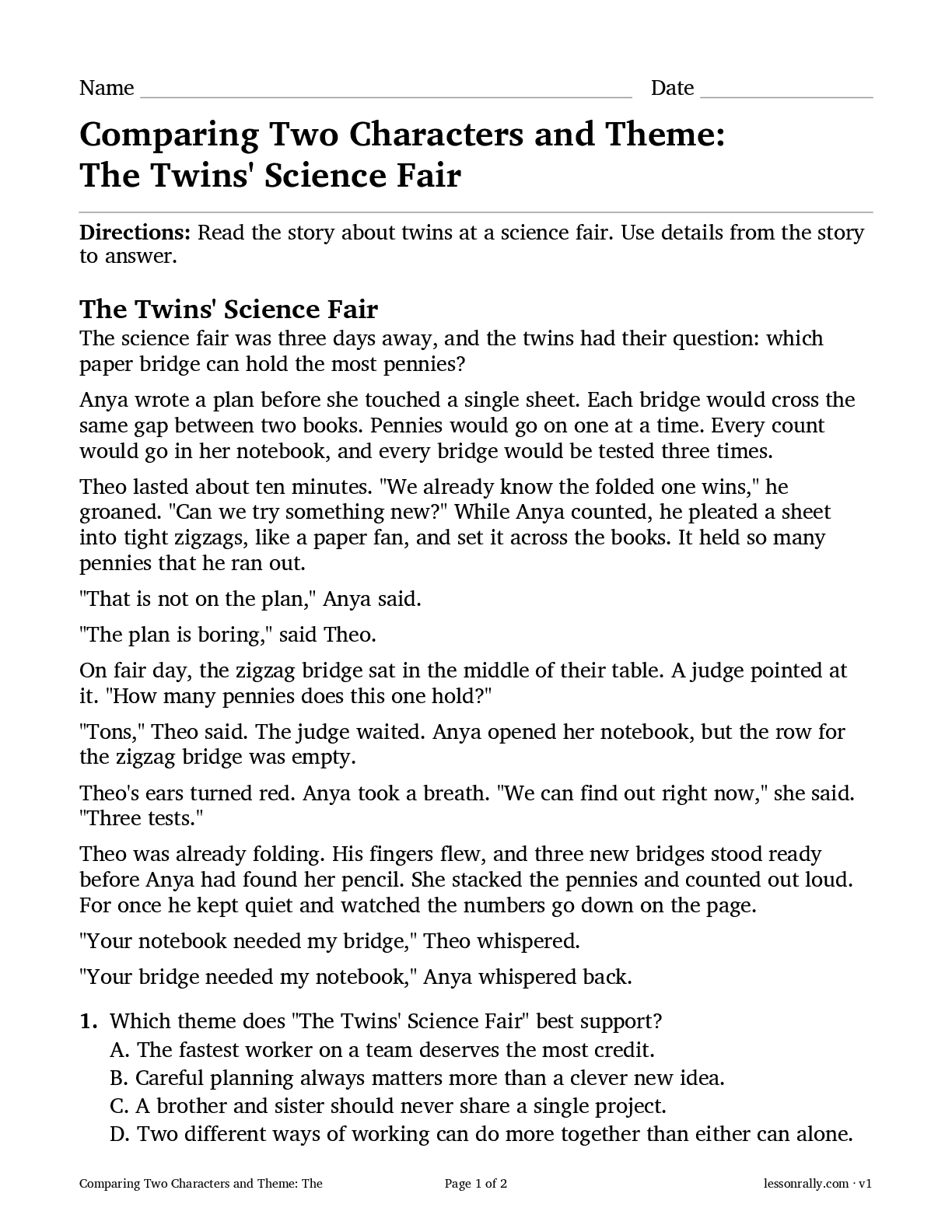
The Twins' Science Fair

The science fair was three days away, and the twins had their question: which paper bridge can hold the most pennies?

Anya wrote a plan before she touched a single sheet. Each bridge would cross the same gap between two books. Pennies would go on one at a time. Every count would go in her notebook, and every bridge would be tested three times.

Theo lasted about ten minutes. "We already know the folded one wins," he groaned. "Can we try something new?" While Anya counted, he pleated a sheet into tight zigzags, like a paper fan, and set it across the books. It held so many pennies that he ran out.

"That is not on the plan," Anya said.

"The plan is boring," said Theo.

On fair day, the zigzag bridge sat in the middle of their table. A judge pointed at it. "How many pennies does this one hold?"

"Tons," Theo said. The judge waited. Anya opened her notebook, but the row for the zigzag bridge was empty.

Theo's ears turned red. Anya took a breath. "We can find out right now," she said. "Three tests."

Theo was already folding. His fingers flew, and three new bridges stood ready before Anya had found her pencil. She stacked the pennies and counted out loud. For once he kept quiet and watched the numbers go down on the page.

"Your notebook needed my bridge," Theo whispered.

"Your bridge needed my notebook," Anya whispered back.

Question 1

Which theme does "The Twins' Science Fair" best support?

Choose one answer.

  • The fastest worker on a team deserves the most credit.
  • A brother and sister should never share a single project.
  • Careful planning always matters more than a clever new idea.
  • Two different ways of working can do more together than either can alone.

Question 2

How do the twins differ in the way they start the project?

Choose one answer.

  • Anya asks a judge for the rules, and Theo reads them aloud.
  • Anya writes a plan first, and Theo wants to try something new.
  • Anya builds the first bridge, and Theo counts the pennies.
  • Anya writes a plan first, and Theo copies it into his own notebook.

Question 3

Anya likes to work in a careful, steady way. Which detail from the story is an example of this?

Choose one answer.

  • She plans to test every bridge three times.
  • She weighs the pennies before she uses them.
  • She tapes the books down so that they cannot slide.
  • She measures each sheet of paper with a ruler.

Question 4

What do Theo's actions show about him when the plan bores him?

Choose one answer.

  • He would rather watch Anya than build anything.
  • He would rather invent something than repeat a test.
  • He would rather quit than lose the science fair.
  • He would rather copy an idea from a book.

Question 5

At the fair, the twins react in different ways to the judge's question. Which two details from the story show how they react? Select two.

Choose 2 answers.

  • Theo reads the answer from a chart.
  • Theo hides the bridge under the table.
  • Anya looks in her notebook for the number.
  • Theo answers with a guess.
  • Anya tells the judge to ask Theo.

Question 6

How are the twins alike at the end of the story?

Choose one answer.

  • Each one thinks the judge asked an unfair question.
  • Each one wishes that the old plan had never changed.
  • Each one sees that the project needed what the other one did.
  • Each one decides to enter the fair alone next year.

Question 7

By the end, Theo respects the way Anya works. Which detail does the story give to show his respect?

Choose one answer.

  • He keeps quiet and watches the numbers go down on the page.
  • He tells the judge that the whole plan was hers.
  • He asks her to check each one of his folds.
  • He offers to copy all of her notes over neatly.

Reviews

No reviews yet.

Reviews come from teachers who assigned this activity to a class.

Sign in to write a review

Have a topic of your own? Make a printable worksheet and online quiz, free.

Create an activity

Answer key

Answer keys come with Premium

Print this worksheet with the correct answers marked. The key includes any explanations, sample answers, and rubrics supplied with the activity.

Answer keys aren't public: only teachers with Premium and the people who can edit an activity can download one, so students can't get a ready-to-print key from this page.

Premium includes:

  • No ads for you, and no ads for your students on the assignments you post.
  • Answer keys for printable worksheets, with the correct answers marked and any explanations, sample answers, and rubrics.
  • Create with AI: up to 100 activities a year (5 during the free trial), with every answer checked before you see the draft.

$29 a year, plus sales tax where it applies.

New Premium teachers can try it free for 7 days. A card or other payment method is needed to start. Unless you cancel before the trial ends, you are charged then and the plan renews every year.

Already have Premium or edit this activity? Sign in