Nuance: Words with Similar Denotations

10 questions · 10 points · Grades 9–10 · English · Preview the 10 questions

Made by Eleanor Wrenfield · LessonRally (AI-assisted)

Digital classroom activity

What is a digital classroom activity?

Teachers who sign in can assign LessonRally activities to their Google Classroom classes: students open them in Classroom and answer online, and their grades go to the teacher's Classroom gradebook. Practice lets you try it first, the way students see it.

Free for teachers. Sign in to assign activities to your Google Classroom classes.

Printable worksheet

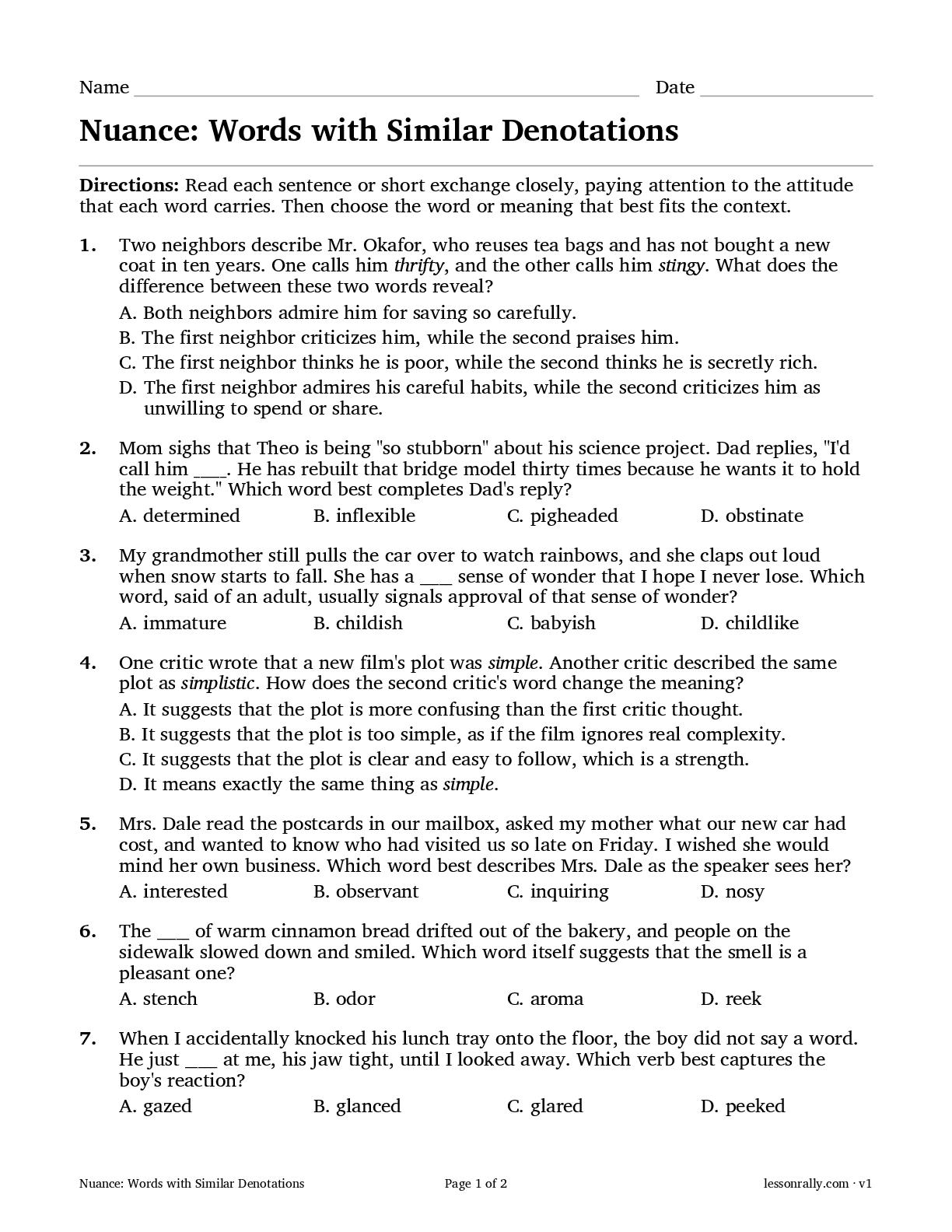
Students compare words with similar denotations, such as thrifty and stingy or childlike and childish, and use context to decide which word fits. Practice with nuance, connotation, denotation and word choice, and with how connotations shift meaning and tone.

Learning goal: Analyze nuances in the meaning of words with similar denotations and choose the word whose connotation fits the context.

Estimated reading level 8.2

  1. Grade 6Hard
  2. Grade 7Stretch
  3. Grade 8On level
  4. Grade 9Easier
  5. Grade 10Easy
About this estimate

The estimate is the middle score of five readability formulas. Their scores run from 6.0 to 8.9.

  • Flesch-Kincaid GradeSentence length and syllables per word6.0
  • Gunning FogSentence length and words of three or more syllables8.7
  • Coleman-LiauLetters per word and sentences per 100 words8.9
  • Automated Readability IndexCharacters per word and words per sentence6.6
  • SMOG Middle scoreWords of three or more syllables, for texts of 30 sentences or more8.2
Flesch Reading Ease
75.2 on a 0 to 100 scale where higher is easier: fairly easy. Not part of the estimate.
Text measured
571 words, 31 sentences

Adapted from common readability formulas (Flesch-Kincaid, Gunning Fog, Coleman-Liau and ARI, plus SMOG for long texts), which look at sentence length and word length. Answer choices count toward word length only. Grades below the estimate will likely find the text harder, grades above it easier. It does not measure ideas, background knowledge or images.

Common Core

Closest anchor: CCRA.L.5 Demonstrate understanding of figurative language, word relationships, and nuances in word meanings.Anchor Standards for LanguageShow 1 matched standardHide matched standard

Matched standard

  • L.9-10.5b

    Analyze nuances in the meaning of words with similar denotations.

    Student preview questions 1, 2, 3, 4, 5, 6, 7, 8, 9, 10

Matched independently by two AI models from this activity's questions.

© Copyright 2010. National Governors Association Center for Best Practices and Council of Chief State School Officers. All rights reserved.

Topic: Connotation and Word Choice Chosen by LessonRally

Question types: multiple choice, select all that apply.

Student preview

The questions as students see them, without the answers.

Read each sentence or short exchange closely, paying attention to the attitude that each word carries. Then choose the word or meaning that best fits the context.

Question 1

Two neighbors describe Mr. Okafor, who reuses tea bags and has not bought a new coat in ten years. One calls him thrifty, and the other calls him stingy. What does the difference between these two words reveal?

Choose one answer.

  • The first neighbor criticizes him, while the second praises him.
  • The first neighbor thinks he is poor, while the second thinks he is secretly rich.
  • The first neighbor admires his careful habits, while the second criticizes him as unwilling to spend or share.
  • Both neighbors admire him for saving so carefully.
Question 2

Mom sighs that Theo is being "so stubborn" about his science project. Dad replies, "I'd call him _____. He has rebuilt that bridge model thirty times because he wants it to hold the weight." Which word best completes Dad's reply?

Choose one answer.

  • inflexible
  • pigheaded
  • obstinate
  • determined

Question 3

My grandmother still pulls the car over to watch rainbows, and she claps out loud when snow starts to fall. She has a _____ sense of wonder that I hope I never lose. Which word, said of an adult, usually signals approval of that sense of wonder?

Choose one answer.

  • childlike
  • childish
  • immature
  • babyish

Question 4

One critic wrote that a new film's plot was simple. Another critic described the same plot as simplistic. How does the second critic's word change the meaning?

Choose one answer.

  • It means exactly the same thing as simple.
  • It suggests that the plot is clear and easy to follow, which is a strength.
  • It suggests that the plot is more confusing than the first critic thought.
  • It suggests that the plot is too simple, as if the film ignores real complexity.

Question 5

Mrs. Dale read the postcards in our mailbox, asked my mother what our new car had cost, and wanted to know who had visited us so late on Friday. I wished she would mind her own business. Which word best describes Mrs. Dale as the speaker sees her?

Choose one answer.

  • observant
  • inquiring
  • interested
  • nosy

Question 6

The _____ of warm cinnamon bread drifted out of the bakery, and people on the sidewalk slowed down and smiled. Which word itself suggests that the smell is a pleasant one?

Choose one answer.

  • aroma
  • reek
  • odor
  • stench

Question 7

When I accidentally knocked his lunch tray onto the floor, the boy did not say a word. He just _____ at me, his jaw tight, until I looked away. Which verb best captures the boy's reaction?

Choose one answer.

  • glanced
  • glared
  • peeked
  • gazed

Question 8

The intersection at Fifth and Main is _____ for its traffic jams, and delivery drivers plan whole routes just to avoid it. Which word itself tells the reader that the intersection is known for something bad?

Choose one answer.

  • acclaimed
  • esteemed
  • celebrated
  • notorious

Question 9

After the championship game, one newspaper described the fans who poured into the streets as a crowd. Another newspaper called the same fans a mob. What does the word mob suggest about the second newspaper's view of the fans?

Choose one answer.

  • It sees the fans as joyful and well behaved.
  • It sees the fans as disorderly and possibly dangerous.
  • It is simply using a more exact word for the size of the group.
  • It thinks there were fewer fans than the first newspaper reported.

Question 10

Grandpa still drives his _____ pickup truck to the hardware store every Saturday, and he waxes it twice a month. Which two words would show that the speaker admires the old truck? Select two.

Choose 2 answers.

  • decrepit
  • rundown
  • outdated
  • vintage
  • classic

Reviews

No reviews yet.

Reviews come from teachers who assigned this activity to a class.

Sign in to write a review

Have a topic of your own? Make a printable worksheet and online quiz, free.

Create an activity

Answer key

Answer keys come with Premium

Print this worksheet with the correct answers marked. The key includes any explanations, sample answers, and rubrics supplied with the activity.

Answer keys aren't public: only teachers with Premium and the people who can edit an activity can download one, so students can't get a ready-to-print key from this page.

Premium includes:

  • No ads for you, and no ads for your students on the assignments you post.
  • Answer keys for printable worksheets, with the correct answers marked and any explanations, sample answers, and rubrics.
  • Create with AI: up to 100 activities a year (5 during the free trial), with every answer checked before you see the draft.

$29 a year, plus sales tax where it applies.

New Premium teachers can try it free for 7 days. A card or other payment method is needed to start. Unless you cancel before the trial ends, you are charged then and the plan renews every year.

Already have Premium or edit this activity? Sign in