Question 1
Complete the sentence about when the Romantic period happened.
Fill in each blank.
The Romantic period in European music follows the Classical period and runs from about blank 1 to about blank 2.
Word bank
- 1750
- 1900
- 1820
- 2000
- 1600


Teachers who sign in can assign LessonRally activities to their Google Classroom classes: students open them in Classroom and answer online, and their grades go to the teacher's Classroom gradebook. Practice lets you try it first, the way students see it.
Free for teachers. Sign in to assign activities to your Google Classroom classes.
 (opens in a new tab)
2 pages · Student copy, no answers
Print worksheet (opens in a new tab)Answer keyPremiumStudents date the Romantic period in music to about 1820 to 1900 and match Schubert, Chopin, Brahms and Tchaikovsky to well-known works. They connect each composer to a city or a famous piece, see how the orchestra grew larger and how valves changed brass instruments, and learn what program music and nationalism mean in Romantic music.
Learning goal: Describe the Romantic period's dates, four of its composers and their well-known works, and the changes in the orchestra and in musical ideas during the 1800s.
The estimate is halfway between the two middle scores of four readability formulas. Their scores run from 8.0 to 11.5.
Adapted from common readability formulas (Flesch-Kincaid, Gunning Fog, Coleman-Liau and ARI, plus SMOG for long texts), which look at sentence length and word length. Answer choices count toward word length only. Grades below the estimate will likely find the text harder, grades above it easier. It does not measure ideas, background knowledge or images.
Topic: Music Chosen by LessonRally
Question types: fill in the blank, matching, multiple choice.
The questions as students see them, without the answers.
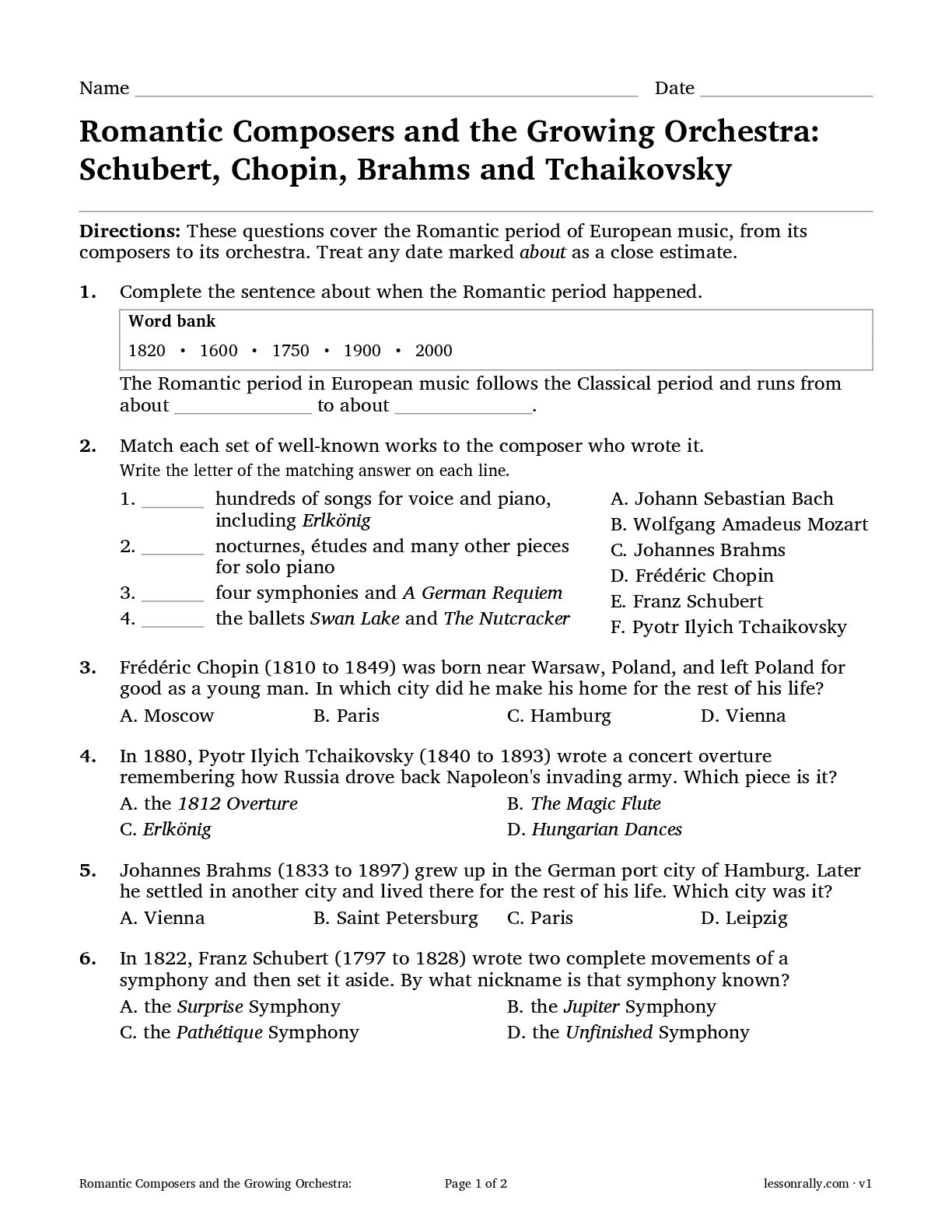
These questions cover the Romantic period of European music, from its composers to its orchestra. Treat any date marked about as a close estimate.
Complete the sentence about when the Romantic period happened.
Fill in each blank.
The Romantic period in European music follows the Classical period and runs from about blank 1 to about blank 2.
Word bank
Match each set of well-known works to the composer who wrote it.
Match each item to an option.
Items
Options
Frédéric Chopin (1810 to 1849) was born near Warsaw, Poland, and left Poland for good as a young man. In which city did he make his home for the rest of his life?
Choose one answer.
In 1880, Pyotr Ilyich Tchaikovsky (1840 to 1893) wrote a concert overture remembering how Russia drove back Napoleon's invading army. Which piece is it?
Choose one answer.
Johannes Brahms (1833 to 1897) grew up in the German port city of Hamburg. Later he settled in another city and lived there for the rest of his life. Which city was it?
Choose one answer.
In 1822, Franz Schubert (1797 to 1828) wrote two complete movements of a symphony and then set it aside. By what nickname is that symphony known?
Choose one answer.
Over the course of the Romantic period, how did the orchestra change?
Choose one answer.
Choose the word that completes the sentence about horns and trumpets.
Fill in each blank.
In the early 1800s, horns and trumpets began to get blank 1, which let players switch to extra lengths of tubing and play many more notes.
Word bank
Many Romantic composers wrote instrumental pieces meant to describe a scene, a poem or a story, without any singing. What is this kind of music called?
Choose one answer.
Chopin wrote many mazurkas and polonaises, pieces built on Polish dances. Other Romantic composers drew on the folk songs, dances and stories of their own countries. What is this trend called?
Choose one answer.
No reviews yet.
Reviews come from teachers who assigned this activity to a class.
Have a topic of your own? Make a printable worksheet and online quiz, free.
Create an activityMade by Miles Penhallow · LessonRally (AI-assisted)
Made by Miles Penhallow · LessonRally (AI-assisted)
Made by Miles Penhallow · LessonRally (AI-assisted)
Made by Miles Penhallow · LessonRally (AI-assisted)