Question 1
A composer adds a dot right after a note. How does the dot change the note's length?
Choose one answer.
- Its length doubles.
- It gains half of its own length.
- It gains one beat, whatever the note is.
- Its length is cut in half.


Teachers who sign in can assign LessonRally activities to their Google Classroom classes: students open them in Classroom and answer online, and their grades go to the teacher's Classroom gradebook. Practice lets you try it first, the way students see it.
Free for teachers. Sign in to assign activities to your Google Classroom classes.
 (opens in a new tab)
2 pages · Student copy, no answers
Print worksheet (opens in a new tab)Answer keyPremiumStudents learn that a dot adds half of a note's own value and that a tie adds a second note's beats onto the first without playing it again. They match dotted and plain notes to their beat values, count dotted notes and tied notes in 3/4 and 4/4 time, find missing beats in dotted rhythms, and type parts of a beat as decimals.
Learning goal: Find how many beats dotted notes and tied notes last in 3/4 and 4/4 time.
The estimate is halfway between the two middle scores of four readability formulas. Their scores run from 3.2 to 6.2.
Adapted from common readability formulas (Flesch-Kincaid, Gunning Fog, Coleman-Liau and ARI, plus SMOG for long texts), which look at sentence length and word length. Answer choices count toward word length only. Grades below the estimate will likely find the text harder, grades above it easier. It does not measure ideas, background knowledge or images.
Topic: Music Chosen by LessonRally
Question types: multiple choice, matching, number answer, fill in the blank.
The questions as students see them, without the answers.
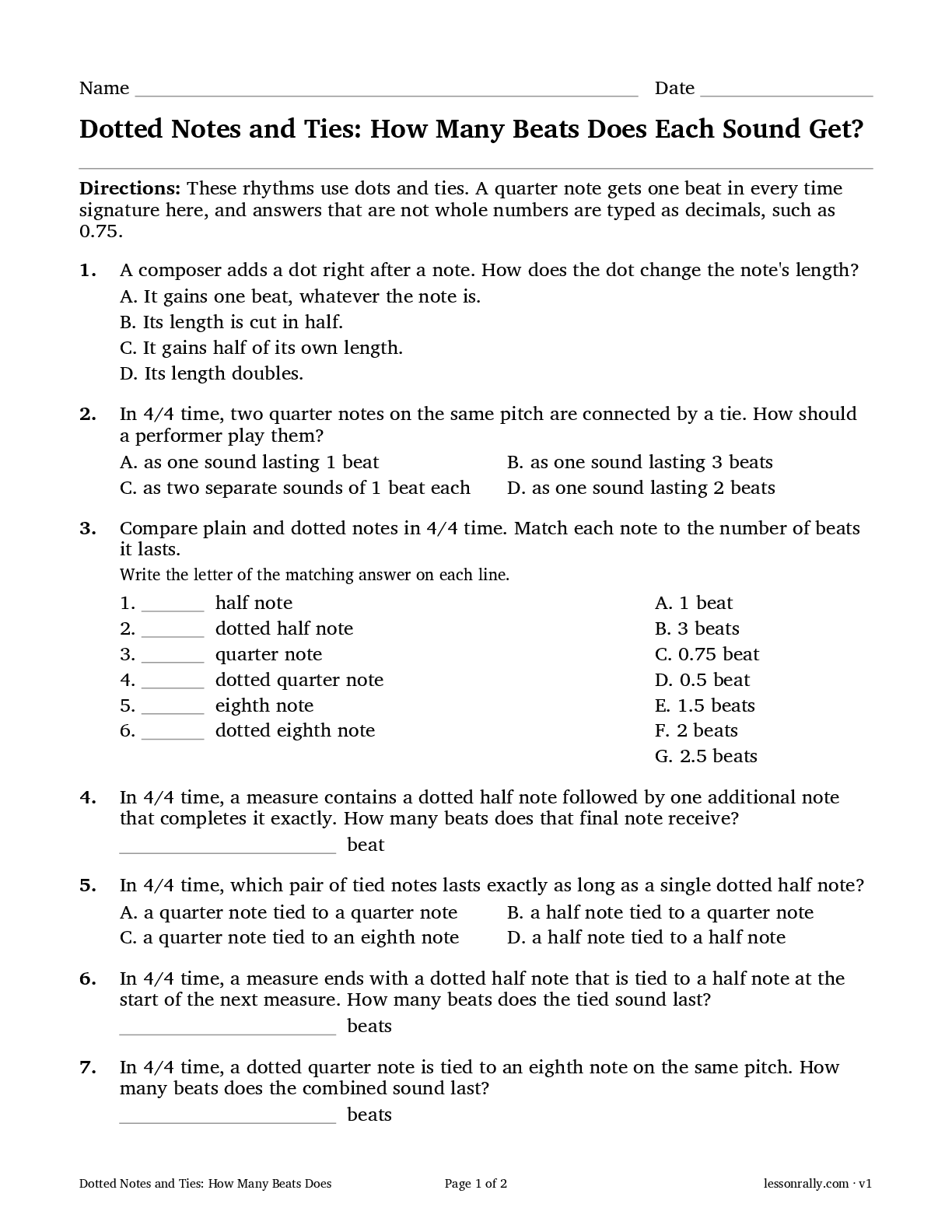
These rhythms use dots and ties. A quarter note gets one beat in every time signature here, and answers that are not whole numbers are typed as decimals, such as 0.75.
A composer adds a dot right after a note. How does the dot change the note's length?
Choose one answer.
In 4/4 time, two quarter notes on the same pitch are connected by a tie. How should a performer play them?
Choose one answer.
Compare plain and dotted notes in 4/4 time. Match each note to the number of beats it lasts.
Match each item to an option.
Items
Options
In 4/4 time, a measure contains a dotted half note followed by one additional note that completes it exactly. How many beats does that final note receive?
Enter a number.
beat
In 4/4 time, which pair of tied notes lasts exactly as long as a single dotted half note?
Choose one answer.
In 4/4 time, a measure ends with a dotted half note that is tied to a half note at the start of the next measure. How many beats does the tied sound last?
Enter a number.
beats
In 4/4 time, a dotted quarter note is tied to an eighth note on the same pitch. How many beats does the combined sound last?
Enter a number.
beats
Choose the note that completes the sentence about 3/4 time.
Fill in each blank.
In 3/4 time, a single blank 1 note can fill an entire measure by itself.
Word bank
In 3/4 time, a composer fills one measure using only dotted quarter notes. How many dotted quarter notes are needed?
Enter a number.
dotted quarter notes
In 4/4 time, Maya's measure so far contains a dotted quarter note and a half note. How many more beats are needed to complete it? Type your answer as a decimal.
Enter a number.
beat
No reviews yet.
Reviews come from teachers who assigned this activity to a class.
Have a topic of your own? Make a printable worksheet and online quiz, free.
Create an activityMade by Miles Penhallow · LessonRally (AI-assisted)
Made by Miles Penhallow · LessonRally (AI-assisted)
Made by Miles Penhallow · LessonRally (AI-assisted)
Made by Miles Penhallow · LessonRally (AI-assisted)