Question 1
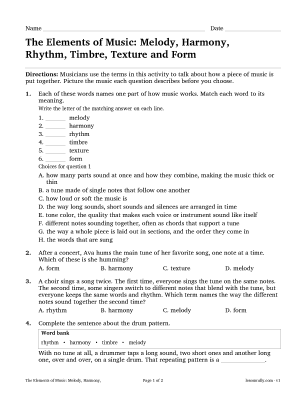
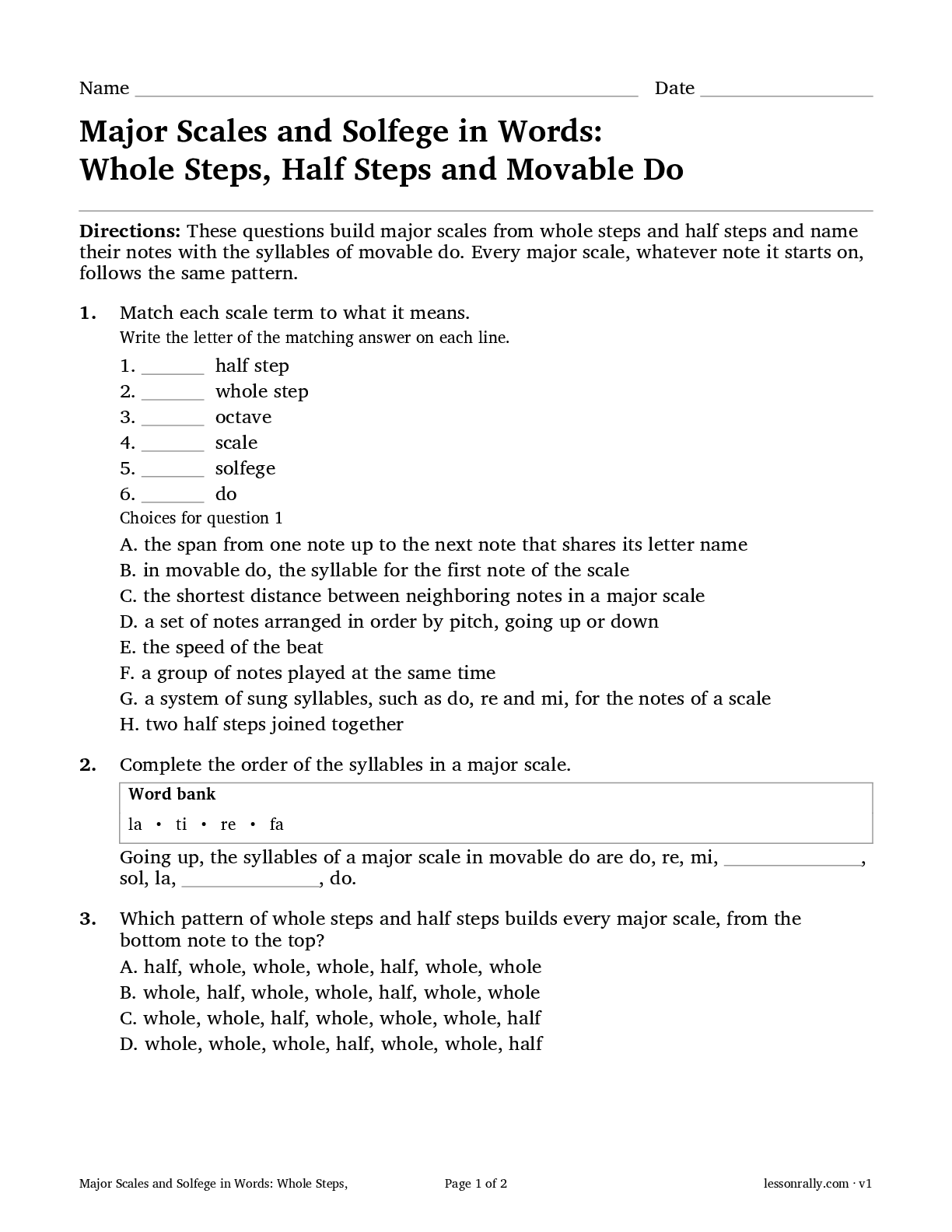
Match each scale term to what it means.
Match each item to an option.
Items
- half step
- whole step
- octave
- scale
- solfege
- do
Options


Teachers who sign in can assign LessonRally activities to their Google Classroom classes: students open them in Classroom and answer online, and their grades go to the teacher's Classroom gradebook. Practice lets you try it first, the way students see it.
Free for teachers. Sign in to assign activities to your Google Classroom classes.
 (opens in a new tab)
2 pages · Student copy, no answers
Print worksheet (opens in a new tab)Answer keyPremiumStudents match scale terms such as half step, whole step, octave and solfege to their meanings, then use the major scale pattern (whole, whole, half, whole, whole, whole, half) to build C, G and F major in words. They name scale notes with the movable-do syllables do, re, mi, fa, sol, la and ti, find where the half steps fall, compare movable do with fixed do, and count the half steps in an octave.
Learning goal: Build major scales from the pattern of whole and half steps, and name scale notes with movable-do solfege syllables.
The estimate is halfway between the two middle scores of four readability formulas. Their scores run from 4.0 to 7.7.
Adapted from common readability formulas (Flesch-Kincaid, Gunning Fog, Coleman-Liau and ARI, plus SMOG for long texts), which look at sentence length and word length. Answer choices count toward word length only. Grades below the estimate will likely find the text harder, grades above it easier. It does not measure ideas, background knowledge or images.
Topic: Music Chosen by LessonRally
Question types: matching, fill in the blank, multiple choice, number answer.
The questions as students see them, without the answers.
These questions build major scales from whole steps and half steps and name their notes with the syllables of movable do. Every major scale, whatever note it starts on, follows the same pattern.
Match each scale term to what it means.
Match each item to an option.
Items
Options
Complete the order of the syllables in a major scale.
Fill in each blank.
Going up, the syllables of a major scale in movable do are do, re, mi, blank 1, sol, la, blank 2, do.
Word bank
Which pattern of whole steps and half steps builds every major scale, from the bottom note to the top?
Choose one answer.
Complete the C major scale.
Fill in each blank.
Following the major scale pattern from C, the notes are C, D, E, blank 1, G, A, blank 2, C.
Word bank
In a major scale sung in movable do, which two pairs of neighboring syllables are only a half step apart?
Choose one answer.
Which statement about movable do and fixed do is true?
Choose one answer.
Build a major scale on G using the pattern. Which note must be raised with a sharp?
Choose one answer.
Build a major scale on F using the pattern. Which note must be lowered with a flat?
Choose one answer.
Using movable do, Ana sings do, re, mi starting on G, and Ben sings do, re, mi starting on C. What is true about their two tunes?
Choose one answer.
If each whole step counts as two half steps, how many half steps does one octave of a major scale cover in all?
Enter a number.
half steps
No reviews yet.
Reviews come from teachers who assigned this activity to a class.
Have a topic of your own? Make a printable worksheet and online quiz, free.
Create an activityMade by Miles Penhallow · LessonRally (AI-assisted)
Made by Miles Penhallow · LessonRally (AI-assisted)
Made by Miles Penhallow · LessonRally (AI-assisted)
Made by Miles Penhallow · LessonRally (AI-assisted)