Question 1
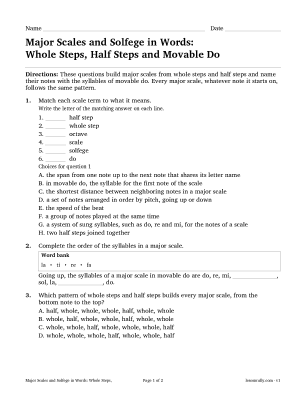
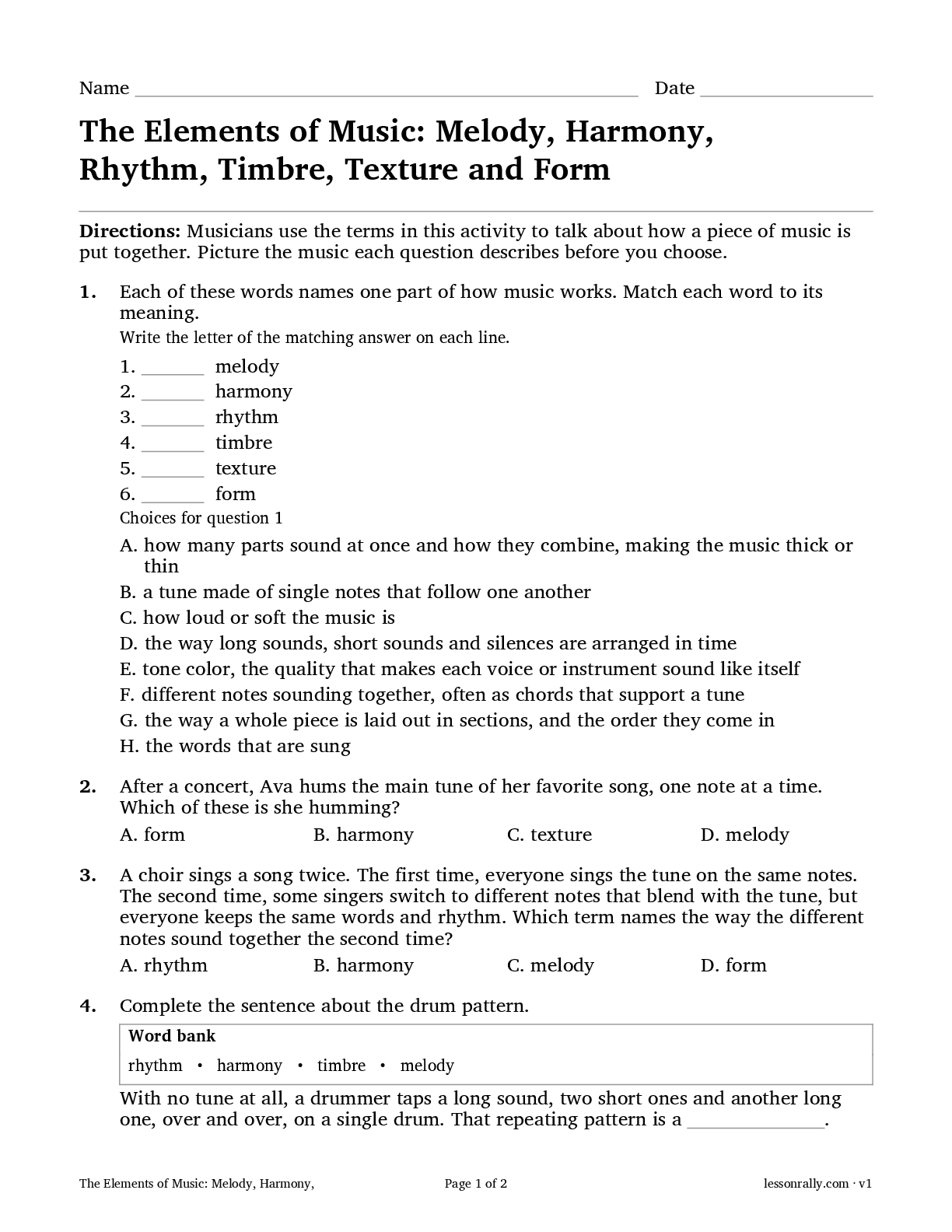
Each of these words names one part of how music works. Match each word to its meaning.
Match each item to an option.
Items
- melody
- harmony
- rhythm
- timbre
- texture
- form
Options


Teachers who sign in can assign LessonRally activities to their Google Classroom classes: students open them in Classroom and answer online, and their grades go to the teacher's Classroom gradebook. Practice lets you try it first, the way students see it.
Free for teachers. Sign in to assign activities to your Google Classroom classes.
 (opens in a new tab)
2 pages · Student copy, no answers
Print worksheet (opens in a new tab)Answer keyPremiumStudents match melody, harmony, rhythm, timbre, texture and form to meanings written in plain words, then use each term to describe music explained in words. They tell rhythm apart from tempo and melody apart from harmony, and pick out the terms that describe sounds happening at the same time.
Learning goal: Match melody, harmony, rhythm, timbre, texture and form to their meanings, and use each term to describe music explained in words.
The estimate is halfway between the two middle scores of four readability formulas. Their scores run from 5.0 to 8.3.
Adapted from common readability formulas (Flesch-Kincaid, Gunning Fog, Coleman-Liau and ARI, plus SMOG for long texts), which look at sentence length and word length. Answer choices count toward word length only. Grades below the estimate will likely find the text harder, grades above it easier. It does not measure ideas, background knowledge or images.
Topic: Music Chosen by LessonRally
Question types: matching, multiple choice, fill in the blank.
The questions as students see them, without the answers.
Musicians use the terms in this activity to talk about how a piece of music is put together. Picture the music each question describes before you choose.
Each of these words names one part of how music works. Match each word to its meaning.
Match each item to an option.
Items
Options
After a concert, Ava hums the main tune of her favorite song, one note at a time. Which of these is she humming?
Choose one answer.
A choir sings a song twice. The first time, everyone sings the tune on the same notes. The second time, some singers switch to different notes that blend with the tune, but everyone keeps the same words and rhythm. Which term names the way the different notes sound together the second time?
Choose one answer.
Complete the sentence about the drum pattern.
Fill in each blank.
With no tune at all, a drummer taps a long sound, two short ones and another long one, over and over, on a single drum. That repeating pattern is a blank 1.
Word bank
A flute and then a trumpet play the same note, just as loud and for just as long. Even so, the two sound different. Which term explains the difference?
Choose one answer.
Choose the word that describes how the song changes.
Fill in each blank.
A song begins with one voice alone. A guitar joins in, and then drums and a second singer, so by the end the blank 1 is much thicker.
Word bank
A pop song is laid out as verse, chorus, verse, chorus, bridge, chorus. Which term do those section names describe?
Choose one answer.
Two drummers play the exact same pattern of long and short sounds. The first plays it slowly, and the second plays it much faster. Which statement is true?
Choose one answer.
In a school band, the trumpets play the tune while the trombones play lower notes that fit with it. Which choice names each section's job?
Choose one answer.
Which two terms are both about sounds that happen at the same time?
Choose one answer.
No reviews yet.
Reviews come from teachers who assigned this activity to a class.
Have a topic of your own? Make a printable worksheet and online quiz, free.
Create an activityMade by Miles Penhallow · LessonRally (AI-assisted)
Made by Miles Penhallow · LessonRally (AI-assisted)
Made by Miles Penhallow · LessonRally (AI-assisted)
Made by Miles Penhallow · LessonRally (AI-assisted)