Made by Miles Penhallow · LessonRally (AI-assisted)
Digital classroom activity
What is a digital classroom activity?
Teachers who sign in can assign LessonRally activities to their Google Classroom classes: students open them in Classroom and answer online, and their grades go to the teacher's Classroom gradebook. Practice lets you try it first, the way students see it.
Students learn how capital letters describe musical form, match binary (AB), ternary (ABA), rondo and theme and variations to their letter patterns, and name the form of pieces described in words. They also count sections and measures and compare repetition and contrast.
Learning goal: Identify binary, ternary, rondo, and theme and variations forms from their letter patterns and from descriptions of pieces.
Estimated reading level4.6
Grade 2Hard
Grade 3Stretch
Grade 4On level
Grade 5Easier
Grade 6Easy
About this estimate
The estimate is halfway between the two middle scores of four readability formulas. Their scores run from 3.0 to 7.6.
Flesch-Kincaid Grade Middle scoreSentence length and syllables per word4.9
Gunning FogSentence length and words of three or more syllables7.6
Coleman-Liau Middle scoreLetters per word and sentences per 100 words4.3
Automated Readability IndexCharacters per word and words per sentence3.0
Grade 181216
Flesch Reading Ease
82.7 on a 0 to 100 scale where higher is easier: easy. Not part of the estimate.
Text measured
430 words, 22 sentences
Adapted from common readability formulas (Flesch-Kincaid, Gunning Fog, Coleman-Liau and ARI, plus SMOG for long texts), which look at sentence length and word length. Answer choices count toward word length only. Grades below the estimate will likely find the text harder, grades above it easier. It does not measure ideas, background knowledge or images.
Question types: multiple choice, matching, number answer, fill in the blank.
Student preview
The questions as students see them, without the answers.
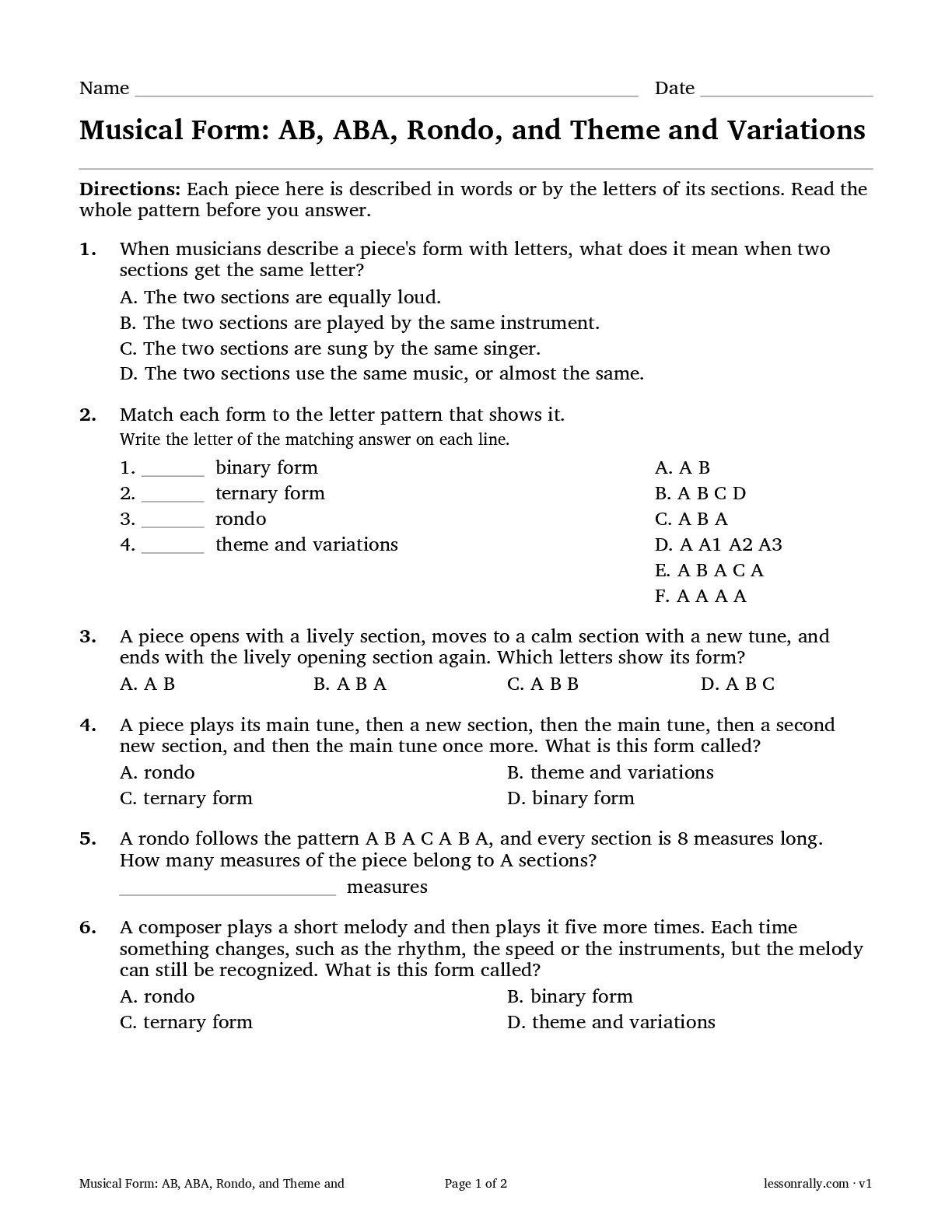
Each piece here is described in words or by the letters of its sections. Read the whole pattern before you answer.
Question 1
When musicians describe a piece's form with letters, what does it mean when two sections get the same letter?
Choose one answer.
The two sections are equally loud.
The two sections use the same music, or almost the same.
The two sections are sung by the same singer.
The two sections are played by the same instrument.
Question 2
Match each form to the letter pattern that shows it.
Match each item to an option.
Items
binary form
ternary form
rondo
theme and variations
Options
A B C D
A B A
A A1 A2 A3
A A A A
A B
A B A C A
Question 3
A piece opens with a lively section, moves to a calm section with a new tune, and ends with the lively opening section again. Which letters show its form?
Choose one answer.
A B
A B B
A B A
A B C
Question 4
A piece plays its main tune, then a new section, then the main tune, then a second new section, and then the main tune once more. What is this form called?
Choose one answer.
ternary form
binary form
theme and variations
rondo
Question 5
A rondo follows the pattern A B A C A B A, and every section is 8 measures long. How many measures of the piece belong to A sections?
Enter a number.
measures
Question 6
A composer plays a short melody and then plays it five more times. Each time something changes, such as the rhythm, the speed or the instruments, but the melody can still be recognized. What is this form called?
Choose one answer.
binary form
rondo
theme and variations
ternary form
Question 7
Complete the sentences about A B A form.
Fill in each blank.
In A B A form, the B section brings blank 1, because its music is new. When A comes back at the end, it brings blank 2.
Word bank
repetition
tempo
harmony
contrast
Question 8
A short dance has two different sections, and the first section never returns after the second one. What is this form called?
Choose one answer.
theme and variations
rondo
ternary form
binary form
Question 9
A piece in A B A form has an A section 16 measures long and a B section 12 measures long. The A section comes back complete at the end. How many measures long is the whole piece?
Enter a number.
measures
Question 10
How is a rondo different from a piece in A B A form?
Choose one answer.
A rondo has only two sections, A and B.
A rondo never repeats any of its sections.
A rondo comes back to A after more than one new section, as in A B A C A.