Question 1
Match each percent change per year to the factor b that the amount is multiplied by each year.
Match each item to an option.
Items
- Grows by 5% each year
- Decays by 5% each year
- Decays by 20% each year
- Grows by 50% each year
Options


Teachers who sign in can assign LessonRally activities to their Google Classroom classes: students open them in Classroom and answer online, and their grades go to the teacher's Classroom gradebook. Practice lets you try it first, the way students see it.
Free for teachers. Sign in to assign activities to your Google Classroom classes.
 (opens in a new tab)
2 pages · Student copy, no answers
Print worksheet (opens in a new tab)Answer keyPremiumA unit review on exponential growth and decay functions: students turn percent growth or decay into a factor, write y = a(b)ˣ from a situation or a table, evaluate for whole-number inputs, interpret a and b, and compare an exponential model with a linear one.
Learning goal: Write and evaluate exponential growth and decay functions from situations and tables, interpret the starting value and factor, and compare exponential and linear models.
Recognize situations in which a quantity grows or decays by a constant percent rate per unit interval relative to another.
Interpret the parameters in a linear or exponential function in terms of a context.
Construct linear and exponential functions, including arithmetic and geometric sequences, given a graph, a description of a relationship, or two input-output pairs (include reading these from a table).
Matched independently by two AI models from this activity's questions.
© Copyright 2010. National Governors Association Center for Best Practices and Council of Chief State School Officers. All rights reserved.
Topic: Exponential Growth and Decay Chosen by LessonRally
Question types: matching, multiple choice, number answer, select all that apply.
The questions as students see them, without the answers.
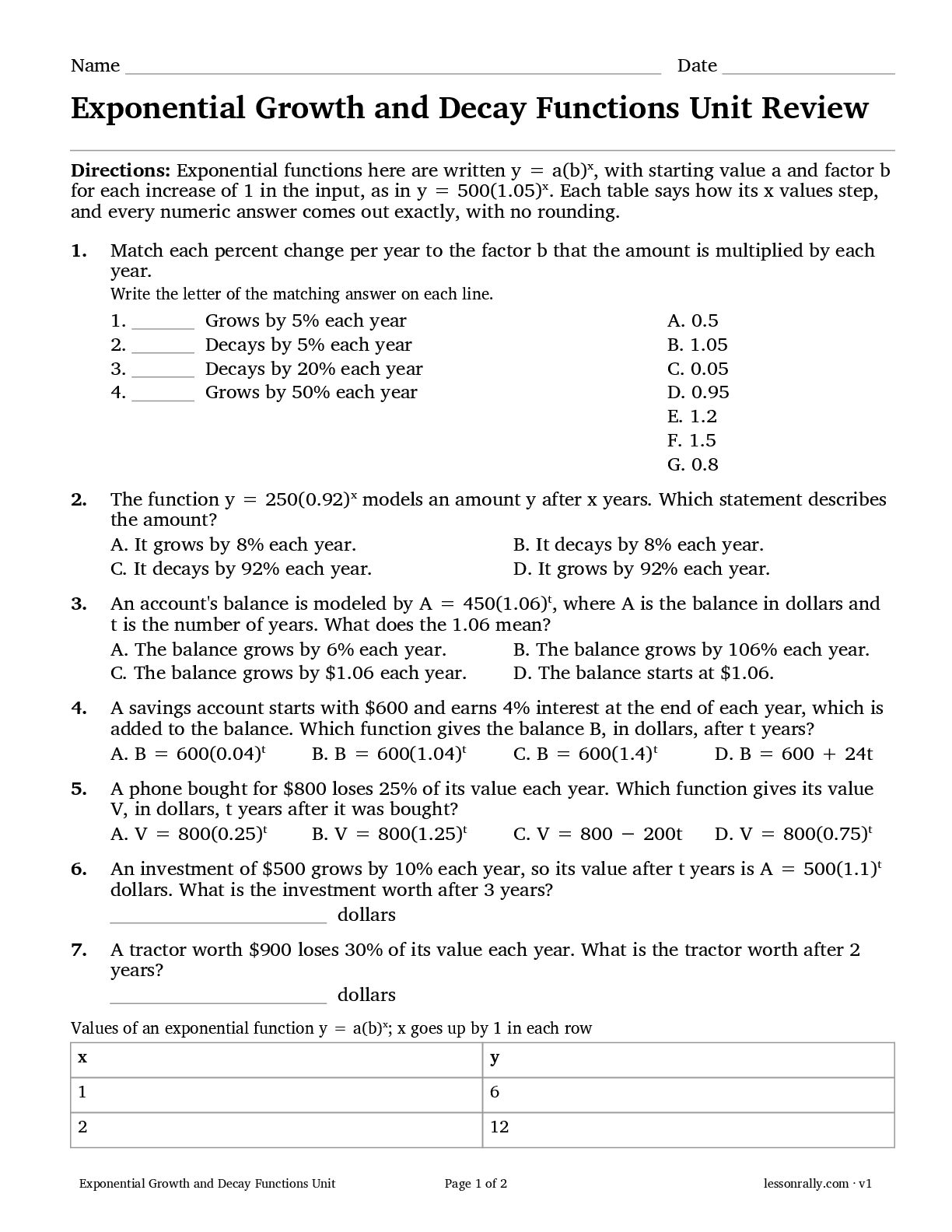
Exponential functions here are written y = a(b)ˣ, with starting value a and factor b for each increase of 1 in the input, as in y = 500(1.05)ˣ. Each table says how its x values step, and every numeric answer comes out exactly, with no rounding.
Match each percent change per year to the factor b that the amount is multiplied by each year.
Match each item to an option.
Items
Options
The function y = 250(0.92)ˣ models an amount y after x years. Which statement describes the amount?
Choose one answer.
An account's balance is modeled by A = 450(1.06)ᵗ, where A is the balance in dollars and t is the number of years. What does the 1.06 mean?
Choose one answer.
A savings account starts with $600 and earns 4% interest at the end of each year, which is added to the balance. Which function gives the balance B, in dollars, after t years?
Choose one answer.
A phone bought for $800 loses 25% of its value each year. Which function gives its value V, in dollars, t years after it was bought?
Choose one answer.
An investment of $500 grows by 10% each year, so its value after t years is A = 500(1.1)ᵗ dollars. What is the investment worth after 3 years?
Enter a number.
dollars
A tractor worth $900 loses 30% of its value each year. What is the tractor worth after 2 years?
Enter a number.
dollars
| x | y |
|---|---|
| 1 | 6 |
| 2 | 12 |
| 3 | 24 |
| 4 | 48 |
The table shows values of an exponential function y = a(b)ˣ, and x goes up by 1 in each row. Which function fits the table?
Choose one answer.
Use the table for these questions.
| x | y |
|---|---|
| 0 | 500 |
| 1 | 400 |
| 2 | 320 |
| 3 | 256 |
This table comes from an exponential function y = a(b)ˣ, with x going up by 1 in each row. What is the function?
Choose one answer.
The table comes from an exponential function y = a(b)ˣ, with x going up by 1 in each row, and the same function continues past the table. What is y when x = 4?
Enter a number.
A 96-gram sample of a substance loses half of its mass each day. How many grams are left after 5 days?
Enter a number.
grams
Which situation can be modeled by an exponential function?
Choose one answer.
Two savings plans both start with $200. Plan A adds $50 at the end of each year, so it holds 200 + 50t dollars after t years. Plan B grows by 20% at the end of each year, so it holds 200(1.2)ᵗ dollars after t years. At the end of which year is Plan B first worth more than Plan A?
Enter a number.
Which of these functions show exponential decay? Select the three correct functions.
Choose 3 answers.
No reviews yet.
Reviews come from teachers who assigned this activity to a class.
Have a topic of your own? Make a printable worksheet and online quiz, free.
Create an activityCommon Core HSA-CED.A.1
Made by Grace Wexley · LessonRally (AI-assisted)
Common Core HSF-LE.A.1a
Made by Grace Wexley · LessonRally (AI-assisted)
Made by Grace Wexley · LessonRally (AI-assisted)
Common Core HSA-REI.B.4b
Made by Grace Wexley · LessonRally (AI-assisted)