Teachers who sign in can assign LessonRally activities to their Google Classroom classes: students open them in Classroom and answer online, and their grades go to the teacher's Classroom gradebook. Practice lets you try it first, the way students see it.
Students justify each step of solving equations with the addition, subtraction, multiplication and division properties of equality, the distributive property, or combining like terms. They match steps to properties, explain why a step is allowed, find a wrong reason, and solve.
Learning goal: Justify each step in solving a linear equation with a property of equality, the distributive property or combining like terms.
Common Core
Press Ctrl+C or Command+C to copy.
Closest cluster:HSA-REI.AUnderstand solving equations as a process of reasoning and explain the reasoning.Reasoning with Equations and InequalitiesShow 2 matched standardsHide matched standards
Explain each step in solving a simple equation as following from the equality of numbers asserted at the previous step, starting from the assumption that the original equation has a solution. Construct a viable argument to justify a solution method.
Question types: matching, multiple choice, select all that apply, number answer.
Student preview
The questions as students see them, without the answers.
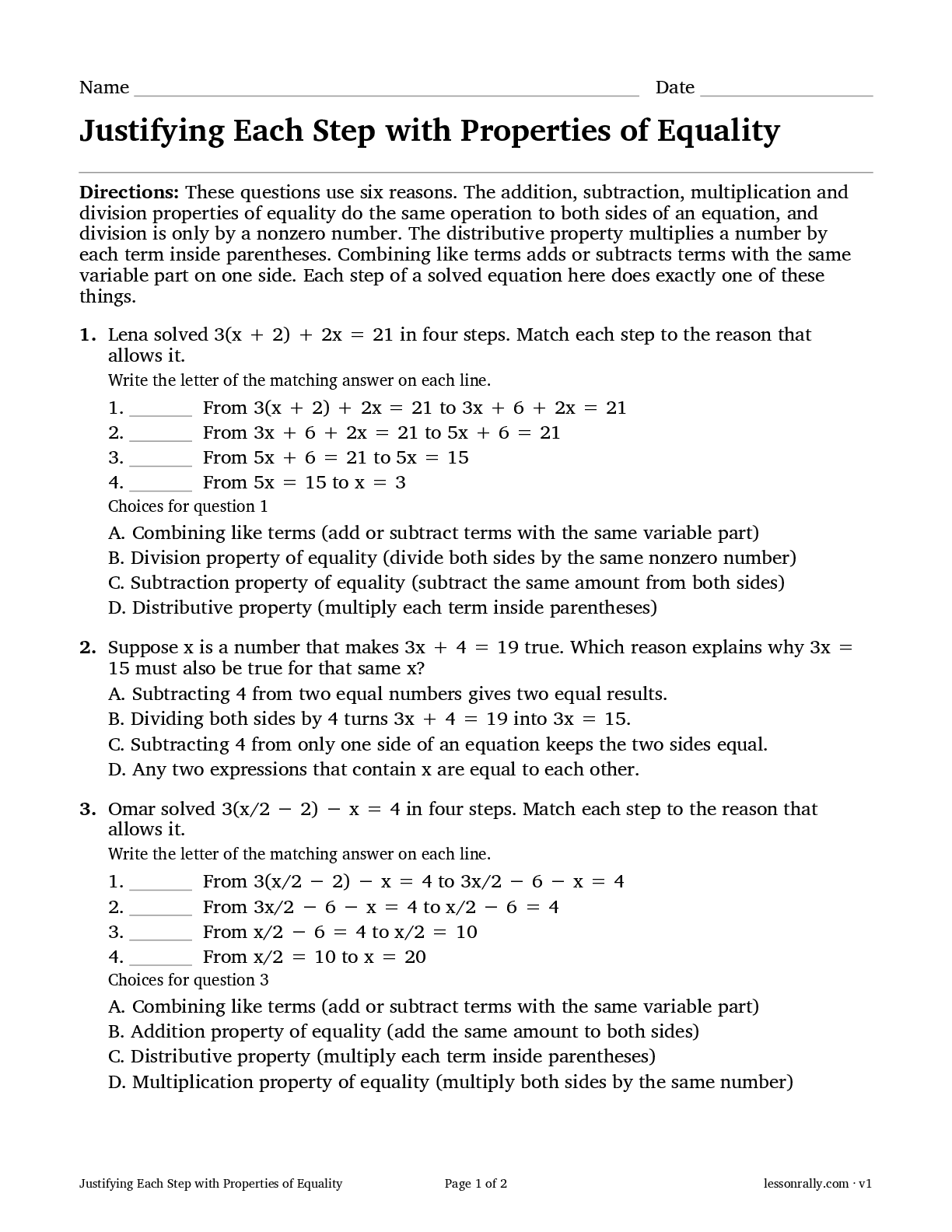
These questions use six reasons. The addition, subtraction, multiplication and division properties of equality do the same operation to both sides of an equation, and division is only by a nonzero number. The distributive property multiplies a number by each term inside parentheses. Combining like terms adds or subtracts terms with the same variable part on one side. Each step of a solved equation here does exactly one of these things.
Question 1
Lena solved 3(x + 2) + 2x = 21 in four steps. Match each step to the reason that allows it.
Match each item to an option.
Items
From 3(x + 2) + 2x = 21 to 3x + 6 + 2x = 21
From 3x + 6 + 2x = 21 to 5x + 6 = 21
From 5x + 6 = 21 to 5x = 15
From 5x = 15 to x = 3
Options
Distributive property (multiply each term inside parentheses)
Subtraction property of equality (subtract the same amount from both sides)
Combining like terms (add or subtract terms with the same variable part)
Division property of equality (divide both sides by the same nonzero number)
Question 2
Suppose x is a number that makes 3x + 4 = 19 true. Which reason explains why 3x = 15 must also be true for that same x?
Choose one answer.
Subtracting 4 from only one side of an equation keeps the two sides equal.
Subtracting 4 from two equal numbers gives two equal results.
Dividing both sides by 4 turns 3x + 4 = 19 into 3x = 15.
Any two expressions that contain x are equal to each other.
Question 3
Omar solved 3(x/2 − 2) − x = 4 in four steps. Match each step to the reason that allows it.
Match each item to an option.
Items
From 3(x/2 − 2) − x = 4 to 3x/2 − 6 − x = 4
From 3x/2 − 6 − x = 4 to x/2 − 6 = 4
From x/2 − 6 = 4 to x/2 = 10
From x/2 = 10 to x = 20
Options
Distributive property (multiply each term inside parentheses)
Addition property of equality (add the same amount to both sides)
Combining like terms (add or subtract terms with the same variable part)
Multiplication property of equality (multiply both sides by the same number)
Question 4
To finish solving −4x = 28, Ava divides both sides by −4 and gets x = −7. Why is this step allowed?
Choose one answer.
Only the side with x needs to be divided, so 28 can stay as it is.
Dividing both sides by a negative number turns the equal sign around.
Both sides of an equation can be divided by the same nonzero number, and −4 is not zero.
Both sides of an equation can be divided by any number, even 0.
Question 5
Which step uses the multiplication property of equality?
Choose one answer.
From x + 6 = −2 to x = −8
From x/6 = −2 to x = −12
From 6x + x = 14 to 7x = 14
From 6(x − 2) = 18 to 6x − 12 = 18
Question 6
Mason solved 4x − 7 = 2x + 9 and wrote a reason next to each step.
2x − 7 = 9 (subtraction property of equality)
2x = 16 (distributive property)
x = 8 (division property of equality)
Which reason is wrong?
Choose one answer.
Subtraction property of equality, for going from 4x − 7 = 2x + 9 to 2x − 7 = 9
Division property of equality, for going from 2x = 16 to x = 8
Distributive property, for going from 2x − 7 = 9 to 2x = 16
Question 7
Which of these are correct first steps for solving 2(x + 1) = 14? Select the two correct steps.