Situational and Dramatic Irony: The Surprise Party

10 questions · 10 points · Grades 9–10 · English · Preview the 10 questions

Made by Eleanor Wrenfield · LessonRally (AI-assisted)

Digital classroom activity

What is a digital classroom activity?

Teachers who sign in can assign LessonRally activities to their Google Classroom classes: students open them in Classroom and answer online, and their grades go to the teacher's Classroom gradebook. Practice lets you try it first, the way students see it.

Free for teachers. Sign in to assign activities to your Google Classroom classes.

Printable worksheet

Students read an original short story about a secret birthday party and analyze both dramatic irony and situational irony. Questions cover what readers know that the characters do not, an outcome that reverses expectations, and how the order of events creates tension and surprise. Practice with irony, ironic outcomes and story structure.

Learning goal: Analyze how an author's choices about the order of events create dramatic and situational irony, tension and surprise.

Estimated reading level 8.2

  1. Grade 6Hard
  2. Grade 7Stretch
  3. Grade 8On level
  4. Grade 9Easier
  5. Grade 10Easy
About this estimate

The estimate is the middle score of five readability formulas. Their scores run from 6.3 to 8.8.

  • Flesch-Kincaid GradeSentence length and syllables per word6.3
  • Gunning Fog Middle scoreSentence length and words of three or more syllables8.2
  • Coleman-LiauLetters per word and sentences per 100 words8.8
  • Automated Readability IndexCharacters per word and words per sentence6.8
  • SMOGWords of three or more syllables, for texts of 30 sentences or more8.5
Flesch Reading Ease
73.9 on a 0 to 100 scale where higher is easier: fairly easy. Not part of the estimate.
Text measured
1,269 words, 59 sentences

Adapted from common readability formulas (Flesch-Kincaid, Gunning Fog, Coleman-Liau and ARI, plus SMOG for long texts), which look at sentence length and word length. Answer choices count toward word length only. Grades below the estimate will likely find the text harder, grades above it easier. It does not measure ideas, background knowledge or images.

Common Core

Closest anchor: CCRA.R.5 Analyze the structure of texts, including how specific sentences, paragraphs, and larger portions of the text (e.g., a section, chapter, scene, or stanza) relate to each other and the whole.Anchor Standards for ReadingShow 1 matched standardHide matched standard

Matched standard

  • RL.9-10.5

    Analyze how an author's choices concerning how to structure a text, order events within it (e.g., parallel plots), and manipulate time (e.g., pacing, flashbacks) create such effects as mystery, tension, or surprise.

    Student preview questions 4, 8, 10

Matched independently by two AI models from this activity's questions.

© Copyright 2010. National Governors Association Center for Best Practices and Council of Chief State School Officers. All rights reserved.

Topic: Irony Chosen by LessonRally

Question types: multiple choice.

Student preview

The questions as students see them, without the answers.

Read the story carefully, paying attention to what you know that the characters do not. Then answer each question, checking every choice against the words of the story.

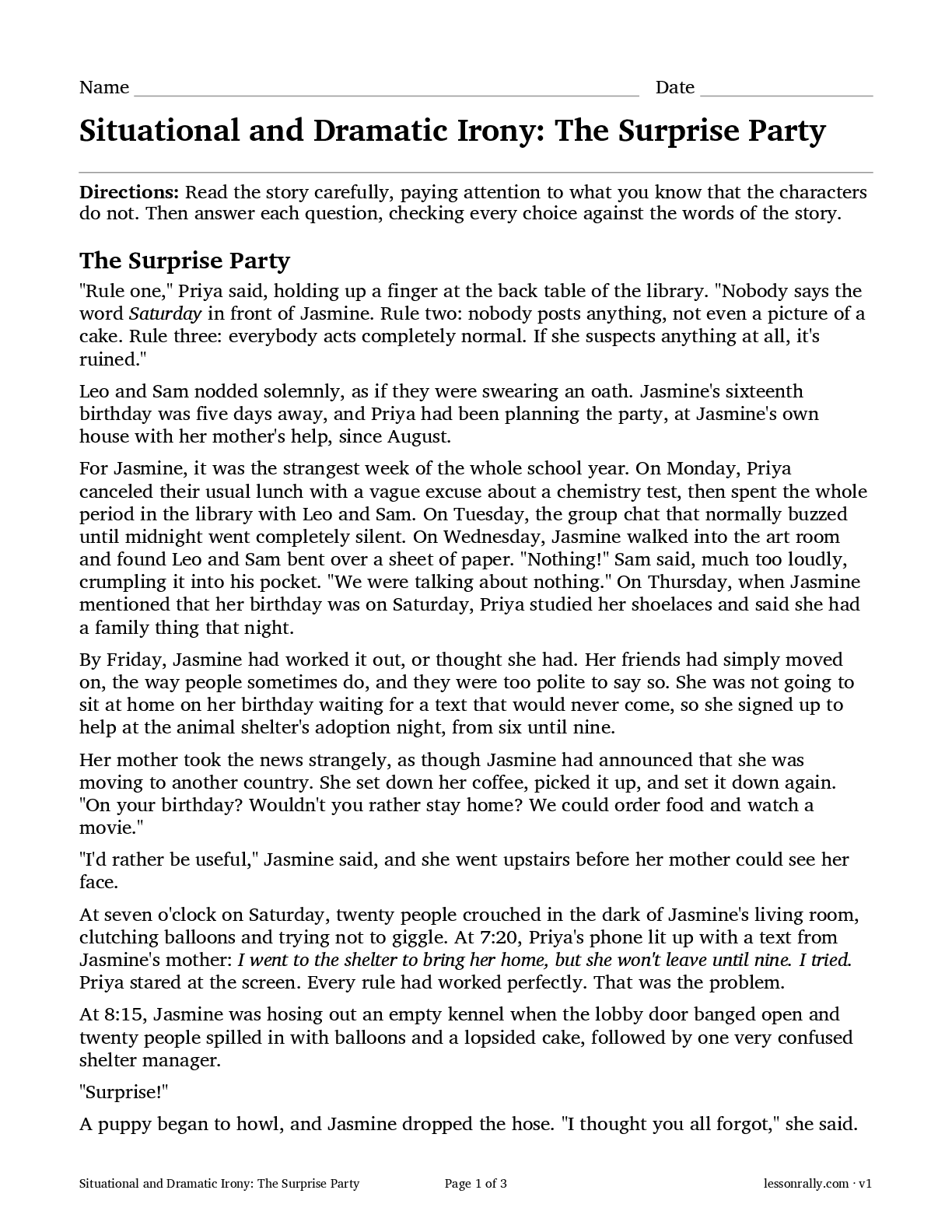
The Surprise Party

"Rule one," Priya said, holding up a finger at the back table of the library. "Nobody says the word Saturday in front of Jasmine. Rule two: nobody posts anything, not even a picture of a cake. Rule three: everybody acts completely normal. If she suspects anything at all, it's ruined."

Leo and Sam nodded solemnly, as if they were swearing an oath. Jasmine's sixteenth birthday was five days away, and Priya had been planning the party, at Jasmine's own house with her mother's help, since August.

For Jasmine, it was the strangest week of the whole school year. On Monday, Priya canceled their usual lunch with a vague excuse about a chemistry test, then spent the whole period in the library with Leo and Sam. On Tuesday, the group chat that normally buzzed until midnight went completely silent. On Wednesday, Jasmine walked into the art room and found Leo and Sam bent over a sheet of paper. "Nothing!" Sam said, much too loudly, crumpling it into his pocket. "We were talking about nothing." On Thursday, when Jasmine mentioned that her birthday was on Saturday, Priya studied her shoelaces and said she had a family thing that night.

By Friday, Jasmine had worked it out, or thought she had. Her friends had simply moved on, the way people sometimes do, and they were too polite to say so. She was not going to sit at home on her birthday waiting for a text that would never come, so she signed up to help at the animal shelter's adoption night, from six until nine.

Her mother took the news strangely, as though Jasmine had announced that she was moving to another country. She set down her coffee, picked it up, and set it down again. "On your birthday? Wouldn't you rather stay home? We could order food and watch a movie."

"I'd rather be useful," Jasmine said, and she went upstairs before her mother could see her face.

At seven o'clock on Saturday, twenty people crouched in the dark of Jasmine's living room, clutching balloons and trying not to giggle. At 7:20, Priya's phone lit up with a text from Jasmine's mother: I went to the shelter to bring her home, but she won't leave until nine. I tried. Priya stared at the screen. Every rule had worked perfectly. That was the problem.

At 8:15, Jasmine was hosing out an empty kennel when the lobby door banged open and twenty people spilled in with balloons and a lopsided cake, followed by one very confused shelter manager.

"Surprise!"

A puppy began to howl, and Jasmine dropped the hose. "I thought you all forgot," she said.

Priya, who had planned everything except this, hugged her, wet sleeves and all. "We were too busy remembering."


Question 1

"The Surprise Party" opens with Priya's rules for keeping the party secret, ending with "If she suspects anything at all, it's ruined." Only then does the story follow Jasmine through her week. What is the effect of letting readers in on the plan first?

Choose one answer.

  • Readers understand the friends' strange behavior while Jasmine does not, which creates dramatic irony and tension.
  • It spoils the story, since readers already know exactly how the evening will end.
  • It makes Priya seem careless about keeping the secret.
  • It shows that Jasmine already knows about the party.

Question 2

On Wednesday, Sam crumples a sheet of paper, shouts "Nothing!" much too loudly and insists that they were talking about nothing. What do readers understand at this moment that Jasmine does not?

Choose one answer.

  • Sam is planning a party for someone else.
  • Sam has started a new friendship that does not include Jasmine.
  • Sam is embarrassed about a bad grade in art class.
  • Sam is hiding something about her party, not shutting her out.

Question 3

The narrator says that by Friday Jasmine "had worked it out, or thought she had." What do the final words "or thought she had" add to this moment in the story?

Choose one answer.

  • They warn readers that her conclusion is mistaken, deepening the dramatic irony.
  • They prove that her friends really have moved on.
  • They show that Jasmine has figured out the surprise.
  • They suggest that Jasmine is joking about her friends.

Question 4

The story follows Jasmine's week day by day, from Monday through Thursday, adding one strange moment each day. What is the effect of organizing this part of the story in this way?

Choose one answer.

  • It shows that the party plans keep changing from day to day.
  • It reveals that Jasmine has guessed the surprise by Thursday.
  • It proves that her friends no longer care about her.
  • Each day adds another clue that Jasmine misreads, so her hurt and the readers' tension build together.

Question 5

When Jasmine announces her plans to volunteer at the animal shelter, her mother "set down her coffee, picked it up, and set it down again." Why is this small moment tense for readers?

Choose one answer.

  • Readers know that her mother is helping with the party, so they can see her trying to save it without giving it away.
  • Readers realize that her mother has told Jasmine about the party.
  • Readers learn that her mother is angry about the animal shelter.
  • Readers suspect that her mother has forgotten the birthday too.

Question 6

At seven o'clock on Saturday, "twenty people crouched in the dark of Jasmine's living room," waiting to surprise her. How has the dramatic irony in the story shifted by this point?

Choose one answer.

  • Now Jasmine knows about the party, but the friends do not know that she knows.
  • Now the friends know where Jasmine is, but readers do not.
  • Now the friends are the ones in the dark, since readers know Jasmine has other plans and the people waiting for her do not.
  • Now readers know less than any of the characters.

Question 7

After the text from Jasmine's mother arrives, the narrator observes that every rule "had worked perfectly" and calls that success "the problem." What makes this an example of situational irony?

Choose one answer.

  • The rules succeeded so completely that the secret kept Jasmine away from her own party.
  • Jasmine broke the rules on purpose to ruin the surprise.
  • The rules failed, so Jasmine found out about the party early.
  • The friends forgot to follow their own rules.

Question 8

After Priya reads the text, the story jumps straight to 8:15 at the shelter, without showing the friends deciding what to do next. What effect does leaving out that decision create?

Choose one answer.

  • Readers, like Jasmine, do not see the friends coming, so their arrival at the shelter is a surprise.
  • It leaves readers uncertain about whose birthday is being celebrated.
  • It shows that the friends gave up and went home.
  • It reveals that Jasmine's mother canceled the party.

Question 9

When Jasmine says, "I thought you all forgot," Priya answers, "We were too busy remembering." What does Priya mean by this reply?

Choose one answer.

  • The friends forgot her birthday until the last minute.
  • The friends were busy remembering their own plans for the weekend.
  • The friends want Jasmine to remember this party forever.
  • The effort to plan a celebration for Jasmine is exactly what made her feel forgotten.

Question 10

How does the ending give the title "The Surprise Party" an ironic second meaning that readers might not expect at first?

Choose one answer.

  • The title shows that Jasmine knew about the party all along.
  • The title means that only Jasmine's mother is surprised.
  • The planners are the ones caught off guard by Jasmine's absence before they finally surprise her somewhere else.
  • The title is ironic because the party never happens.

Reviews

No reviews yet.

Reviews come from teachers who assigned this activity to a class.

Sign in to write a review

Have a topic of your own? Make a printable worksheet and online quiz, free.

Create an activity

Answer key

Answer keys come with Premium

Print this worksheet with the correct answers marked. The key includes any explanations, sample answers, and rubrics supplied with the activity.

Answer keys aren't public: only teachers with Premium and the people who can edit an activity can download one, so students can't get a ready-to-print key from this page.

Premium includes:

  • No ads for you, and no ads for your students on the assignments you post.
  • Answer keys for printable worksheets, with the correct answers marked and any explanations, sample answers, and rubrics.
  • Create with AI: up to 100 activities a year (5 during the free trial), with every answer checked before you see the draft.

$29 a year, plus sales tax where it applies.

New Premium teachers can try it free for 7 days. A card or other payment method is needed to start. Unless you cancel before the trial ends, you are charged then and the plan renews every year.

Already have Premium or edit this activity? Sign in