Made by Simone Thornbury · LessonRally (AI-assisted)
Digital classroom activity
What is a digital classroom activity?
Teachers who sign in can assign LessonRally activities to their Google Classroom classes: students open them in Classroom and answer online, and their grades go to the teacher's Classroom gradebook. Practice lets you try it first, the way students see it.
Students learn that words with the same denotation can carry positive, negative or neutral connotations. They compare word pairs, find the neutral word in a set, choose words that match a speaker's attitude, and match positive or neutral words to negative partners with similar meanings. Grade 7 connotation and denotation practice.
Learning goal: Distinguish among the positive, negative and neutral connotations of words with similar denotations, and choose words that fit a speaker's attitude.
Estimated reading level6.9
Grade 4Hard
Grade 5Stretch
Grade 6On level
Grade 7Easier
Grade 8Easy
About this estimate
The estimate is halfway between the two middle scores of four readability formulas. Their scores run from 5.0 to 9.1.
Flesch-Kincaid GradeSentence length and syllables per word5.0
Gunning Fog Middle scoreSentence length and words of three or more syllables8.0
Coleman-LiauLetters per word and sentences per 100 words9.1
Automated Readability Index Middle scoreCharacters per word and words per sentence5.8
Grade 181216
Flesch Reading Ease
76.4 on a 0 to 100 scale where higher is easier: fairly easy. Not part of the estimate.
Text measured
466 words, 28 sentences
Adapted from common readability formulas (Flesch-Kincaid, Gunning Fog, Coleman-Liau and ARI, plus SMOG for long texts), which look at sentence length and word length. Answer choices count toward word length only. Grades below the estimate will likely find the text harder, grades above it easier. It does not measure ideas, background knowledge or images.
Common Core
Press Ctrl+C or Command+C to copy.
Closest anchor:CCRA.L.5Demonstrate understanding of figurative language, word relationships, and nuances in word meanings.Anchor Standards for LanguageShow 1 matched standardHide matched standard
Distinguish among the connotations (associations) of words with similar denotations (definitions) (e.g., refined, respectful, polite, diplomatic, condescending).
The questions as students see them, without the answers.
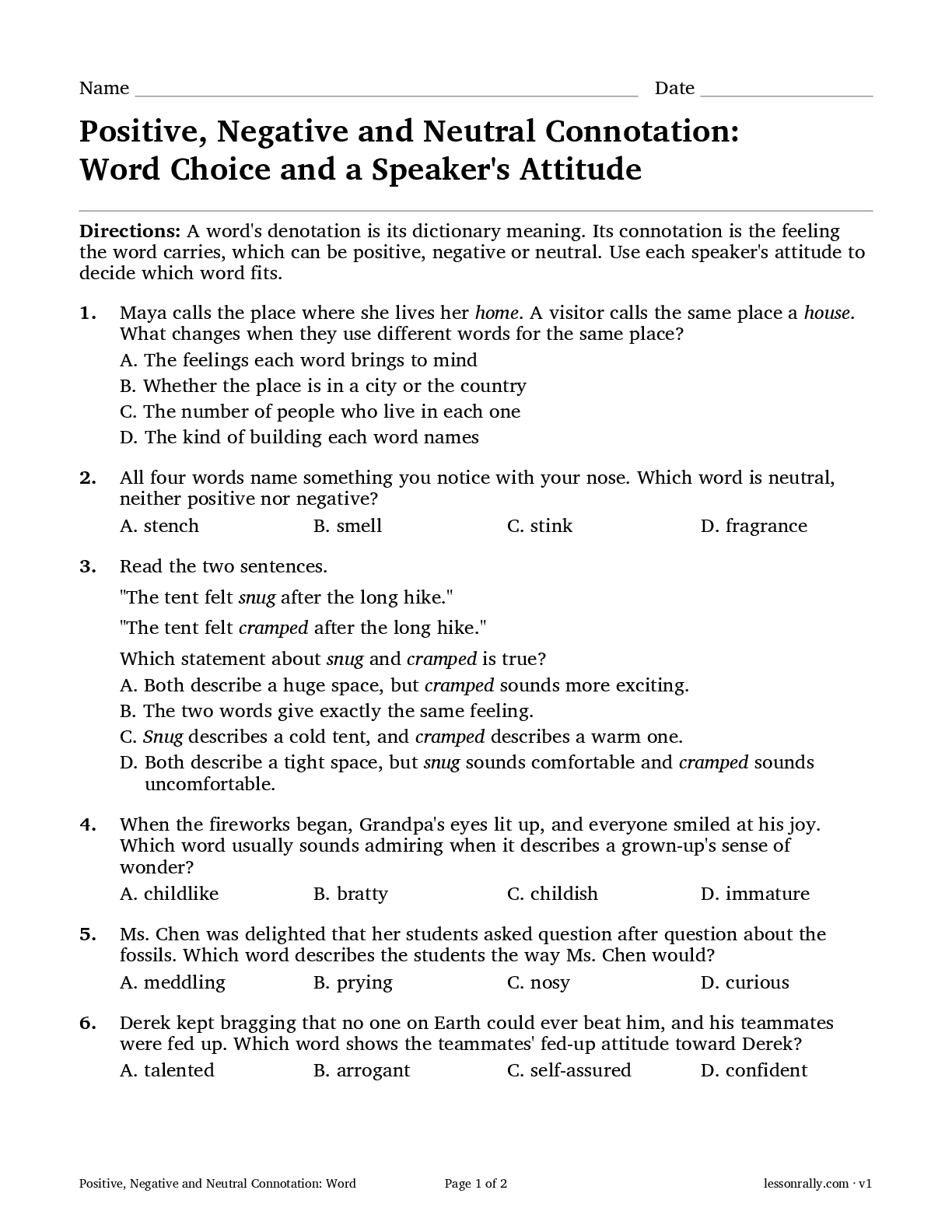
A word's denotation is its dictionary meaning. Its connotation is the feeling the word carries, which can be positive, negative or neutral. Use each speaker's attitude to decide which word fits.
Question 1
Maya calls the place where she lives her home. A visitor calls the same place a house. What changes when they use different words for the same place?
Choose one answer.
Whether the place is in a city or the country
The feelings each word brings to mind
The number of people who live in each one
The kind of building each word names
Question 2
All four words name something you notice with your nose. Which word is neutral, neither positive nor negative?
Choose one answer.
stink
stench
fragrance
smell
Question 3
Read the two sentences.
"The tent felt snug after the long hike."
"The tent felt cramped after the long hike."
Which statement about snug and cramped is true?
Choose one answer.
Both describe a huge space, but cramped sounds more exciting.
Both describe a tight space, but snug sounds comfortable and cramped sounds uncomfortable.
Snug describes a cold tent, and cramped describes a warm one.
The two words give exactly the same feeling.
Question 4
When the fireworks began, Grandpa's eyes lit up, and everyone smiled at his joy. Which word usually sounds admiring when it describes a grown-up's sense of wonder?
Choose one answer.
bratty
childlike
immature
childish
Question 5
Ms. Chen was delighted that her students asked question after question about the fossils. Which word describes the students the way Ms. Chen would?
Choose one answer.
prying
curious
meddling
nosy
Question 6
Derek kept bragging that no one on Earth could ever beat him, and his teammates were fed up. Which word shows the teammates' fed-up attitude toward Derek?
Choose one answer.
self-assured
talented
arrogant
confident
Question 7
Two reporters wrote about the same chef. One called her famous, and the other called her notorious. What does the second reporter's word choice suggest?
Choose one answer.
The second reporter thinks the chef just opened her restaurant.
The second reporter thinks the chef is known for something bad.
The second reporter has never heard of the chef.
The second reporter thinks the chef is the best in town.
Question 8
Which sentence uses a word with a negative connotation to describe a dog?
Choose one answer.
The loyal dog waited by the door every evening.
The playful dog chased its tail in circles.
The mangy dog nosed through the overturned trash.
The large dog dozed on the porch.
Question 9
Kai was angry that someone had borrowed his markers without asking.
"Stop touching those markers!" Kai said.
Which word could replace said to show Kai's anger?
Choose one answer.
snapped
remarked
explained
suggested
Question 10
Match each word in italics to a word with a similar meaning but a negative connotation. Two words in the list will not be used.