Question 1
Which structure gathers sounds and sends them toward a barn owl's ears?
Choose one answer.
- Its sharp claws
- Its large eyes
- Its heart-shaped face
- The soft edges of its wing feathers


Teachers who sign in can assign LessonRally activities to their Google Classroom classes: students open them in Classroom and answer online, and their grades go to the teacher's Classroom gradebook. Practice lets you try it first, the way students see it.
Free for teachers. Sign in to assign activities to your Google Classroom classes.
 (opens in a new tab)
2 pages · Student copy, no answers
Print worksheet (opens in a new tab)Answer keyPremiumStudents read about a barn owl hunting at dusk and explain how body structures, such as its large eyes, dish-like face, and soft-edged wing feathers, help it survive. Questions also trace how the owl takes in information through its senses, sends it to its brain, and responds, and apply the idea of structures to a turtle, a duck, and a rabbit.
Learning goal: Explain how an animal's structures help it survive, and describe how an animal takes in information through its senses and responds to it.
The estimate is halfway between the two middle scores of four readability formulas. Their scores run from 3.3 to 5.9.
Adapted from common readability formulas (Flesch-Kincaid, Gunning Fog, Coleman-Liau and ARI, plus SMOG for long texts), which look at sentence length and word length. Answer choices count toward word length only. Grades below the estimate will likely find the text harder, grades above it easier. It does not measure ideas, background knowledge or images.
Refer to details and examples in a text when explaining what the text says explicitly and when drawing inferences from the text.
Explain events, procedures, ideas, or concepts in a historical, scientific, or technical text, including what happened and why, based on specific information in the text.
Matched independently by two AI models from this activity's questions.
© Copyright 2010. National Governors Association Center for Best Practices and Council of Chief State School Officers. All rights reserved.
Topic: Evolution and Natural Selection Chosen by LessonRally
Question types: multiple choice, fill in the blank.
The questions as students see them, without the answers.
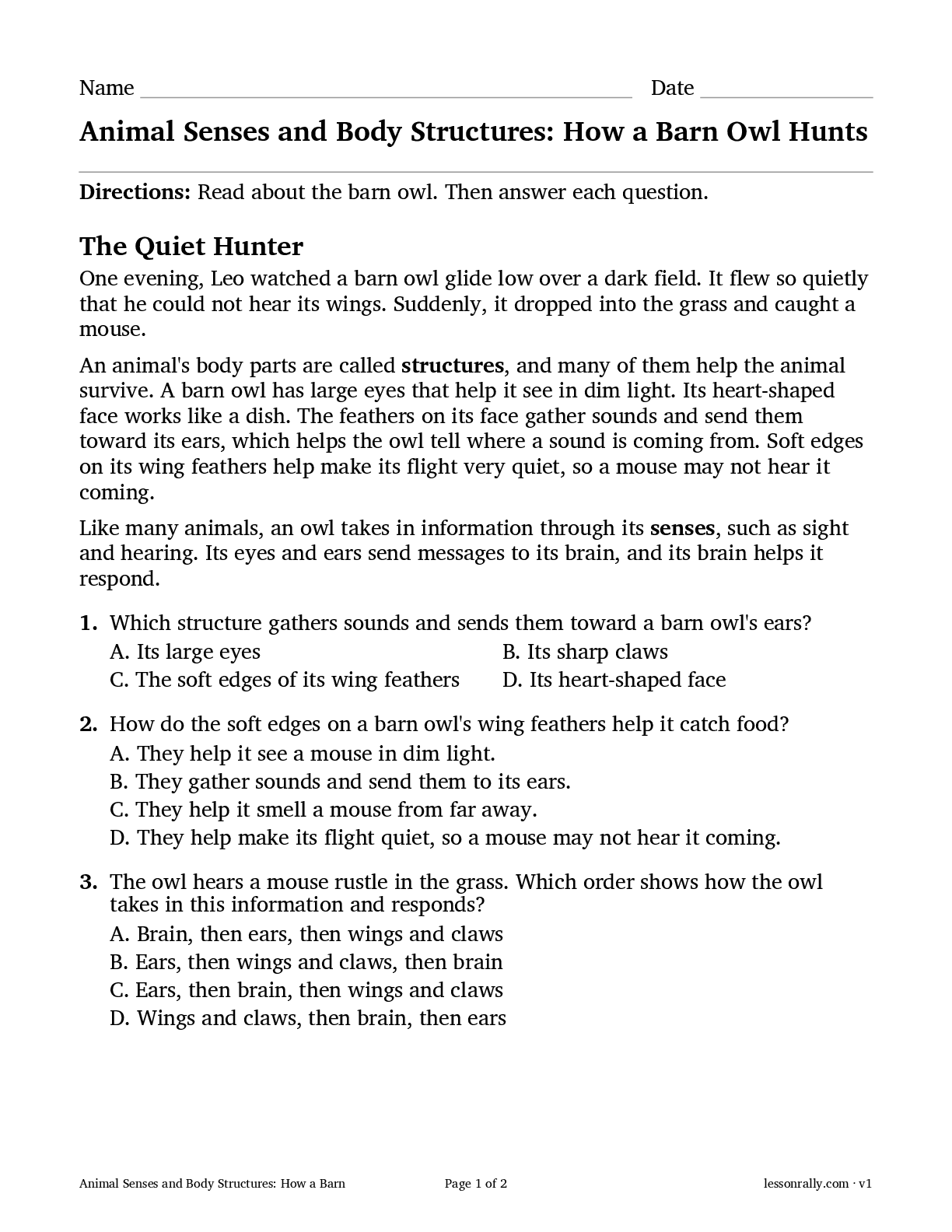
Read about the barn owl. Then answer each question.
One evening, Leo watched a barn owl glide low over a dark field. It flew so quietly that he could not hear its wings. Suddenly, it dropped into the grass and caught a mouse.
An animal's body parts are called structures, and many of them help the animal survive. A barn owl has large eyes that help it see in dim light. Its heart-shaped face works like a dish. The feathers on its face gather sounds and send them toward its ears, which helps the owl tell where a sound is coming from. Soft edges on its wing feathers help make its flight very quiet, so a mouse may not hear it coming.
Like many animals, an owl takes in information through its senses, such as sight and hearing. Its eyes and ears send messages to its brain, and its brain helps it respond.
Which structure gathers sounds and sends them toward a barn owl's ears?
Choose one answer.
How do the soft edges on a barn owl's wing feathers help it catch food?
Choose one answer.
The owl hears a mouse rustle in the grass. Which order shows how the owl takes in this information and responds?
Choose one answer.
Which sentence about the barn owl's large eyes is best supported by the passage?
Choose one answer.
Use the word bank to finish the sentences about other animals' structures.
Fill in each blank.
A box turtle can pull its head and legs inside its hard blank 1, which helps protect it. A duck's webbed blank 2 push against the water and help it swim.
Word bank
A rabbit has long ears that can turn toward a sound. How do these ears most likely help it survive?
Choose one answer.
The passage calls an animal's body parts structures. Which of these is a structure?
Choose one answer.
What would happen if the feathers on a barn owl's face were damaged and could not gather sounds well?
Choose one answer.
No reviews yet.
Reviews come from teachers who assigned this activity to a class.
Have a topic of your own? Make a printable worksheet and online quiz, free.
Create an activityCommon Core RI.4.3
Made by Wes Calloway · LessonRally (AI-assisted)
Common Core RI.4.3
Made by Wes Calloway · LessonRally (AI-assisted)
Common Core RI.4.1
Made by Wes Calloway · LessonRally (AI-assisted)
Common Core RI.4.4
Made by Wes Calloway · LessonRally (AI-assisted)