Adaptations: Beak Shape and Food Type

9 questions · 9 points · Grade 8 · English · Preview the 9 questions

Made by Myra Jefferson · LessonRally (AI-assisted)

Digital classroom activity

What is a digital classroom activity?

Teachers who sign in can assign LessonRally activities to their Google Classroom classes: students open them in Classroom and answer online, and their grades go to the teacher's Classroom gradebook. Practice lets you try it first, the way students see it.

Free for teachers. Sign in to assign activities to your Google Classroom classes.

Printable worksheet

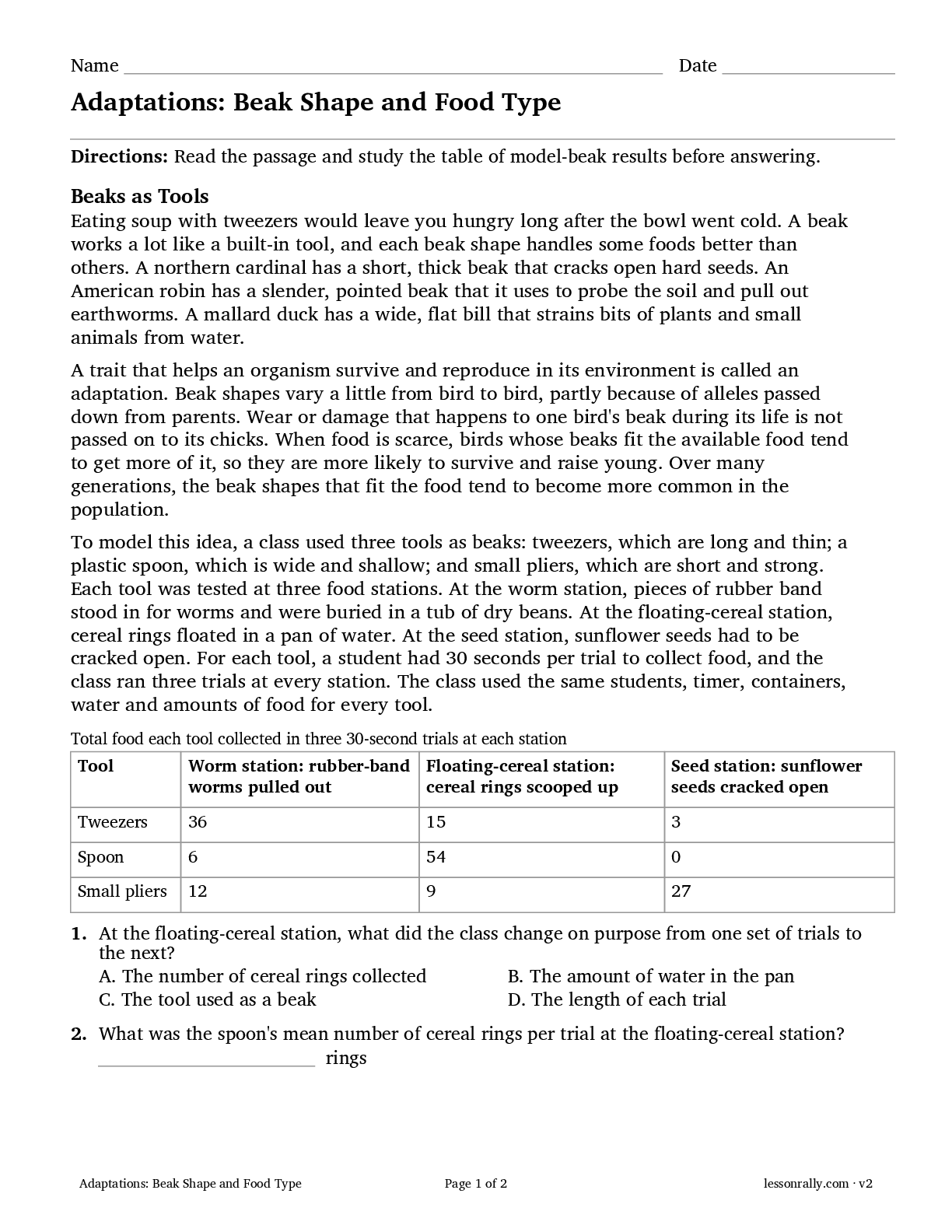
Students read how beak shape relates to food and how helpful beak shapes become common in a population over many generations. They then analyze a class model in which tweezers, a spoon and small pliers act as beaks at three food stations, choose evidence, match a tool to a bird, and predict how a population would change when one food disappears.

Learning goal: Use evidence from a model investigation to explain how beak shape relates to food type and how adaptations become common in a population over generations.

Estimated reading level 8.4

  1. Grade 6Hard
  2. Grade 7Stretch
  3. Grade 8On level
  4. Grade 9Easier
  5. Grade 10Easy
About this estimate

The estimate is the middle score of five readability formulas. Their scores run from 6.5 to 8.7.

  • Flesch-Kincaid GradeSentence length and syllables per word6.5
  • Gunning FogSentence length and words of three or more syllables8.6
  • Coleman-Liau Middle scoreLetters per word and sentences per 100 words8.4
  • Automated Readability IndexCharacters per word and words per sentence7.7
  • SMOGWords of three or more syllables, for texts of 30 sentences or more8.7
Flesch Reading Ease
78.1 on a 0 to 100 scale where higher is easier: fairly easy. Not part of the estimate.
Text measured
868 words, 30 sentences

Adapted from common readability formulas (Flesch-Kincaid, Gunning Fog, Coleman-Liau and ARI, plus SMOG for long texts), which look at sentence length and word length. Answer choices count toward word length only. Grades below the estimate will likely find the text harder, grades above it easier. It does not measure ideas, background knowledge or images.

Common Core

Closest anchor: CCRA.R.1 Read closely to determine what the text says explicitly and to make logical inferences from it; cite specific textual evidence when writing or speaking to support conclusions drawn from the text.Anchor Standards for ReadingShow 1 matched standardHide matched standard

Matched standard

  • RST.6-8.1

    Cite specific textual evidence to support analysis of science and technical texts.

Chosen by LessonRally.

© Copyright 2010. National Governors Association Center for Best Practices and Council of Chief State School Officers. All rights reserved.

Topics: Evolution and Natural Selection, Experimental Design Chosen by LessonRally

Question types: multiple choice, number answer.

Student preview

The questions as students see them, without the answers.

Read the passage and study the table of model-beak results before answering.

Beaks as Tools

Eating soup with tweezers would leave you hungry long after the bowl went cold. A beak works a lot like a built-in tool, and each beak shape handles some foods better than others. A northern cardinal has a short, thick beak that cracks open hard seeds. An American robin has a slender, pointed beak that it uses to probe the soil and pull out earthworms. A mallard duck has a wide, flat bill that strains bits of plants and small animals from water.

A trait that helps an organism survive and reproduce in its environment is called an adaptation. Beak shapes vary a little from bird to bird, partly because of alleles passed down from parents. Wear or damage that happens to one bird's beak during its life is not passed on to its chicks. When food is scarce, birds whose beaks fit the available food tend to get more of it, so they are more likely to survive and raise young. Over many generations, the beak shapes that fit the food tend to become more common in the population.

To model this idea, a class used three tools as beaks: tweezers, which are long and thin; a plastic spoon, which is wide and shallow; and small pliers, which are short and strong. Each tool was tested at three food stations. At the worm station, pieces of rubber band stood in for worms and were buried in a tub of dry beans. At the floating-cereal station, cereal rings floated in a pan of water. At the seed station, sunflower seeds had to be cracked open. For each tool, a student had 30 seconds per trial to collect food, and the class ran three trials at every station. The class used the same students, timer, containers, water and amounts of food for every tool.


Total food each tool collected in three 30-second trials at each station
ToolWorm station: rubber-band worms pulled outFloating-cereal station: cereal rings scooped upSeed station: sunflower seeds cracked open
Tweezers36153
Spoon6540
Small pliers12927

Question 1

At the floating-cereal station, what did the class change on purpose from one set of trials to the next?

Choose one answer.

  • The number of cereal rings collected
  • The amount of water in the pan
  • The tool used as a beak
  • The length of each trial

Question 2

What was the spoon's mean number of cereal rings per trial at the floating-cereal station?

Enter a number.

rings

Question 3

Among the three tools tested, which evidence best supports the idea that the spoon works best for picking up food floating on water?

Choose one answer.

  • The spoon scooped up 54 cereal rings, compared with 15 for the tweezers and 9 for the pliers.
  • The tweezers pulled out 36 worms, the most at the worm station.
  • The spoon pulled out 6 worms, the fewest of the three tools.
  • The spoon cracked 0 seeds, fewer than either other tool.

Question 4

Of the three tools tested, which one's results best match the job the passage gives a northern cardinal's beak?

Choose one answer.

  • The spoon, which scooped up the most cereal rings
  • The tweezers, which cracked more seeds than the spoon did
  • The small pliers, which cracked the most sunflower seeds
  • The tweezers, which pulled out the most rubber-band worms

Question 5

Which conclusion fits the model-beak totals?

Choose one answer.

  • In this model, the tools changed their shapes to match each food.
  • In this model, the tool that did best with worms also did best with seeds.
  • In this model, each of the three tools had the highest total at a different station.
  • In this model, the tweezers had the highest total at every station.

Question 6

According to the passage, how does a bird population come to have beaks that fit its food?

Choose one answer.

  • Every bird in a population hatches with exactly the same beak, already the best shape for the food.
  • Birds whose beaks fit the food tend to survive and raise more young, so over many generations those beak shapes become more common.
  • Birds that eat a lot of one food make new alleles for the beak shape that fits it.
  • Parent birds pass on to their chicks the beak changes caused by years of eating hard foods.

Question 7

Look only at the floating-cereal and seed stations. Among the three tools tested, which had the lowest combined total at those two stations?

Choose one answer.

  • All three tools had the same combined total
  • The small pliers
  • The tweezers
  • The spoon

Question 8

On an island, earthworms die out, leaving only hard seeds and food floating on ponds, and there is not enough food for every bird. Beak shape varies among the island's birds and is partly inherited. What would most likely happen to the population's beaks over many generations?

Choose one answer.

  • Beak shapes would stay exactly the same, because beak shape is inherited.
  • Birds with long, thin beaks would pass thicker beaks to their chicks after years of cracking seeds.
  • Long, thin beaks would likely become less common in the population.
  • Long, thin beaks would become more common, because those birds would search harder for worms.

Question 9

What is one limit of using tools as models of beaks?

Choose one answer.

  • The class kept the timer and amounts of food the same, which made the comparison unfair.
  • The tools collected different amounts of food, so the model has no limits.
  • The model proves that every bird in nature eats only one kind of food.
  • Tools only stand in for beaks, so real birds feeding in nature could get different results.

Reviews

No reviews yet.

Reviews come from teachers who assigned this activity to a class.

Sign in to write a review

Have a topic of your own? Make a printable worksheet and online quiz, free.

Create an activity

Answer key

Answer keys come with Premium

Print this worksheet with the correct answers marked. The key includes any explanations, sample answers, and rubrics supplied with the activity.

Answer keys aren't public: only teachers with Premium and the people who can edit an activity can download one, so students can't get a ready-to-print key from this page.

Premium includes:

  • No ads for you, and no ads for your students on the assignments you post.
  • Answer keys for printable worksheets, with the correct answers marked and any explanations, sample answers, and rubrics.
  • Create with AI: up to 100 activities a year (5 during the free trial), with every answer checked before you see the draft.

$29 a year, plus sales tax where it applies.

New Premium teachers can try it free for 7 days. A card or other payment method is needed to start. Unless you cancel before the trial ends, you are charged then and the plan renews every year.

Already have Premium or edit this activity? Sign in