

Verbs and Verb Tenses
A verb shows an action or a state of being, and its tense shows when. Students find action verbs, form past, present and future tenses, use irregular forms such as went, and keep tense consistent.
Topics are chosen by LessonRally.
Filter by grade
- English Language Arts
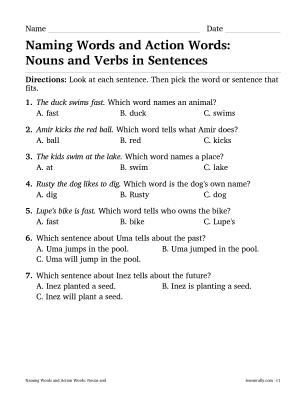
Naming Words and Action Words: Nouns and Verbs in Sentences (opens in a new tab)
- Grade 1
- 7 questions
- Estimated reading level 1.7 (short text, rough estimate)
Common Core L.1.1b
Made by Nell Hargrove · LessonRally (AI-assisted)
- English Language Arts
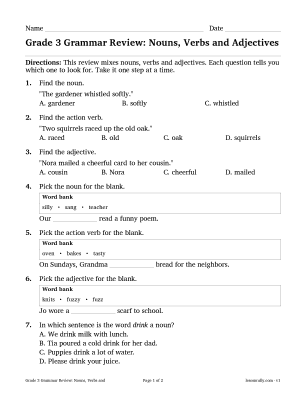
Grade 3 Grammar Review: Nouns, Verbs and Adjectives (opens in a new tab)
- Grade 3
- 12 questions
- Estimated reading level 3.0
Common Core L.3.1a
Made by Sophia Howard · LessonRally (AI-assisted)
- English Language Arts
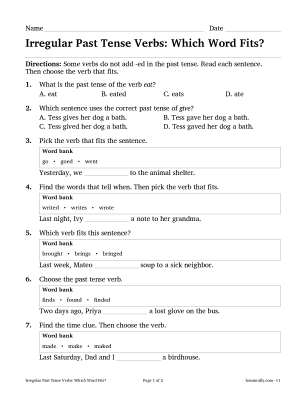
Irregular Past Tense Verbs: Which Word Fits? (opens in a new tab)
- Grade 3
- 10 questions
- Estimated reading level 2.7
Common Core L.3.1d
Made by Sophia Howard · LessonRally (AI-assisted)
- English Language Arts
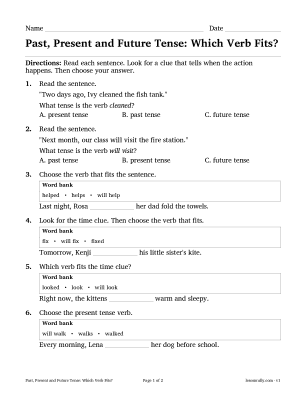
Past, Present and Future Tense: Which Verb Fits? (opens in a new tab)
- Grade 3
- 10 questions
- Estimated reading level 2.9
Common Core L.3.1e
Made by Sophia Howard · LessonRally (AI-assisted)
- English Language Arts
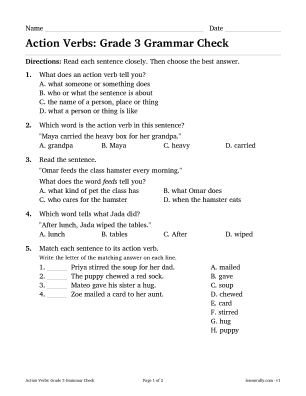
Action Verbs: Grade 3 Grammar Check (opens in a new tab)
- Grade 3
- 10 questions
- Estimated reading level 2.5
Common Core L.3.1a
Made by Sophia Howard · LessonRally (AI-assisted)
About teaching Verbs and Verb Tenses
- What students practice
- Finding the verb by asking what the subject does or is, adding -ed with spelling changes such as stopped and carried, using will for the future, learning irregular sets such as see, saw, seen, and checking that a paragraph stays in one tense unless the time changes.
- Common mistakes
- Students often add -ed to irregular verbs, writing teached or runned; keep a class chart of irregular forms. In formal writing, many use a past participle without a helper, as in “I seen it”; have them write I saw it, I have seen it or I had seen it.
- Ways to use these activities
- Use one of these activities as a warm-up during a writing unit, then have students circle the verbs in their own drafts and check each tense. In pairs, one student says a verb and the other gives its past and future tense, checking irregular verbs against the class chart.