

Nouns
A noun names a person, place, thing or idea. Students sort common and proper nouns, form regular and irregular plurals, use apostrophes in possessive nouns, and recognize collective nouns like herd and abstract nouns like courage.
Topics are chosen by LessonRally.
Filter by grade
- English Language Arts
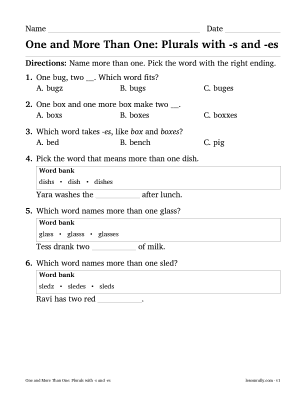
One and More Than One: Plurals with -s and -es (opens in a new tab)
- Grade 1
- 6 questions
- Estimated reading level 1.5 (short text, rough estimate)
Made by Nell Hargrove · LessonRally (AI-assisted)
- English Language Arts
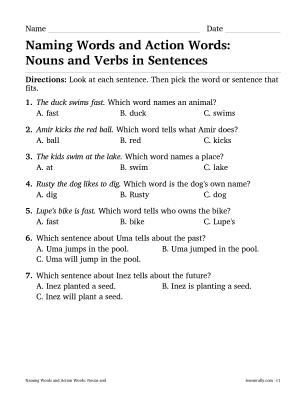
Naming Words and Action Words: Nouns and Verbs in Sentences (opens in a new tab)
- Grade 1
- 7 questions
- Estimated reading level 1.7 (short text, rough estimate)
Common Core L.1.1b
Made by Nell Hargrove · LessonRally (AI-assisted)
- English Language Arts
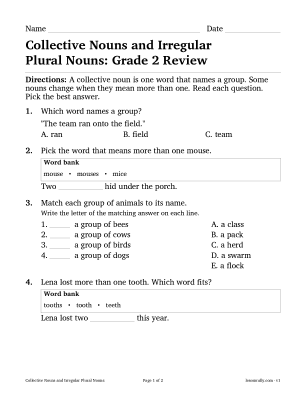
Collective Nouns and Irregular Plural Nouns: Grade 2 Review (opens in a new tab)
- Grade 2
- 10 questions
- Estimated reading level 2.2
Common Core L.2.1a
Made by Sophia Howard · LessonRally (AI-assisted)
- English Language Arts
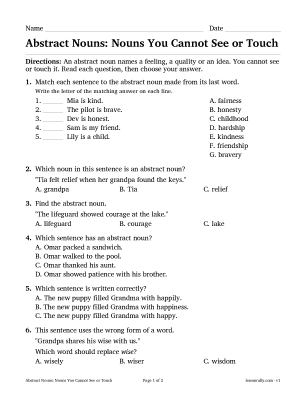
Abstract Nouns: Nouns You Cannot See or Touch (opens in a new tab)
- Grade 3
- 8 questions
- Estimated reading level 4.1
Common Core L.3.1c
Made by Sophia Howard · LessonRally (AI-assisted)
- English Language Arts
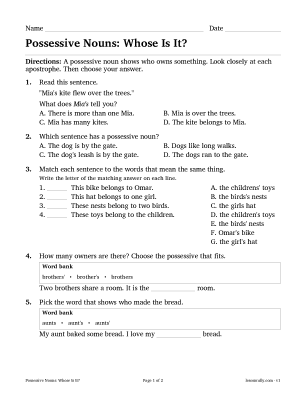
Possessive Nouns: Whose Is It? (opens in a new tab)
- Grade 3
- 10 questions
- Estimated reading level 2.7
Common Core L.3.2d
Made by Sophia Howard · LessonRally (AI-assisted)
- English Language Arts
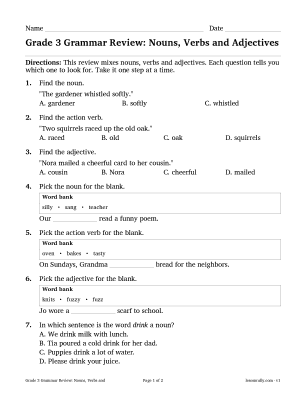
Grade 3 Grammar Review: Nouns, Verbs and Adjectives (opens in a new tab)
- Grade 3
- 12 questions
- Estimated reading level 3.0
Common Core L.3.1a
Made by Sophia Howard · LessonRally (AI-assisted)
- English Language Arts
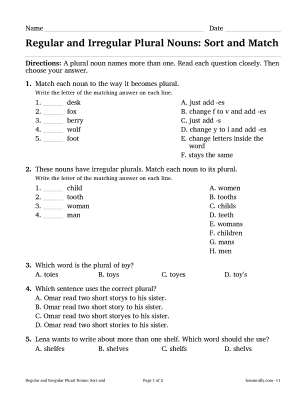
Regular and Irregular Plural Nouns: Sort and Match (opens in a new tab)
- Grade 3
- 8 questions
- Estimated reading level 2.6
Common Core L.3.1b
Made by Sophia Howard · LessonRally (AI-assisted)
- English Language Arts
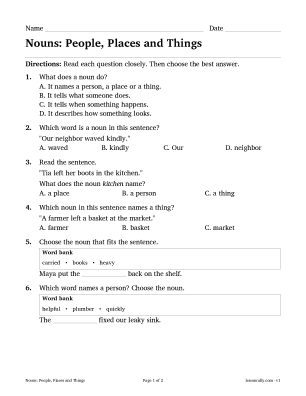
Nouns: People, Places and Things (opens in a new tab)
- Grade 3
- 10 questions
- Estimated reading level 2.6
Common Core L.3.1a
Made by Sophia Howard · LessonRally (AI-assisted)
About teaching Nouns
- What students practice
- Adding -es to most words ending in s, x, z, ch or sh, for most common nouns ending in a consonant and y, changing y to i and adding -es (city, cities), and placing the apostrophe: one dog’s bowl, two dogs’ bowls, the children’s room.
- Common mistakes
- Students often make plurals with an apostrophe, as in two apple’s; ask whether anything belongs to the apple. For plural possessives, have them write the plural first, then add an apostrophe, plus s if the plural does not end in s: girls’, men’s. For errors like childs and foots, keep a class list of irregular plurals.
- Ways to use these activities
- Use one of these activities during a writing unit, then have students check every plural and possessive in their own drafts. In pairs, one student names a person or animal, such as fox or child, and the other gives its plural and plural possessive.