

Cluster · Math · High school
HSF-IF.A
Understand the concept of a function and use function notation.
Activities matched to standards under HSF-IF.A
Filter by grade
- MathFeatured
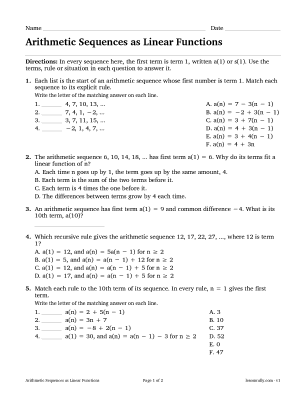
Arithmetic Sequences as Linear Functions (opens in a new tab)
- Grade 9
- 8 questions
Common Core HSF-IF.A.3
Made by Grace Wexley · LessonRally (AI-assisted)
- MathFeatured
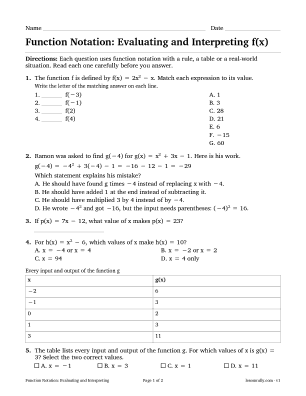
Function Notation: Evaluating and Interpreting f(x) (opens in a new tab)
- Grade 9
- 8 questions
Common Core HSF-IF.A.2
Made by Grace Wexley · LessonRally (AI-assisted)
- Math
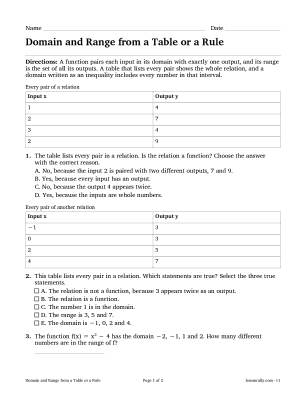
Domain and Range from a Table or a Rule (opens in a new tab)
- Grade 9
- 8 questions
Common Core HSF-IF.A.1
Made by Grace Wexley · LessonRally (AI-assisted)
Where it fits
Standards in this cluster (3)
HSF-IF.A.1 1 activity
Understand that a function from one set (called the domain) to another set (called the range) assigns to each element of the domain exactly one element of the range. If f is a function and x is an element of its domain, then f(x) denotes the output of f corresponding to the input x. The graph of f is the graph of the equation y = f(x).
HSF-IF.A.2 2 activities
Use function notation, evaluate functions for inputs in their domains, and interpret statements that use function notation in terms of a context.
HSF-IF.A.3 1 activity
Recognize that sequences are functions, sometimes defined recursively, whose domain is a subset of the integers. For example, the Fibonacci sequence is defined recursively by f(0) = f(1) = 1, f(n+1) = f(n) + f(n-1) for n ≥ 1.
Counts updated 22 minutes ago.
How matching works
LessonRally matches each shared activity to the Common Core standards its questions require, using AI after the activity passes review. Every standard shown in Browse was chosen independently by two AI models, or by LessonRally.
© Copyright 2010. National Governors Association Center for Best Practices and Council of Chief State School Officers. All rights reserved.