Opportunity Cost: Scarcity, Choices and the Next-Best Alternative

10 questions · 12 points · Grades 11–12 · English · Preview the 10 questions

Made by Nathan Kessler · LessonRally (AI-assisted)

Digital classroom activity

What is a digital classroom activity?

Teachers who sign in can assign LessonRally activities to their Google Classroom classes: students open them in Classroom and answer online, and their grades go to the teacher's Classroom gradebook. Practice lets you try it first, the way students see it.

Free for teachers. Sign in to assign activities to your Google Classroom classes.

Printable worksheet

Students apply scarcity and opportunity cost one choice or one change at a time: they find the single next-best alternative a choice gives up, see how a change in an alternative's value changes opportunity cost, set sunk costs aside, and use a production possibilities frontier (PPF) given as a table of data to measure opportunity costs, sort efficient, inefficient and unattainable combinations, and predict the effect of new technology.

Learning goal: Identify the opportunity cost of a choice as the single next-best alternative given up, and apply scarcity, sunk costs and a production possibilities frontier to predict how one change affects a choice.

Estimated reading level 9.3

  1. Grade 7Hard
  2. Grade 8Stretch
  3. Grade 9On level
  4. Grade 10Easier
  5. Grade 11Easy
About this estimate

The estimate is halfway between the two middle scores of four readability formulas. Their scores run from 8.5 to 11.2.

  • Flesch-Kincaid GradeSentence length and syllables per word8.5
  • Gunning FogSentence length and words of three or more syllables11.2
  • Coleman-Liau Middle scoreLetters per word and sentences per 100 words9.8
  • Automated Readability Index Middle scoreCharacters per word and words per sentence8.8
Flesch Reading Ease
62.0 on a 0 to 100 scale where higher is easier: standard. Not part of the estimate.
Text measured
796 words, 28 sentences

Adapted from common readability formulas (Flesch-Kincaid, Gunning Fog, Coleman-Liau and ARI, plus SMOG for long texts), which look at sentence length and word length. Answer choices count toward word length only. Grades below the estimate will likely find the text harder, grades above it easier. It does not measure ideas, background knowledge or images.

Topic: Economics Chosen by LessonRally

Question types: multiple choice, number answer, matching.

Student preview

The questions as students see them, without the answers.

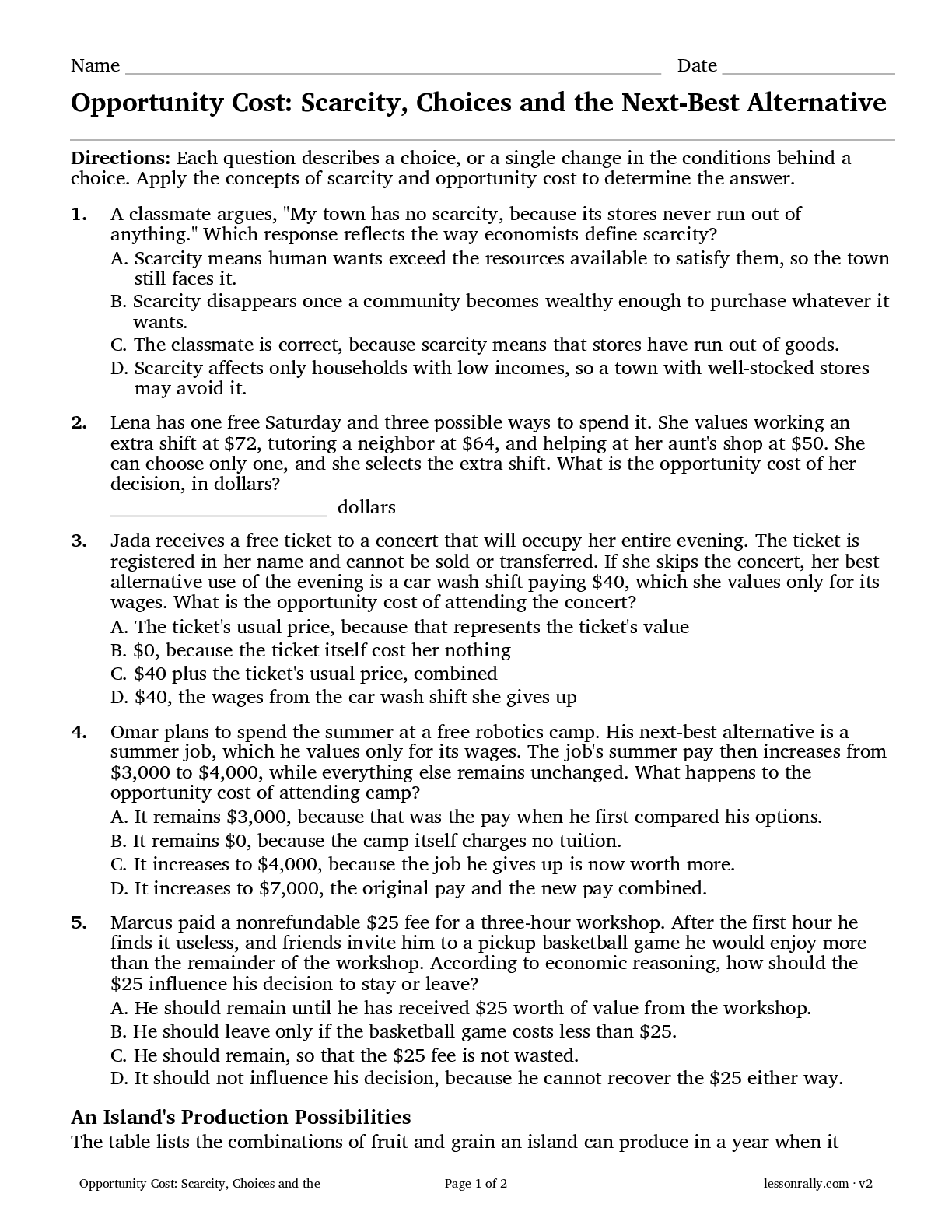
Each question describes a choice, or a single change in the conditions behind a choice. Apply the concepts of scarcity and opportunity cost to determine the answer.

Question 1

A classmate argues, "My town has no scarcity, because its stores never run out of anything." Which response reflects the way economists define scarcity?

Choose one answer.

  • The classmate is correct, because scarcity means that stores have run out of goods.
  • Scarcity means human wants exceed the resources available to satisfy them, so the town still faces it.
  • Scarcity affects only households with low incomes, so a town with well-stocked stores may avoid it.
  • Scarcity disappears once a community becomes wealthy enough to purchase whatever it wants.
Question 2

Lena has one free Saturday and three possible ways to spend it. She values working an extra shift at $72, tutoring a neighbor at $64, and helping at her aunt's shop at $50. She can choose only one, and she selects the extra shift. What is the opportunity cost of her decision, in dollars?

Enter a number.

dollars

Question 3

Jada receives a free ticket to a concert that will occupy her entire evening. The ticket is registered in her name and cannot be sold or transferred. If she skips the concert, her best alternative use of the evening is a car wash shift paying $40, which she values only for its wages. What is the opportunity cost of attending the concert?

Choose one answer.

  • $0, because the ticket itself cost her nothing
  • $40, the wages from the car wash shift she gives up
  • $40 plus the ticket's usual price, combined
  • The ticket's usual price, because that represents the ticket's value

Question 4

Omar plans to spend the summer at a free robotics camp. His next-best alternative is a summer job, which he values only for its wages. The job's summer pay then increases from $3,000 to $4,000, while everything else remains unchanged. What happens to the opportunity cost of attending camp?

Choose one answer.

  • It increases to $7,000, the original pay and the new pay combined.
  • It increases to $4,000, because the job he gives up is now worth more.
  • It remains $0, because the camp itself charges no tuition.
  • It remains $3,000, because that was the pay when he first compared his options.

Question 5

Marcus paid a nonrefundable $25 fee for a three-hour workshop. After the first hour he finds it useless, and friends invite him to a pickup basketball game he would enjoy more than the remainder of the workshop. According to economic reasoning, how should the $25 influence his decision to stay or leave?

Choose one answer.

  • He should remain until he has received $25 worth of value from the workshop.
  • He should leave only if the basketball game costs less than $25.
  • He should remain, so that the $25 fee is not wasted.
  • It should not influence his decision, because he cannot recover the $25 either way.

An Island's Production Possibilities

The table lists the combinations of fruit and grain an island can produce in a year when it employs all of its land and workers fully and efficiently. Refer to it throughout this set.

Yearly output combinations for an island's farms
CombinationFruit (tons)Grain (tons)
A0120
B20110
C4090
D6060
E800

Question 6

The island moves from combination C to combination D. How many tons of grain must it sacrifice to gain those 20 additional tons of fruit?

Enter a number.

tons of grain

Question 7

When the island moves from combination D to combination E, what is the average opportunity cost per additional ton of fruit, measured in tons of grain?

Enter a number.

tons of grain

Question 8

As the island shifts production from combination A toward combination E, each step adds 20 tons of fruit. What happens to the amount of grain sacrificed at each step, and which change in how the farms use their resources could explain the pattern?

Choose one answer.

  • It increases, because the market price of fruit rises at each step.
  • It increases. This can happen if farms use the resources best suited to fruit first and later shift resources better suited to grain into fruit production.
  • It remains constant, because every step adds the same 20 tons of fruit.
  • It decreases, because farmers become more skilled at growing fruit with practice.

Question 9

Match each output combination to its position relative to the island's production possibilities frontier.

Match each item to an option.

Items

  1. 60 tons of fruit and 80 tons of grain
  2. 40 tons of fruit and 90 tons of grain
  3. 40 tons of fruit and 70 tons of grain

Options

  1. Inside the frontier: attainable but inefficient
  2. On the frontier: productively efficient
  3. Outside the frontier: unattainable with current resources
  4. Outside the frontier: attainable but wasteful

Question 10

A new irrigation technique allows the island's farms to produce more fruit and more grain using the same land and workers. How does this development affect the island's production possibilities?

Choose one answer.

  • The frontier shifts outward, so some previously unattainable combinations become possible.
  • The island moves along its existing frontier toward more fruit.
  • Nothing changes, because the island still has the same land and workers.
  • The frontier shifts inward, because farmers must spend time learning the technique.

Reviews

No reviews yet.

Reviews come from teachers who assigned this activity to a class.

Sign in to write a review

Have a topic of your own? Make a printable worksheet and online quiz, free.

Create an activity

Answer key

Answer keys come with Premium

Print this worksheet with the correct answers marked. The key includes any explanations, sample answers, and rubrics supplied with the activity.

Answer keys aren't public: only teachers with Premium and the people who can edit an activity can download one, so students can't get a ready-to-print key from this page.

Premium includes:

  • No ads for you, and no ads for your students on the assignments you post.
  • Answer keys for printable worksheets, with the correct answers marked and any explanations, sample answers, and rubrics.
  • Create with AI: up to 100 activities a year (5 during the free trial), with every answer checked before you see the draft.

$29 a year, plus sales tax where it applies.

New Premium teachers can try it free for 7 days. A card or other payment method is needed to start. Unless you cancel before the trial ends, you are charged then and the plan renews every year.

Already have Premium or edit this activity? Sign in