Made by Nathan Kessler · LessonRally (AI-assisted)
Digital classroom activity
What is a digital classroom activity?
Teachers who sign in can assign LessonRally activities to their Google Classroom classes: students open them in Classroom and answer online, and their grades go to the teacher's Classroom gradebook. Practice lets you try it first, the way students see it.
Students match situations to money's functions as a medium of exchange, a store of value and a unit of account, explain barter's problem, identify fiat money, predict what inflation does to cash, and describe banks as intermediaries whose deposits are liabilities. In an example with a 20 percent reserve ratio, they compute what a bank can lend, see how lending adds deposits, find the largest total of deposits and predict the effect of a higher ratio.
Learning goal: Identify the functions of money, explain how banks act as intermediaries between savers and borrowers, and compute how a reserve ratio limits lending and deposit creation in an example.
Estimated reading level11.4
Grade 9Hard
Grade 10Stretch
Grade 11On level
Grade 12Easier
About this estimate
The estimate is halfway between the two middle scores of four readability formulas. Their scores run from 10.4 to 12.8.
Flesch-Kincaid GradeSentence length and syllables per word10.4
Gunning FogSentence length and words of three or more syllables12.8
Coleman-Liau Middle scoreLetters per word and sentences per 100 words11.7
Automated Readability Index Middle scoreCharacters per word and words per sentence11.0
Grade 181216
Flesch Reading Ease
52.2 on a 0 to 100 scale where higher is easier: fairly difficult. Not part of the estimate.
Text measured
791 words, 22 sentences
Adapted from common readability formulas (Flesch-Kincaid, Gunning Fog, Coleman-Liau and ARI, plus SMOG for long texts), which look at sentence length and word length. Answer choices count toward word length only. Grades below the estimate will likely find the text harder, grades above it easier. It does not measure ideas, background knowledge or images.
Question types: matching, multiple choice, number answer.
Student preview
The questions as students see them, without the answers.
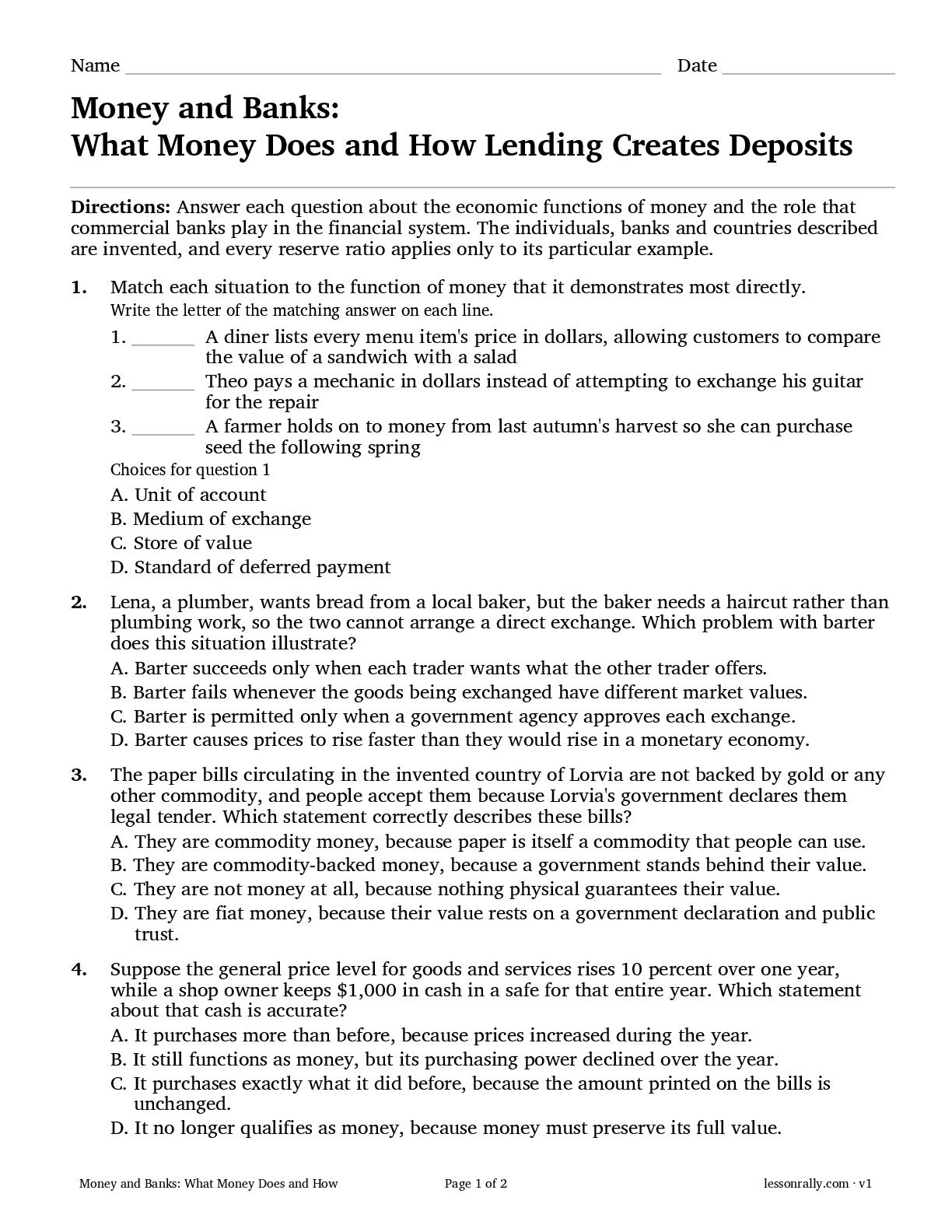
Answer each question about the economic functions of money and the role that commercial banks play in the financial system. The individuals, banks and countries described are invented, and every reserve ratio applies only to its particular example.
Question 1
Match each situation to the function of money that it demonstrates most directly.
Match each item to an option.
Items
A diner lists every menu item's price in dollars, allowing customers to compare the value of a sandwich with a salad
Theo pays a mechanic in dollars instead of attempting to exchange his guitar for the repair
A farmer holds on to money from last autumn's harvest so she can purchase seed the following spring
Options
Unit of account
Medium of exchange
Standard of deferred payment
Store of value
Question 2
Lena, a plumber, wants bread from a local baker, but the baker needs a haircut rather than plumbing work, so the two cannot arrange a direct exchange. Which problem with barter does this situation illustrate?
Choose one answer.
Barter succeeds only when each trader wants what the other trader offers.
Barter causes prices to rise faster than they would rise in a monetary economy.
Barter is permitted only when a government agency approves each exchange.
Barter fails whenever the goods being exchanged have different market values.
Question 3
The paper bills circulating in the invented country of Lorvia are not backed by gold or any other commodity, and people accept them because Lorvia's government declares them legal tender. Which statement correctly describes these bills?
Choose one answer.
They are commodity money, because paper is itself a commodity that people can use.
They are fiat money, because their value rests on a government declaration and public trust.
They are commodity-backed money, because a government stands behind their value.
They are not money at all, because nothing physical guarantees their value.
Question 4
Suppose the general price level for goods and services rises 10 percent over one year, while a shop owner keeps $1,000 in cash in a safe for that entire year. Which statement about that cash is accurate?
Choose one answer.
It still functions as money, but its purchasing power declined over the year.
It purchases more than before, because prices increased during the year.
It purchases exactly what it did before, because the amount printed on the bills is unchanged.
It no longer qualifies as money, because money must preserve its full value.
Question 5
A commercial bank accepts deposits from savers and uses those funds to make loans to individuals and businesses. What economic role is the bank performing?
Choose one answer.
A financial intermediary that channels funds from savers to borrowers
A central bank that determines the quantity of money in the entire country
A government printer that manufactures the paper bills it lends to borrowers
A storage vault that holds every deposit until the depositor returns
Question 6
Customers' deposits appear as liabilities on a commercial bank's balance sheet. Why do accountants classify deposits as liabilities rather than assets?
Choose one answer.
The bank owns the deposits and may spend them however it prefers.
Deposits are loans the bank has extended to its customers.
Deposits generate interest payments for the bank from its borrowers.
The bank owes the deposits to its customers, who can withdraw them.
One Deposit, Many Loans
Teodor deposits $5,000 in cash at Harbor Bank. In this example, every bank keeps 20 percent of each new deposit as reserves and lends out the remainder, and every loan is spent and then deposited in full at some bank. The 20 percent ratio applies only to this example; it is not a legal requirement.
Question 7
In this example, how many dollars can Harbor Bank lend from Teodor's deposit after setting aside its reserves?
Enter a number.
dollars
Question 8
Harbor Bank lends money from Teodor's deposit to Wren, who spends it at a hardware store, and the store deposits the full amount at Ridge Bank, while Teodor's $5,000 remains in his account. What has happened to the total of all deposits in the banking system?
Choose one answer.
It has grown, because the store's new deposit adds to Teodor's deposit.
It is unchanged, because the loan merely transferred Teodor's money elsewhere.
It has decreased by the amount that Harbor Bank retained as reserves.
It has decreased, because Harbor Bank surrendered part of Teodor's deposit.
Question 9
Using the money multiplier, what is the largest total amount of deposits that Teodor's $5,000 can support across the banking system in this example, counting his original deposit?
Enter a number.
dollars
Question 10
Suppose that every bank in this example kept 25 percent of each new deposit as reserves instead of 20 percent, with nothing else changed. How would the largest total of deposits that Teodor's $5,000 can support change?
Choose one answer.
It would remain unchanged, because Teodor's deposit would still equal $5,000.
It would increase, because the money multiplier would rise to 25.
It would decrease, because banks would lend a smaller fraction of each deposit.
It would increase, because banks would be holding additional reserves.