Made by Nathan Kessler · LessonRally (AI-assisted)
Digital classroom activity
What is a digital classroom activity?
Teachers who sign in can assign LessonRally activities to their Google Classroom classes: students open them in Classroom and answer online, and their grades go to the teacher's Classroom gradebook. Practice lets you try it first, the way students see it.
Students use a table of output for two countries to separate absolute advantage from comparative advantage, compute exact opportunity costs, find a trading price that lets both countries gain, and predict how a new technology changes which country should specialize in which good. A final question applies comparative advantage and specialization to two workers in one office.
Learning goal: Distinguish absolute from comparative advantage, compute opportunity costs exactly, and predict how specialization and trade at a price between two producers' opportunity costs can benefit both.
Estimated reading level10.2
Grade 8Hard
Grade 9Stretch
Grade 10On level
Grade 11Easier
Grade 12Easy
About this estimate
The estimate is halfway between the two middle scores of four readability formulas. Their scores run from 8.8 to 11.9.
Flesch-Kincaid GradeSentence length and syllables per word8.8
Gunning FogSentence length and words of three or more syllables11.9
Coleman-Liau Middle scoreLetters per word and sentences per 100 words10.8
Automated Readability Index Middle scoreCharacters per word and words per sentence9.5
Grade 181216
Flesch Reading Ease
60.6 on a 0 to 100 scale where higher is easier: standard. Not part of the estimate.
Text measured
556 words, 19 sentences
Adapted from common readability formulas (Flesch-Kincaid, Gunning Fog, Coleman-Liau and ARI, plus SMOG for long texts), which look at sentence length and word length. Answer choices count toward word length only. Grades below the estimate will likely find the text harder, grades above it easier. It does not measure ideas, background knowledge or images.
Question types: multiple choice, number answer.
Student preview
The questions as students see them, without the answers.
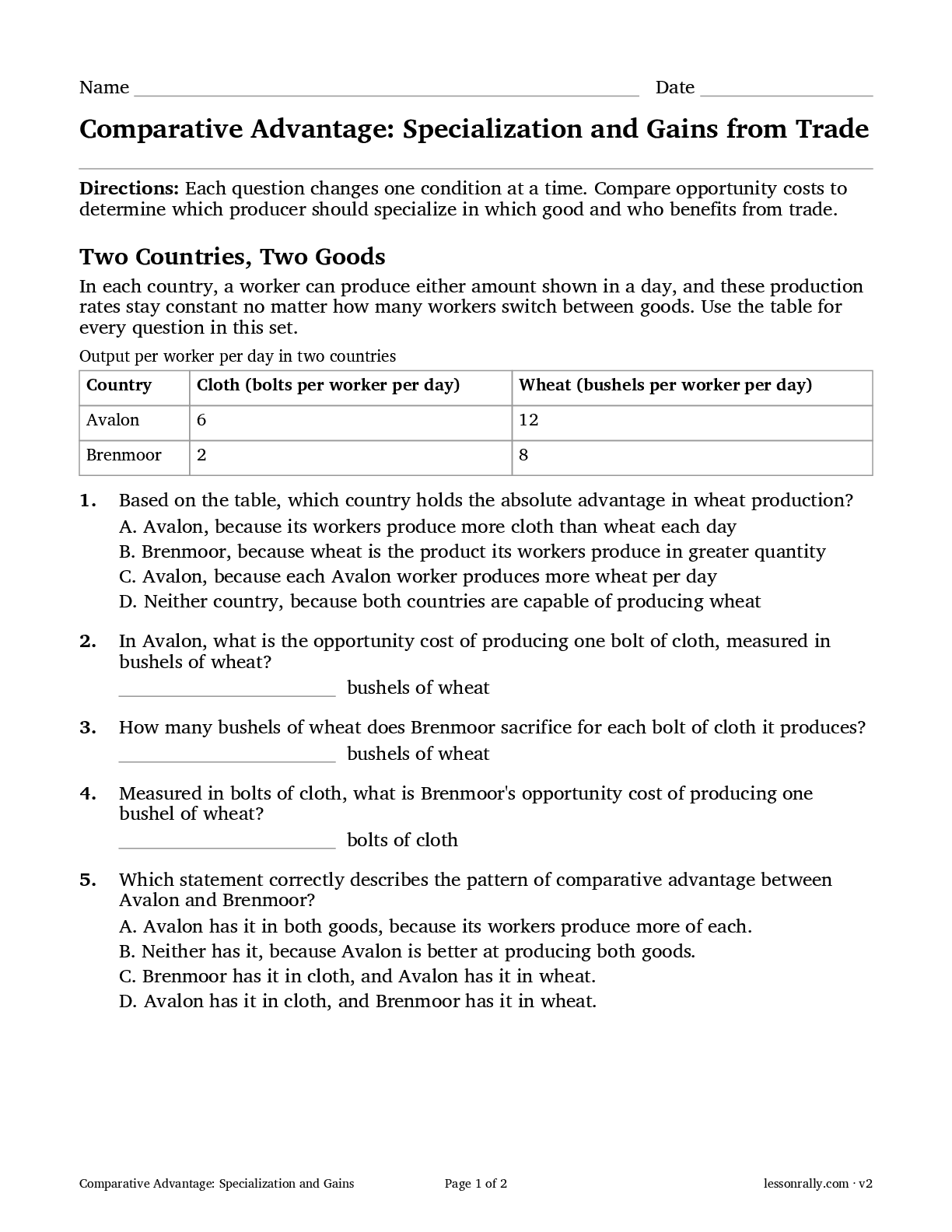
Each question changes one condition at a time. Compare opportunity costs to determine which producer should specialize in which good and who benefits from trade.
Two Countries, Two Goods
In each country, a worker can produce either amount shown in a day, and these production rates stay constant no matter how many workers switch between goods. Use the table for every question in this set.
Output per worker per day in two countries
Country
Cloth (bolts per worker per day)
Wheat (bushels per worker per day)
Avalon
6
12
Brenmoor
2
8
Question 1
Based on the table, which country holds the absolute advantage in wheat production?
Choose one answer.
Avalon, because its workers produce more cloth than wheat each day
Brenmoor, because wheat is the product its workers produce in greater quantity
Neither country, because both countries are capable of producing wheat
Avalon, because each Avalon worker produces more wheat per day
Question 2
In Avalon, what is the opportunity cost of producing one bolt of cloth, measured in bushels of wheat?
Enter a number.
bushels of wheat
Question 3
How many bushels of wheat does Brenmoor sacrifice for each bolt of cloth it produces?
Enter a number.
bushels of wheat
Question 4
Measured in bolts of cloth, what is Brenmoor's opportunity cost of producing one bushel of wheat?
Enter a number.
bolts of cloth
Question 5
Which statement correctly describes the pattern of comparative advantage between Avalon and Brenmoor?
Choose one answer.
Brenmoor has it in cloth, and Avalon has it in wheat.
Avalon has it in cloth, and Brenmoor has it in wheat.
Avalon has it in both goods, because its workers produce more of each.
Neither has it, because Avalon is better at producing both goods.
Question 6
Avalon's workers produce more of both goods than Brenmoor's workers do. Can both countries nevertheless gain by specializing and trading?
Choose one answer.
Yes, if each specializes according to comparative advantage and the trade price falls between their opportunity costs for cloth.
No, because trade helps only the country that has the absolute advantage in both goods.
Yes, but only Brenmoor gains, because Avalon always gives up more in any trade.
No, because Avalon can make both goods for itself more cheaply than Brenmoor can.
Question 7
Avalon proposes exchanging its cloth for Brenmoor's wheat. At which price, measured in bushels of wheat per bolt of cloth, would both countries benefit from the exchange?
Choose one answer.
1.5 bushels per bolt
3 bushels per bolt
6 bushels per bolt
4.5 bushels per bolt
Question 8
Suppose a new loom increases cloth production in Brenmoor to 5 bolts per worker per day, while its wheat production remains 8 bushels. What is Brenmoor's new opportunity cost of one bolt of cloth, measured in bushels of wheat?
Enter a number.
bushels of wheat
Question 9
After Brenmoor's new loom increases its cloth production to 5 bolts per worker per day, with wheat production still at 8 bushels and Avalon unchanged, which country now holds the comparative advantage in cloth?
Choose one answer.
Avalon, because nothing changed in Avalon's own production
Neither, because the two countries' costs of cloth are now equal
Brenmoor, because its opportunity cost of cloth is now lower than Avalon's
Avalon, because each Avalon worker still produces more cloth, 6 bolts to 5
Question 10
In an invented law office, a lawyer types 30 pages an hour and her assistant types 20. Each hour the lawyer spends typing sacrifices $240 of legal work, and each hour the assistant spends typing sacrifices $30 of filing work. Who holds the comparative advantage in typing?
Choose one answer.
Neither, because the two of them type at different speeds
The lawyer, because an hour of her time is worth more
The lawyer, because she types more pages each hour
The assistant, because each page she types gives up less other work