World War I and the Home Front: Key Terms from Neutrality to Armistice

10 questions · 14 points · Grade 11 · English · Preview the 10 questions

Made by Monica Ellison · LessonRally (AI-assisted)

Digital classroom activity

What is a digital classroom activity?

Teachers who sign in can assign LessonRally activities to their Google Classroom classes: students open them in Classroom and answer online, and their grades go to the teacher's Classroom gradebook. Practice lets you try it first, the way students see it.

Free for teachers. Sign in to assign activities to your Google Classroom classes.

Printable worksheet

Students read a passage about the United States in World War I, from neutrality and submarine warfare to the draft, wartime propaganda, the Espionage and Sedition Acts, the Great Migration, the 1918 influenza pandemic and the armistice. They work out the meaning of key terms such as neutrality, conscription, propaganda, sedition and armistice from context, and trace how the passage refines what neutrality and loyalty meant in wartime America.

Learning goal: Determine the meaning of key terms in a passage about World War I and the home front, and analyze how the passage refines the meaning of terms such as neutrality and loyalty.

Estimated reading level 10.1

  1. Grade 8Hard
  2. Grade 9Stretch
  3. Grade 10On level
  4. Grade 11Easier
  5. Grade 12Easy
About this estimate

The estimate is the middle score of five readability formulas. Their scores run from 9.2 to 12.2.

  • Flesch-Kincaid GradeSentence length and syllables per word9.2
  • Gunning FogSentence length and words of three or more syllables12.2
  • Coleman-Liau Middle scoreLetters per word and sentences per 100 words10.1
  • Automated Readability IndexCharacters per word and words per sentence9.6
  • SMOGWords of three or more syllables, for texts of 30 sentences or more12.0
Flesch Reading Ease
59.2 on a 0 to 100 scale where higher is easier: fairly difficult. Not part of the estimate.
Text measured
1,294 words, 50 sentences

Adapted from common readability formulas (Flesch-Kincaid, Gunning Fog, Coleman-Liau and ARI, plus SMOG for long texts), which look at sentence length and word length. Answer choices count toward word length only. Grades below the estimate will likely find the text harder, grades above it easier. It does not measure ideas, background knowledge or images.

Common Core

Closest anchor: CCRA.R.4 Interpret words and phrases as they are used in a text, including determining technical, connotative, and figurative meanings, and analyze how specific word choices shape meaning or tone.Anchor Standards for ReadingShow 1 matched standardHide matched standard

Matched standard

  • RH.11-12.4

    Determine the meaning of words and phrases as they are used in a text, including analyzing how an author uses and refines the meaning of a key term over the course of a text (e.g., how Madison defines faction in Federalist No. 10).

    Student preview questions 1, 2, 3, 5, 7, 9

Matched independently by two AI models from this activity's questions.

© Copyright 2010. National Governors Association Center for Best Practices and Council of Chief State School Officers. All rights reserved.

Topic: World War I Chosen by LessonRally

Question types: multiple choice, matching, select all that apply, fill in the blank.

Student preview

The questions as students see them, without the answers.

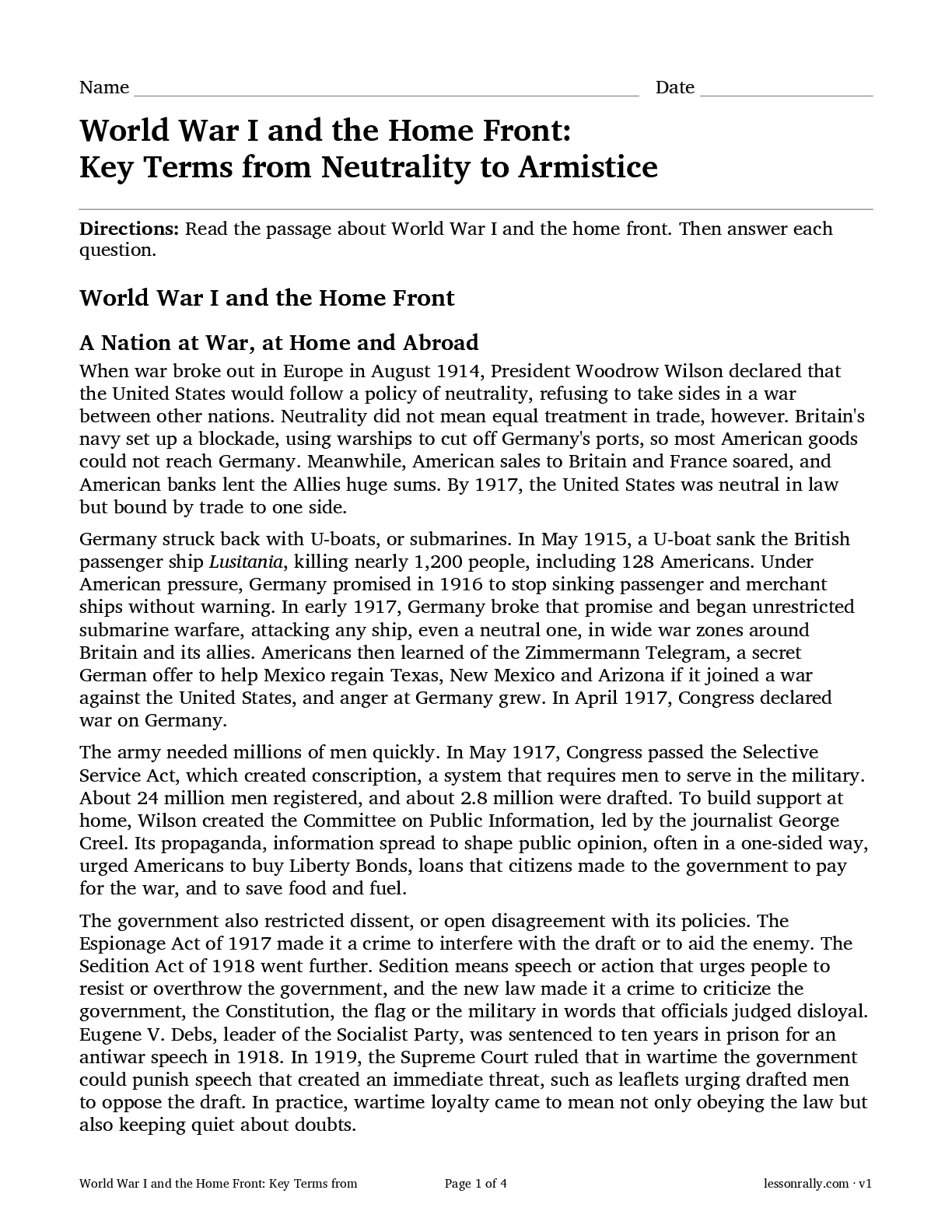
Read the passage about World War I and the home front. Then answer each question.

World War I and the Home Front

A Nation at War, at Home and Abroad

When war broke out in Europe in August 1914, President Woodrow Wilson declared that the United States would follow a policy of neutrality, refusing to take sides in a war between other nations. Neutrality did not mean equal treatment in trade, however. Britain's navy set up a blockade, using warships to cut off Germany's ports, so most American goods could not reach Germany. Meanwhile, American sales to Britain and France soared, and American banks lent the Allies huge sums. By 1917, the United States was neutral in law but bound by trade to one side.

Germany struck back with U-boats, or submarines. In May 1915, a U-boat sank the British passenger ship Lusitania, killing nearly 1,200 people, including 128 Americans. Under American pressure, Germany promised in 1916 to stop sinking passenger and merchant ships without warning. In early 1917, Germany broke that promise and began unrestricted submarine warfare, attacking any ship, even a neutral one, in wide war zones around Britain and its allies. Americans then learned of the Zimmermann Telegram, a secret German offer to help Mexico regain Texas, New Mexico and Arizona if it joined a war against the United States, and anger at Germany grew. In April 1917, Congress declared war on Germany.

The army needed millions of men quickly. In May 1917, Congress passed the Selective Service Act, which created conscription, a system that requires men to serve in the military. About 24 million men registered, and about 2.8 million were drafted. To build support at home, Wilson created the Committee on Public Information, led by the journalist George Creel. Its propaganda, information spread to shape public opinion, often in a one-sided way, urged Americans to buy Liberty Bonds, loans that citizens made to the government to pay for the war, and to save food and fuel.

The government also restricted dissent, or open disagreement with its policies. The Espionage Act of 1917 made it a crime to interfere with the draft or to aid the enemy. The Sedition Act of 1918 went further. Sedition means speech or action that urges people to resist or overthrow the government, and the new law made it a crime to criticize the government, the Constitution, the flag or the military in words that officials judged disloyal. Eugene V. Debs, leader of the Socialist Party, was sentenced to ten years in prison for an antiwar speech in 1918. In 1919, the Supreme Court ruled that in wartime the government could punish speech that created an immediate threat, such as leaflets urging drafted men to oppose the draft. In practice, wartime loyalty came to mean not only obeying the law but also keeping quiet about doubts.

The war also changed where Americans lived and worked. Immigration from Europe nearly stopped, and millions of men left their jobs for the military. Northern factories needed workers, and recruiters and Black newspapers urged Black Southerners to come north. Hundreds of thousands moved to cities such as Chicago, Detroit, New York and Philadelphia during the war years, part of the Great Migration, a movement of Black Americans out of the South that lasted for decades. Migrants hoped for better pay and an escape from segregation and lynching, but many found crowded housing, job discrimination and, in some cities, attacks by white mobs. Women also took factory and railroad jobs that men had left, and their war work strengthened the case for women's right to vote.

In 1918, a pandemic, an outbreak of disease that crosses many countries, swept through army camps and cities. The influenza of 1918 took the lives of an estimated 675,000 Americans. Around the world, the death toll was at least 50 million. Disease, especially influenza, killed more American service members than combat did. The fighting ended with an armistice, an agreement to stop fighting, on November 11, 1918. About 116,000 Americans in uniform had died.


Question 1

In the first paragraph, what does neutrality mean?

Choose one answer.

  • Refusing to take sides in a war between other nations
  • Joining whichever side in a war seems most likely to win it
  • Lending money to both sides in a war in equal amounts
  • Ending a war by signing a peace treaty

Question 2

How does the first paragraph refine, or add to, the meaning of neutrality by the time it reaches 1917?

Choose one answer.

  • It shows the nation staying out of the fighting while trade and loans tied it to Britain and France.
  • It shows the United States trading equally with every nation that was at war in Europe.
  • It shows that neutrality required the nation to build a large army and navy at once, well before 1917.
  • It shows that neutrality meant Americans could no longer travel on any ships at all.

Question 3

As the passage uses the term, what was unrestricted submarine warfare?

Choose one answer.

  • Building as many submarines as a nation wants, with no limit set by any treaty
  • Using submarines to rescue sailors from sinking ships
  • Allowing only passenger ships to cross the ocean safely
  • Attacking any ship, even a neutral one, in wide war zones

Question 4

Besides the new submarine attacks, what gave Americans another reason to go to war in early 1917, according to the passage?

Choose one answer.

  • The Sedition Act, which Congress passed in 1918
  • The Selective Service Act, which Congress passed in May 1917 to raise an army
  • The influenza pandemic that swept through army camps and cities in 1918
  • News of a secret German offer to help Mexico regain land

Question 5

Match each term to the meaning the passage gives it.

Match each item to an option.

Items

  1. conscription
  2. propaganda
  3. Liberty Bonds
  4. pandemic

Options

  1. Information spread to shape public opinion, often in a one-sided way
  2. Loans that citizens made to the government to pay for the war
  3. An outbreak of disease that crosses many countries
  4. The use of warships to cut off an enemy's ports
  5. A system that requires men to serve in the military

Question 6

Which example from the passage shows the government punishing speech during the war?

Choose one answer.

  • Eugene V. Debs was sentenced to ten years in prison for an antiwar speech.
  • Germany promised in 1916 to stop sinking ships without warning.
  • Recruiters and Black newspapers urged Black Southerners to move north for factory jobs.
  • About 24 million men registered under the Selective Service Act.

Question 7

By the end of the paragraph on the Espionage and Sedition Acts, how has the passage refined the idea of loyalty in wartime?

Choose one answer.

  • Loyalty came to mean voting for the Socialist Party.
  • Loyalty came to mean keeping quiet about doubts as well as obeying the law.
  • Loyalty came to mean refusing to buy Liberty Bonds.
  • Loyalty came to mean moving north to take a factory job that a soldier had left.

Question 8

Which two reasons does the passage give for the move of hundreds of thousands of Black Southerners to Northern cities during the war?

Choose 2 answers.

  • Northern cities promised them uncrowded housing and an end to job discrimination.
  • The Sedition Act had shut down the Black newspapers of the South.
  • Northern factories needed workers after immigration from Europe nearly stopped.
  • Migrants hoped to escape segregation and lynching in the South.
  • The Selective Service Act ordered Black men to report to army camps in the North.

Question 9

Two more terms from the passage belong in these sentences. Pick each from the word bank.

Fill in each blank.

The fighting stopped with an blank 1 on November 11, 1918. The wartime move of Black Southerners to Northern cities was part of the blank 2, which lasted for decades.

Word bank

  • conscription
  • blockade
  • neutrality
  • armistice
  • Great Migration

Question 10

According to the passage, what was one effect of the war on women's work?

Choose one answer.

  • Women were barred from buying Liberty Bonds.
  • Women took factory and railroad jobs that men had left.
  • Women were drafted into the army under the Selective Service Act.
  • Women lost the right to vote in several states.

Reviews

No reviews yet.

Reviews come from teachers who assigned this activity to a class.

Sign in to write a review

Have a topic of your own? Make a printable worksheet and online quiz, free.

Create an activity

Answer key

Answer keys come with Premium

Print this worksheet with the correct answers marked. The key includes any explanations, sample answers, and rubrics supplied with the activity.

Answer keys aren't public: only teachers with Premium and the people who can edit an activity can download one, so students can't get a ready-to-print key from this page.

Premium includes:

  • No ads for you, and no ads for your students on the assignments you post.
  • Answer keys for printable worksheets, with the correct answers marked and any explanations, sample answers, and rubrics.
  • Create with AI: up to 100 activities a year (5 during the free trial), with every answer checked before you see the draft.

$29 a year, plus sales tax where it applies.

New Premium teachers can try it free for 7 days. A card or other payment method is needed to start. Unless you cancel before the trial ends, you are charged then and the plan renews every year.

Already have Premium or edit this activity? Sign in