The Progressive Era: Muckrakers, Reform Laws and Who Was Left Out

10 questions · 14 points · Grade 11 · English · Preview the 10 questions

Made by Monica Ellison · LessonRally (AI-assisted)

Digital classroom activity

What is a digital classroom activity?

Teachers who sign in can assign LessonRally activities to their Google Classroom classes: students open them in Classroom and answer online, and their grades go to the teacher's Classroom gradebook. Practice lets you try it first, the way students see it.

Free for teachers. Sign in to assign activities to your Google Classroom classes.

Printable worksheet

Students read a passage on the Progressive Era, from muckraking journalists and the 1906 food and drug laws to the Triangle Shirtwaist fire, the 16th through 19th Amendments, and the reforms that left Black Americans out as segregation spread. They identify the central idea, trace how key details relate to it, summarize Ida B. Wells's work against lynching, and explain what Progressive reforms changed and what they did not.

Learning goal: Determine the central idea of a passage on the Progressive Era and explain how its key details relate, including what the reforms achieved and whom they left out.

Estimated reading level 10.8

  1. Grade 8Hard
  2. Grade 9Stretch
  3. Grade 10On level
  4. Grade 11Easier
  5. Grade 12Easy
About this estimate

The estimate is the middle score of five readability formulas. Their scores run from 8.7 to 11.7.

  • Flesch-Kincaid GradeSentence length and syllables per word8.7
  • Gunning FogSentence length and words of three or more syllables11.7
  • Coleman-Liau Middle scoreLetters per word and sentences per 100 words10.8
  • Automated Readability IndexCharacters per word and words per sentence9.3
  • SMOGWords of three or more syllables, for texts of 30 sentences or more11.2
Flesch Reading Ease
58.8 on a 0 to 100 scale where higher is easier: fairly difficult. Not part of the estimate.
Text measured
1,347 words, 57 sentences

Adapted from common readability formulas (Flesch-Kincaid, Gunning Fog, Coleman-Liau and ARI, plus SMOG for long texts), which look at sentence length and word length. Answer choices count toward word length only. Grades below the estimate will likely find the text harder, grades above it easier. It does not measure ideas, background knowledge or images.

Common Core

Closest anchor: CCRA.R.2 Determine central ideas or themes of a text and analyze their development; summarize the key supporting details and ideas.Anchor Standards for ReadingShow 1 matched standardHide matched standard

Matched standard

  • RH.11-12.2

    Determine the central ideas or information of a primary or secondary source; provide an accurate summary that makes clear the relationships among the key details and ideas.

    Student preview question 10

Matched independently by two AI models from this activity's questions.

© Copyright 2010. National Governors Association Center for Best Practices and Council of Chief State School Officers. All rights reserved.

Topic: Progressive Era Chosen by LessonRally

Question types: multiple choice, fill in the blank, matching, select all that apply.

Student preview

The questions as students see them, without the answers.

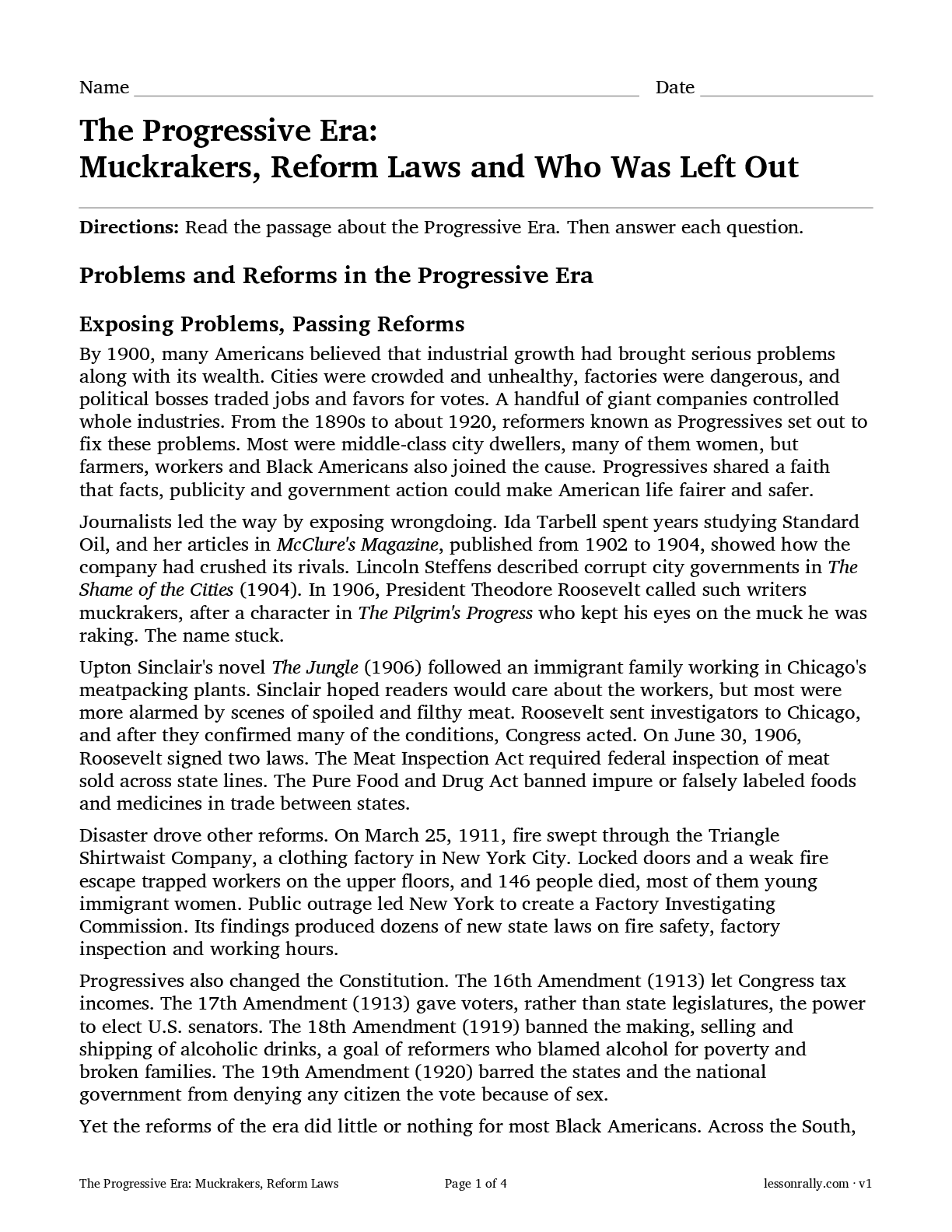
Read the passage about the Progressive Era. Then answer each question.

Problems and Reforms in the Progressive Era

Exposing Problems, Passing Reforms

By 1900, many Americans believed that industrial growth had brought serious problems along with its wealth. Cities were crowded and unhealthy, factories were dangerous, and political bosses traded jobs and favors for votes. A handful of giant companies controlled whole industries. From the 1890s to about 1920, reformers known as Progressives set out to fix these problems. Most were middle-class city dwellers, many of them women, but farmers, workers and Black Americans also joined the cause. Progressives shared a faith that facts, publicity and government action could make American life fairer and safer.

Journalists led the way by exposing wrongdoing. Ida Tarbell spent years studying Standard Oil, and her articles in McClure's Magazine, published from 1902 to 1904, showed how the company had crushed its rivals. Lincoln Steffens described corrupt city governments in The Shame of the Cities (1904). In 1906, President Theodore Roosevelt called such writers muckrakers, after a character in The Pilgrim's Progress who kept his eyes on the muck he was raking. The name stuck.

Upton Sinclair's novel The Jungle (1906) followed an immigrant family working in Chicago's meatpacking plants. Sinclair hoped readers would care about the workers, but most were more alarmed by scenes of spoiled and filthy meat. Roosevelt sent investigators to Chicago, and after they confirmed many of the conditions, Congress acted. On June 30, 1906, Roosevelt signed two laws. The Meat Inspection Act required federal inspection of meat sold across state lines. The Pure Food and Drug Act banned impure or falsely labeled foods and medicines in trade between states.

Disaster drove other reforms. On March 25, 1911, fire swept through the Triangle Shirtwaist Company, a clothing factory in New York City. Locked doors and a weak fire escape trapped workers on the upper floors, and 146 people died, most of them young immigrant women. Public outrage led New York to create a Factory Investigating Commission. Its findings produced dozens of new state laws on fire safety, factory inspection and working hours.

Progressives also changed the Constitution. The 16th Amendment (1913) let Congress tax incomes. The 17th Amendment (1913) gave voters, rather than state legislatures, the power to elect U.S. senators. The 18th Amendment (1919) banned the making, selling and shipping of alcoholic drinks, a goal of reformers who blamed alcohol for poverty and broken families. The 19th Amendment (1920) barred the states and the national government from denying any citizen the vote because of sex.

Yet the reforms of the era did little or nothing for most Black Americans. Across the South, poll taxes, literacy tests and whites-only primary elections kept most Black men from voting, and new laws separated Black and white people in public places. Some white Southern reformers even argued that separating the races was a modern way to prevent conflict. In 1913, President Woodrow Wilson's administration segregated Black federal workers in departments such as the Treasury and the Post Office. After the 19th Amendment took effect, the same barriers kept many Black women in the South from voting.

Ida B. Wells fought injustice with facts. Born into slavery in Mississippi in 1862, she became a journalist and part owner of a Black newspaper in Memphis. In 1892, a white mob lynched three Black men who ran a successful grocery store, among them her close friend Thomas Moss. Lynching meant the murder of a person by a mob, without any trial. Wells began investigating lynchings across the South. In pamphlets such as Southern Horrors (1892), she showed that the charges used to excuse many lynchings were false, and she argued that mobs used terror to keep Black Americans from getting ahead. While she was away from Memphis, a mob wrecked her newspaper's office, and she never returned. She carried on her work from the North. In 1909, she helped found the National Association for the Advancement of Colored People (NAACP), which fought segregation and lynching.


Question 1

What main point does the passage develop about the Progressive Era as a whole?

Choose one answer.

  • Reformers fought industrial problems with facts, publicity and laws, but did little for most Black Americans.
  • Muckraking journalists were the only reformers of the era whose reporting led to any new laws or amendments.
  • Progressives mainly wanted to shrink the power of the national government over big business and the states.
  • Progressive reforms ended segregation in the South and won equal voting rights for every American by 1920.

Question 2

The passage says journalists "led the way by exposing wrongdoing." Which example from the passage fits that claim?

Choose one answer.

  • New York created a Factory Investigating Commission after a deadly fire.
  • Wilson's administration segregated Black federal workers.
  • The 17th Amendment gave voters, not state legislatures, the power to elect senators.
  • Ida Tarbell's articles showed how Standard Oil had crushed its rivals.

Question 3

These sentences use two terms the passage defines. Fill in each one from the word bank.

Fill in each blank.

Roosevelt gave the name blank 1 to writers who exposed wrongdoing. The murder of a person by a mob, without any trial, is called blank 2.

Word bank

  • muckrakers
  • Prohibition
  • Progressives
  • segregation
  • lynching

Question 4

According to the passage, what was one effect of Upton Sinclair's novel The Jungle?

Choose one answer.

  • Readers demanded an amendment that would let Congress tax incomes.
  • Chicago's meatpackers closed their plants and moved to New York.
  • Roosevelt had Sinclair arrested for criticizing the government in his novel.
  • Alarm over unsafe meat helped push Congress to pass two laws in 1906.

Question 5

What led New York to create its Factory Investigating Commission, according to the passage?

Choose one answer.

  • A long strike by meatpacking workers in the city of Chicago in 1906
  • The ratification of the 19th Amendment by the states in 1920
  • Public outrage over the Triangle fire, in which 146 people died
  • Ida Tarbell's magazine articles about the Standard Oil Company

Question 6

Match each amendment to the change the passage says it made.

Match each item to an option.

Items

  1. 16th Amendment (1913)
  2. 17th Amendment (1913)
  3. 18th Amendment (1919)
  4. 19th Amendment (1920)

Options

  1. Let Congress tax incomes
  2. Let voters elect U.S. senators
  3. Barred denying the vote because of sex
  4. Banned poll taxes in national elections
  5. Banned the making and selling of alcoholic drinks

Question 7

Why does the passage include the detail about President Wilson's administration in 1913?

Choose one answer.

  • To explain why Congress passed the Pure Food and Drug Act
  • To show that segregation reached the national government in an age of reform
  • To show that Wilson led the campaign for the 17th Amendment
  • To show that federal departments hired more Black workers than at any time before

Question 8

Which two details from the passage show that the reforms of the era left many Black Americans out?

Choose 2 answers.

  • Poll taxes, literacy tests and whites-only primaries kept most Black men in the South from voting.
  • Investigators confirmed many of the conditions in Chicago's meatpacking plants.
  • Tarbell's articles about Standard Oil appeared from 1902 to 1904.
  • Some white Southern reformers argued that separating the races was a modern way to prevent conflict.
  • The 17th Amendment gave voters the power to elect U.S. senators.

Question 9

How does the passage limit its account of what the 19th Amendment achieved?

Choose one answer.

  • It explains that the amendment applied only to elections for U.S. senators and not to others.
  • It says the amendment was repealed a few years after it passed.
  • It reports that most states refused to accept the amendment.
  • It notes that other barriers still kept many Black women in the South from voting.

Question 10

Which summary of the passage's account of Ida B. Wells is most accurate?

Choose one answer.

  • She won a federal law against lynching in 1892, then left journalism and ran her friend's grocery store in Memphis for the rest of the 1890s while others ran her paper.
  • She wrote the novel about Chicago's meatpacking plants and was sent to prison for it under a law against disloyal writing.
  • She began writing about lynching only after helping found the NAACP in 1909, and she stayed in Memphis to edit her newspaper.
  • After a mob lynched her friend and two other grocers, she investigated lynchings, exposed the false charges behind many, and kept working from the North.

Reviews

No reviews yet.

Reviews come from teachers who assigned this activity to a class.

Sign in to write a review

Have a topic of your own? Make a printable worksheet and online quiz, free.

Create an activity

Answer key

Answer keys come with Premium

Print this worksheet with the correct answers marked. The key includes any explanations, sample answers, and rubrics supplied with the activity.

Answer keys aren't public: only teachers with Premium and the people who can edit an activity can download one, so students can't get a ready-to-print key from this page.

Premium includes:

  • No ads for you, and no ads for your students on the assignments you post.
  • Answer keys for printable worksheets, with the correct answers marked and any explanations, sample answers, and rubrics.
  • Create with AI: up to 100 activities a year (5 during the free trial), with every answer checked before you see the draft.

$29 a year, plus sales tax where it applies.

New Premium teachers can try it free for 7 days. A card or other payment method is needed to start. Unless you cancel before the trial ends, you are charged then and the plan renews every year.

Already have Premium or edit this activity? Sign in