Pitch and Volume: How Instruments Change Their Sound

10 questions · 14 points · Grade 5 · English · Preview the 10 questions

Made by Miles Penhallow · LessonRally (AI-assisted)

Digital classroom activity

What is a digital classroom activity?

Teachers who sign in can assign LessonRally activities to their Google Classroom classes: students open them in Classroom and answer online, and their grades go to the teacher's Classroom gradebook. Practice lets you try it first, the way students see it.

Free for teachers. Sign in to assign activities to your Google Classroom classes.

Printable worksheet

Students learn that pitch is how high or low a sound is and volume is how loud or soft it is. They see how a shorter or tighter string, a shorter tube or bar, or a tighter drumhead gives a higher pitch, how playing harder gives more volume, and how pitch and volume can change separately on string, wind and percussion instruments.

Learning goal: Explain how players change the pitch and the volume of string, wind and percussion instruments.

Estimated reading level 4.1

  1. Grade 2Hard
  2. Grade 3Stretch
  3. Grade 4On level
  4. Grade 5Easier
  5. Grade 6Easy
About this estimate

The estimate is halfway between the two middle scores of four readability formulas. Their scores run from 2.9 to 5.4.

  • Flesch-Kincaid Grade Middle scoreSentence length and syllables per word3.2
  • Gunning Fog Middle scoreSentence length and words of three or more syllables4.9
  • Coleman-LiauLetters per word and sentences per 100 words5.4
  • Automated Readability IndexCharacters per word and words per sentence2.9
Flesch Reading Ease
90.1 on a 0 to 100 scale where higher is easier: very easy. Not part of the estimate.
Text measured
496 words, 19 sentences

Adapted from common readability formulas (Flesch-Kincaid, Gunning Fog, Coleman-Liau and ARI, plus SMOG for long texts), which look at sentence length and word length. Answer choices count toward word length only. Grades below the estimate will likely find the text harder, grades above it easier. It does not measure ideas, background knowledge or images.


Topic: Music Chosen by LessonRally

Question types: multiple choice, matching, fill in the blank.

Student preview

The questions as students see them, without the answers.

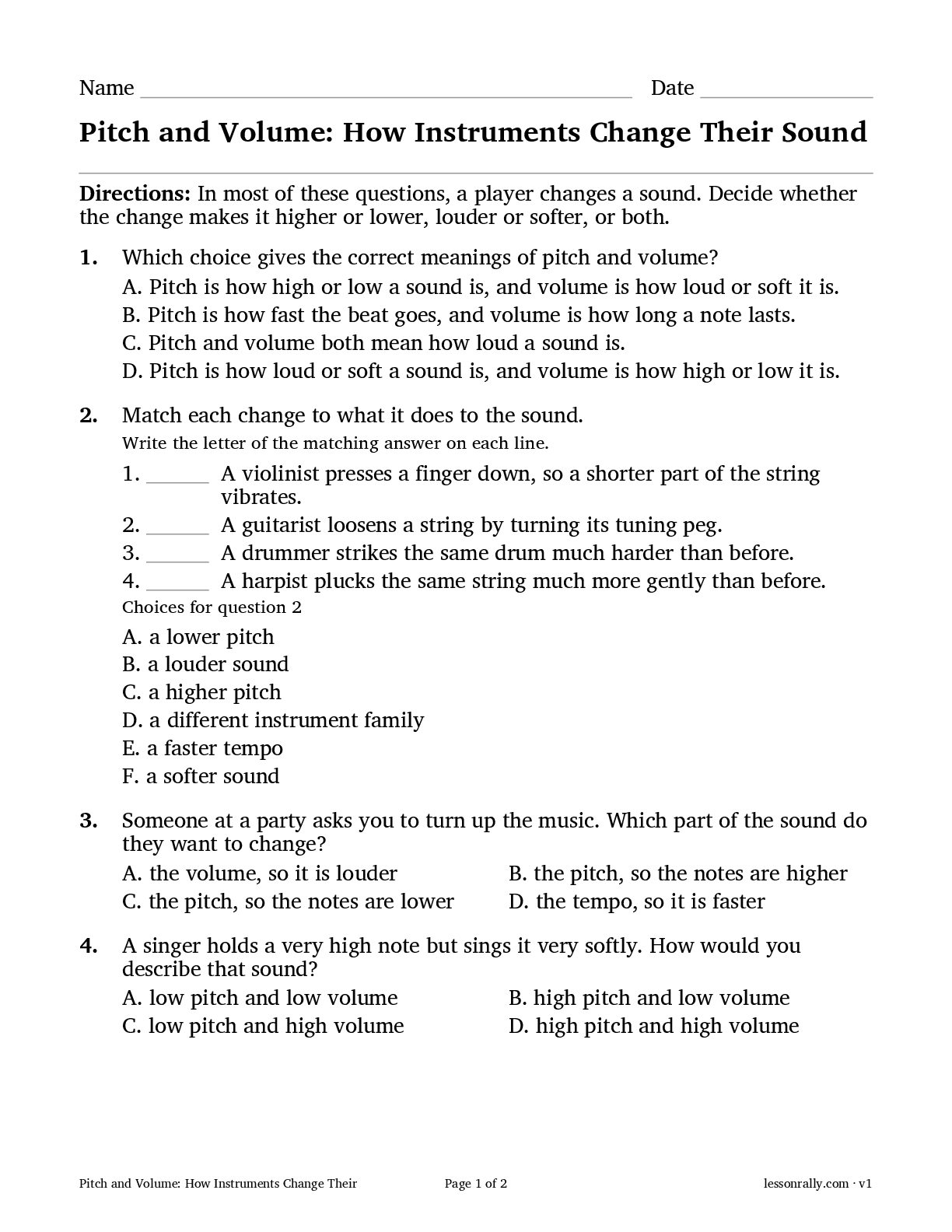
In most of these questions, a player changes a sound. Decide whether the change makes it higher or lower, louder or softer, or both.

Question 1

Which choice gives the correct meanings of pitch and volume?

Choose one answer.

  • Pitch is how loud or soft a sound is, and volume is how high or low it is.
  • Pitch is how high or low a sound is, and volume is how loud or soft it is.
  • Pitch and volume both mean how loud a sound is.
  • Pitch is how fast the beat goes, and volume is how long a note lasts.

Question 2

Match each change to what it does to the sound.

Match each item to an option.

Items

  1. A violinist presses a finger down, so a shorter part of the string vibrates.
  2. A guitarist loosens a string by turning its tuning peg.
  3. A drummer strikes the same drum much harder than before.
  4. A harpist plucks the same string much more gently than before.

Options

  1. a higher pitch
  2. a louder sound
  3. a softer sound
  4. a different instrument family
  5. a lower pitch
  6. a faster tempo

Question 3

Someone at a party asks you to turn up the music. Which part of the sound do they want to change?

Choose one answer.

  • the pitch, so the notes are higher
  • the pitch, so the notes are lower
  • the tempo, so it is faster
  • the volume, so it is louder

Question 4

A singer holds a very high note but sings it very softly. How would you describe that sound?

Choose one answer.

  • low pitch and low volume
  • high pitch and high volume
  • high pitch and low volume
  • low pitch and high volume

Question 5

Panpipes are a row of tubes of different lengths tied together, and the player blows across the top of each one. Which tube plays the highest note?

Choose one answer.

  • the shortest tube
  • the tube in the middle
  • the longest tube
  • every tube plays the same note

Question 6

Complete the sentence about the marimba's bars.

Fill in each blank.

On a marimba, the blank 1 bars play the higher notes, and the blank 2 bars play the lower notes.

Word bank

  • louder
  • shorter
  • softer
  • longer

Question 7

A drummer tightens a drumhead by turning the screws around its rim. What happens to the drum's pitch?

Choose one answer.

  • It goes up.
  • The drum stops making any sound.
  • It stays the same, but the drum gets louder.
  • It goes down.

Question 8

A cellist wants the same note to sound louder. What should she do?

Choose one answer.

  • Press the bow harder or move it faster across the string.
  • Loosen the string with its tuning peg.
  • Bow more slowly and lightly.
  • Press a finger down to shorten the string.

Question 9

Lea wants to play a violin note louder without changing its pitch. What must stay the same?

Choose one answer.

  • how long and how tight the vibrating part of the string is
  • how fast she moves the bow
  • how hard she presses the bow on the string
  • how loud the note is

Question 10

Which change would make a drum sound both higher and louder?

Choose one answer.

  • Loosen the drumhead and tap it gently.
  • Tighten the drumhead and tap it gently.
  • Loosen the drumhead and hit it harder.
  • Tighten the drumhead and hit it harder.

Reviews

No reviews yet.

Reviews come from teachers who assigned this activity to a class.

Sign in to write a review

Have a topic of your own? Make a printable worksheet and online quiz, free.

Create an activity

Answer key

Answer keys come with Premium

Print this worksheet with the correct answers marked. The key includes any explanations, sample answers, and rubrics supplied with the activity.

Answer keys aren't public: only teachers with Premium and the people who can edit an activity can download one, so students can't get a ready-to-print key from this page.

Premium includes:

  • No ads for you, and no ads for your students on the assignments you post.
  • Answer keys for printable worksheets, with the correct answers marked and any explanations, sample answers, and rubrics.
  • Create with AI: up to 100 activities a year (5 during the free trial), with every answer checked before you see the draft.

$29 a year, plus sales tax where it applies.

New Premium teachers can try it free for 7 days. A card or other payment method is needed to start. Unless you cancel before the trial ends, you are charged then and the plan renews every year.

Already have Premium or edit this activity? Sign in