Question 1
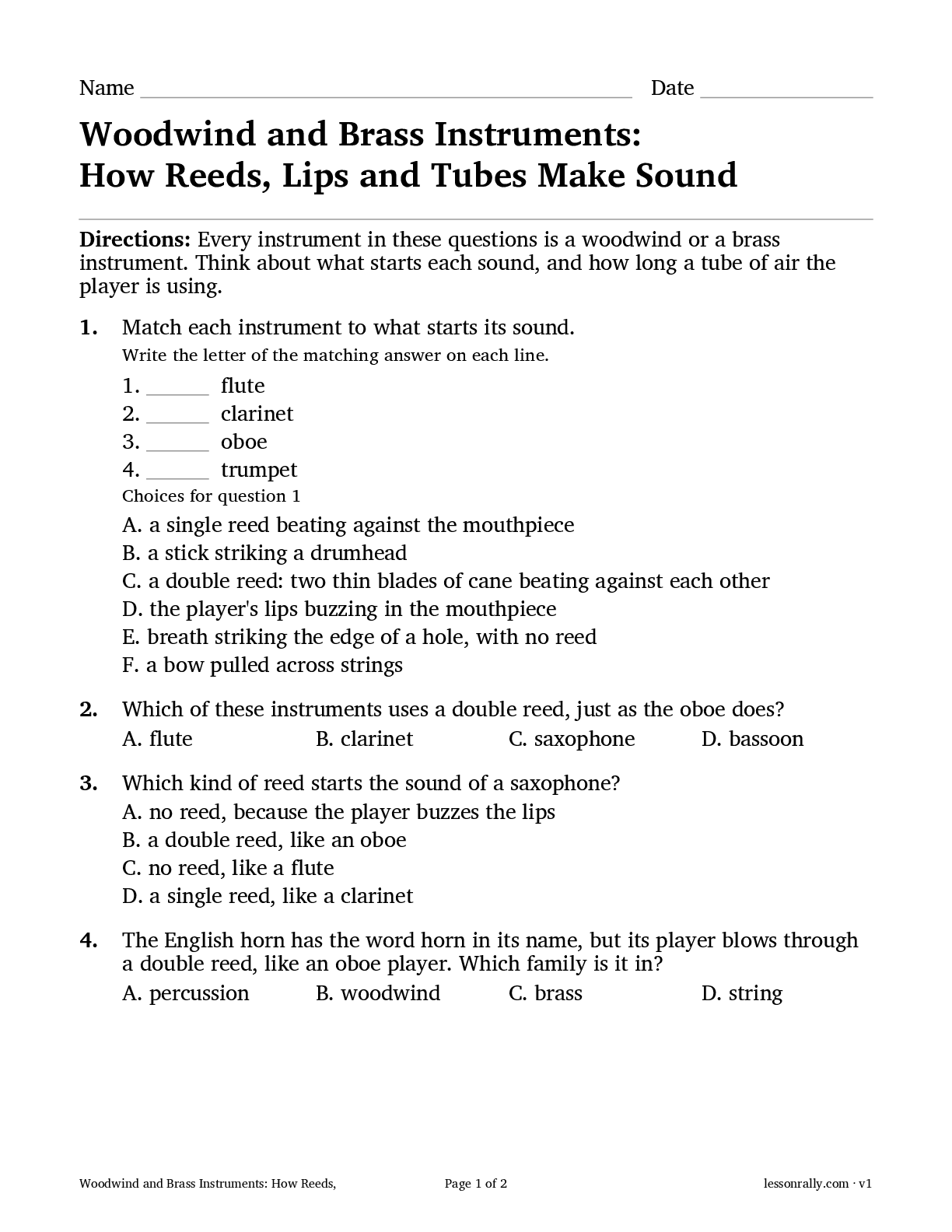
Match each instrument to what starts its sound.
Match each item to an option.
Items
- flute
- clarinet
- oboe
- trumpet
Options


Teachers who sign in can assign LessonRally activities to their Google Classroom classes: students open them in Classroom and answer online, and their grades go to the teacher's Classroom gradebook. Practice lets you try it first, the way students see it.
Free for teachers. Sign in to assign activities to your Google Classroom classes.
 (opens in a new tab)
2 pages · Student copy, no answers
Print worksheet (opens in a new tab)Answer keyPremiumStudents learn how woodwind and brass instruments start their sound: the flute has no reed, the clarinet and saxophone use a single reed, the oboe, bassoon and English horn use a double reed, and brass players buzz their lips. They see how a valve, a slide or covered holes make the tube of air longer for lower notes, why the tuba plays lower than the trumpet and the piccolo higher than the flute, and how a bugler changes notes.
Learning goal: Explain how woodwind and brass instruments start their sound, and how players use valves, slides, covered holes and their lips to change the note.
The estimate is halfway between the two middle scores of four readability formulas. Their scores run from 4.2 to 6.8.
Adapted from common readability formulas (Flesch-Kincaid, Gunning Fog, Coleman-Liau and ARI, plus SMOG for long texts), which look at sentence length and word length. Answer choices count toward word length only. Grades below the estimate will likely find the text harder, grades above it easier. It does not measure ideas, background knowledge or images.
Topic: Music Chosen by LessonRally
Question types: matching, multiple choice, fill in the blank.
The questions as students see them, without the answers.
Every instrument in these questions is a woodwind or a brass instrument. Think about what starts each sound, and how long a tube of air the player is using.
Match each instrument to what starts its sound.
Match each item to an option.
Items
Options
Which of these instruments uses a double reed, just as the oboe does?
Choose one answer.
Which kind of reed starts the sound of a saxophone?
Choose one answer.
The English horn has the word horn in its name, but its player blows through a double reed, like an oboe player. Which family is it in?
Choose one answer.
Choose the words that tell what a trumpet valve does.
Fill in each blank.
Pressing a valve on a trumpet sends the air through an extra loop of tubing. That makes the tube blank 1, so the pitch goes blank 2.
Word bank
A trombone player pushes the slide all the way out and changes nothing else. What happens to the note?
Choose one answer.
The tuba and the trumpet are both brass instruments, yet the tuba's notes are far lower. What is the main reason?
Choose one answer.
A piccolo is played the same way as a flute, but it is much shorter. How do its notes compare with the flute's?
Choose one answer.
On a recorder, covering more of the finger holes, working down from the top, makes the note lower. Why?
Choose one answer.
A bugle is a simple brass tube with no valves, no slide and no finger holes, yet a bugler can play several different notes. How?
Choose one answer.
No reviews yet.
Reviews come from teachers who assigned this activity to a class.
Have a topic of your own? Make a printable worksheet and online quiz, free.
Create an activityMade by Miles Penhallow · LessonRally (AI-assisted)
Made by Miles Penhallow · LessonRally (AI-assisted)
Made by Miles Penhallow · LessonRally (AI-assisted)
Made by Miles Penhallow · LessonRally (AI-assisted)