Question 1
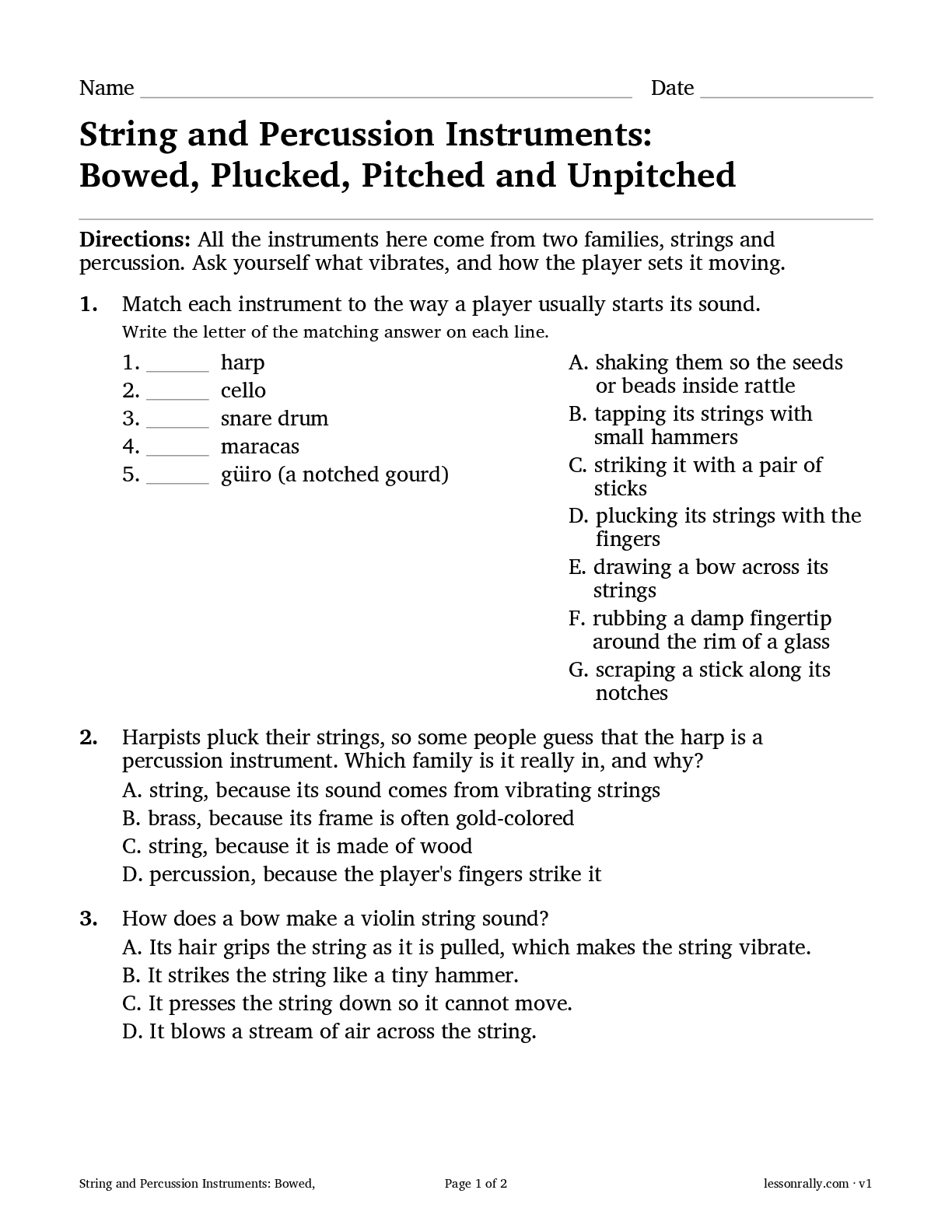
Match each instrument to the way a player usually starts its sound.
Match each item to an option.
Items
- harp
- cello
- snare drum
- maracas
- güiro (a notched gourd)
Options


Teachers who sign in can assign LessonRally activities to their Google Classroom classes: students open them in Classroom and answer online, and their grades go to the teacher's Classroom gradebook. Practice lets you try it first, the way students see it.
Free for teachers. Sign in to assign activities to your Google Classroom classes.
 (opens in a new tab)
2 pages · Student copy, no answers
Print worksheet (opens in a new tab)Answer keyPremiumStudents sort string and percussion instruments by how their sound starts: orchestra strings are bowed or plucked, and most percussion is struck, while some is shaken or scraped. They learn that the harp is a string instrument, how a bow makes a string sound, which percussion instruments are pitched or unpitched, what gives a snare drum its buzz, and where the steel pan was developed.
Learning goal: Explain how string and percussion instruments start their sound, and sort percussion instruments into pitched and unpitched groups.
The estimate is halfway between the two middle scores of four readability formulas. Their scores run from 5.3 to 9.5.
Adapted from common readability formulas (Flesch-Kincaid, Gunning Fog, Coleman-Liau and ARI, plus SMOG for long texts), which look at sentence length and word length. Answer choices count toward word length only. Grades below the estimate will likely find the text harder, grades above it easier. It does not measure ideas, background knowledge or images.
Topic: Music Chosen by LessonRally
Question types: matching, multiple choice, fill in the blank.
The questions as students see them, without the answers.
All the instruments here come from two families, strings and percussion. Ask yourself what vibrates, and how the player sets it moving.
Match each instrument to the way a player usually starts its sound.
Match each item to an option.
Items
Options
Harpists pluck their strings, so some people guess that the harp is a percussion instrument. Which family is it really in, and why?
Choose one answer.
How does a bow make a violin string sound?
Choose one answer.
Percussion that can play the notes of a tune is called pitched. In a symphony orchestra, which of these drums is usually tuned to a definite note?
Choose one answer.
Sort these percussion instruments into the right groups.
Fill in each blank.
A marimba and a glockenspiel are blank 1 percussion, but a triangle and a pair of cymbals are blank 2.
Word bank
Which of these standard orchestra instruments uses metal bars to play notes?
Choose one answer.
What gives a snare drum its crisp, buzzing sound?
Choose one answer.
The steel pan was developed in Trinidad and Tobago in the mid-1900s. It is hammered from a metal drum into curved sections, and each one is tuned. Is it pitched or unpitched?
Choose one answer.
Which pair has one pitched and one unpitched instrument?
Choose one answer.
Which sentence about percussion instruments is true?
Choose one answer.
No reviews yet.
Reviews come from teachers who assigned this activity to a class.
Have a topic of your own? Make a printable worksheet and online quiz, free.
Create an activityMade by Miles Penhallow · LessonRally (AI-assisted)
Made by Miles Penhallow · LessonRally (AI-assisted)
Made by Miles Penhallow · LessonRally (AI-assisted)
Made by Miles Penhallow · LessonRally (AI-assisted)