Question 1
How many halves are in 3?
3 ÷ (1/2)
Enter a number.


Teachers who sign in can assign LessonRally activities to their Google Classroom classes: students open them in Classroom and answer online, and their grades go to the teacher's Classroom gradebook. Practice lets you try it first, the way students see it.
Free for teachers. Sign in to assign activities to your Google Classroom classes.
 (opens in a new tab)
2 pages · Student copy, no answers
Print worksheet (opens in a new tab)Answer keyPremiumStudents divide a unit fraction by a whole number and a whole number by a unit fraction. They match a division to a story, check a quotient with multiplication, see that the order of the two numbers changes the quotient, and solve word problems about sharing a piece equally or counting how many small pieces fit. One question asks who is right when a student divides by 3 instead of by 1/3. Dividing fractions practice with unit fractions.
Learning goal: Divide a unit fraction by a whole number and a whole number by a unit fraction, explain each quotient with multiplication, and solve word problems with these quotients.
Interpret division of a whole number by a unit fraction, and compute such quotients. For example, create a story context for 4 ÷ (1/5), and use a visual fraction model to show the quotient. Use the relationship between multiplication and division to explain that 4 ÷ (1/5) = 20 because 20 × (1/5) = 4.
Interpret division of a unit fraction by a non-zero whole number, and compute such quotients. For example, create a story context for (1/3) ÷ 4, and use a visual fraction model to show the quotient. Use the relationship between multiplication and division to explain that (1/3) ÷ 4 = 1/12 because (1/12) × 4 = 1/3.
Solve real world problems involving division of unit fractions by non-zero whole numbers and division of whole numbers by unit fractions, e.g., by using visual fraction models and equations to represent the problem. For example, how much chocolate will each person get if 3 people share 1/2 lb of chocolate equally? How many 1/3-cup servings are in 2 cups of raisins?
Chosen by LessonRally.
© Copyright 2010. National Governors Association Center for Best Practices and Council of Chief State School Officers. All rights reserved.
Topic: Fraction Operations Chosen by LessonRally
Question types: number answer, fill in the blank, multiple choice, select all that apply.
The questions as students see them, without the answers.
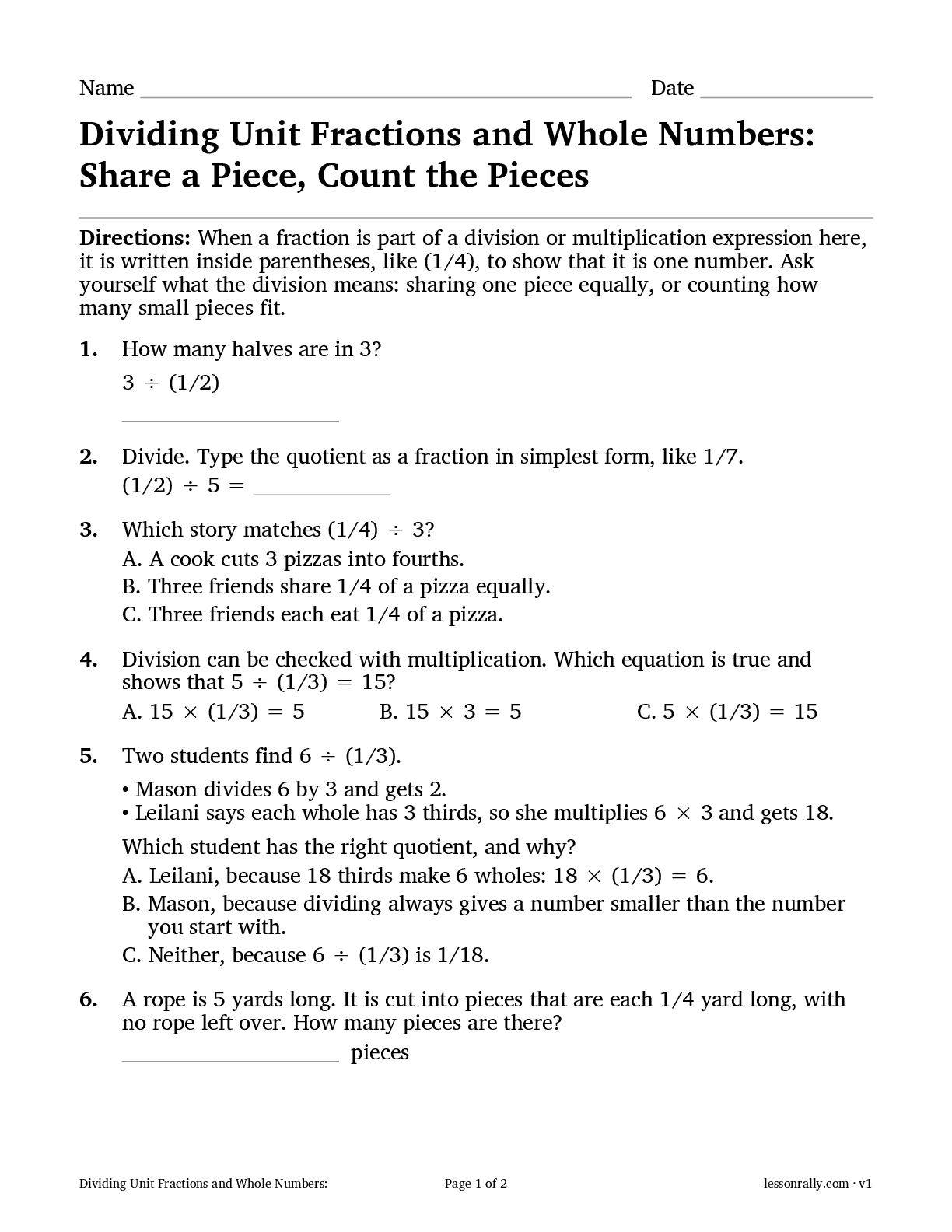
When a fraction is part of a division or multiplication expression here, it is written inside parentheses, like (1/4), to show that it is one number. Ask yourself what the division means: sharing one piece equally, or counting how many small pieces fit.
How many halves are in 3?
3 ÷ (1/2)
Enter a number.
Divide. Type the quotient as a fraction in simplest form, like 1/7.
Fill in each blank.
(1/2) ÷ 5 = blank 1
Which story matches (1/4) ÷ 3?
Choose one answer.
Division can be checked with multiplication. Which equation is true and shows that 5 ÷ (1/3) = 15?
Choose one answer.
Two students find 6 ÷ (1/3).
Which student has the right quotient, and why?
Choose one answer.
A rope is 5 yards long. It is cut into pieces that are each 1/4 yard long, with no rope left over. How many pieces are there?
Enter a number.
pieces
Two hikers share 1/3 pound of trail mix equally. How much trail mix does each hiker get? Type a fraction in simplest form, with a slash, as in 1/9.
Fill in each blank.
Each hiker gets blank 1 pound of trail mix.
The numbers 2 and 1/6 can be divided in two orders. Which statement about 2 ÷ (1/6) and (1/6) ÷ 2 is true?
Choose one answer.
Which expressions are equal to 8? Select the two that equal 8.
Choose 2 answers.
A jug has 2 gallons of lemonade. Each glass gets 1/8 gallon. After 9 glasses are poured, how many more glasses can be poured from the jug?
Enter a number.
glasses
No reviews yet.
Reviews come from teachers who assigned this activity to a class.
Have a topic of your own? Make a printable worksheet and online quiz, free.
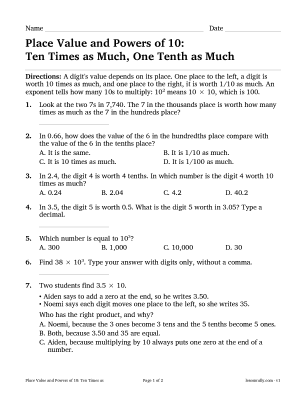
Create an activityCommon Core 5.NBT.A.2
Made by Hannah Yoon · LessonRally (AI-assisted)
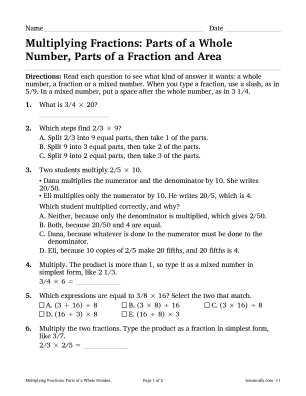
Common Core 5.NF.B.4a
Made by Hannah Yoon · LessonRally (AI-assisted)
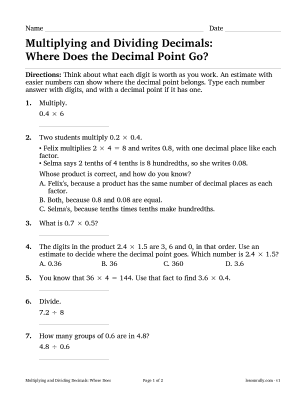
Common Core 5.NBT.B.7
Made by Hannah Yoon · LessonRally (AI-assisted)
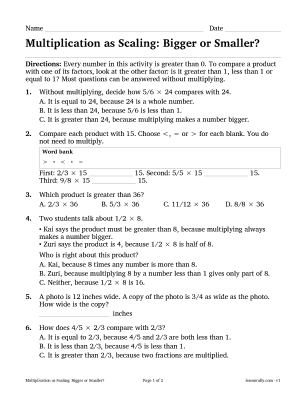
Common Core 5.NF.B.5a
Made by Hannah Yoon · LessonRally (AI-assisted)