Tracing an Argument: Claims, Evidence and Reasoning

8 questions · 8 points · Grades 11–12 · English · Preview the 8 questions

Made by Julian Corvell · LessonRally (AI-assisted)

Digital classroom activity

What is a digital classroom activity?

Teachers who sign in can assign LessonRally activities to their Google Classroom classes: students open them in Classroom and answer online, and their grades go to the teacher's Classroom gradebook. Practice lets you try it first, the way students see it.

Free for teachers. Sign in to assign activities to your Google Classroom classes.

Printable worksheet

Students trace the structure of an original argumentative essay that proposes a longer school lunch period. They identify the main claim, match each piece of evidence to the claim it supports and recognize the reasoning that links evidence to a claim. They also judge how the essay's structure makes its points clear and convincing. Eight self-grading questions on claims, evidence and reasoning in an argument.

Learning goal: Trace an argument by matching evidence to the claims it supports and identifying the reasoning that connects them, then evaluate how the structure makes the argument clear and convincing.

Estimated reading level 9.8

  1. Grade 7Hard
  2. Grade 8Stretch
  3. Grade 9On level
  4. Grade 10Easier
  5. Grade 11Easy
About this estimate

The estimate is the middle score of five readability formulas. Their scores run from 8.3 to 10.8.

  • Flesch-Kincaid GradeSentence length and syllables per word8.3
  • Gunning FogSentence length and words of three or more syllables10.8
  • Coleman-Liau Middle scoreLetters per word and sentences per 100 words9.8
  • Automated Readability IndexCharacters per word and words per sentence9.4
  • SMOGWords of three or more syllables, for texts of 30 sentences or more10.4
Flesch Reading Ease
67.1 on a 0 to 100 scale where higher is easier: standard. Not part of the estimate.
Text measured
1,194 words, 38 sentences

Adapted from common readability formulas (Flesch-Kincaid, Gunning Fog, Coleman-Liau and ARI, plus SMOG for long texts), which look at sentence length and word length. Answer choices count toward word length only. Grades below the estimate will likely find the text harder, grades above it easier. It does not measure ideas, background knowledge or images.

Common Core

Closest anchor: CCRA.R.5 Analyze the structure of texts, including how specific sentences, paragraphs, and larger portions of the text (e.g., a section, chapter, scene, or stanza) relate to each other and the whole.Anchor Standards for ReadingShow 2 matched standardsHide matched standards

Matched standards

  • RI.11-12.5

    Analyze and evaluate the effectiveness of the structure an author uses in his or her exposition or argument, including whether the structure makes points clear, convincing, and engaging.

    Student preview question 8

  • RI.11-12.8

    Delineate and evaluate the reasoning in seminal U.S. texts, including the application of constitutional principles and use of legal reasoning (e.g., in U.S. Supreme Court majority opinions and dissents) and the premises, purposes, and arguments in works of public advocacy (e.g., The Federalist, presidential addresses).

    Student preview question 5

Matched independently by two AI models from this activity's questions.

© Copyright 2010. National Governors Association Center for Best Practices and Council of Chief State School Officers. All rights reserved.

Topic: Author's Claims and Evidence Chosen by LessonRally

Question types: multiple choice, select all that apply.

Student preview

The questions as students see them, without the answers.

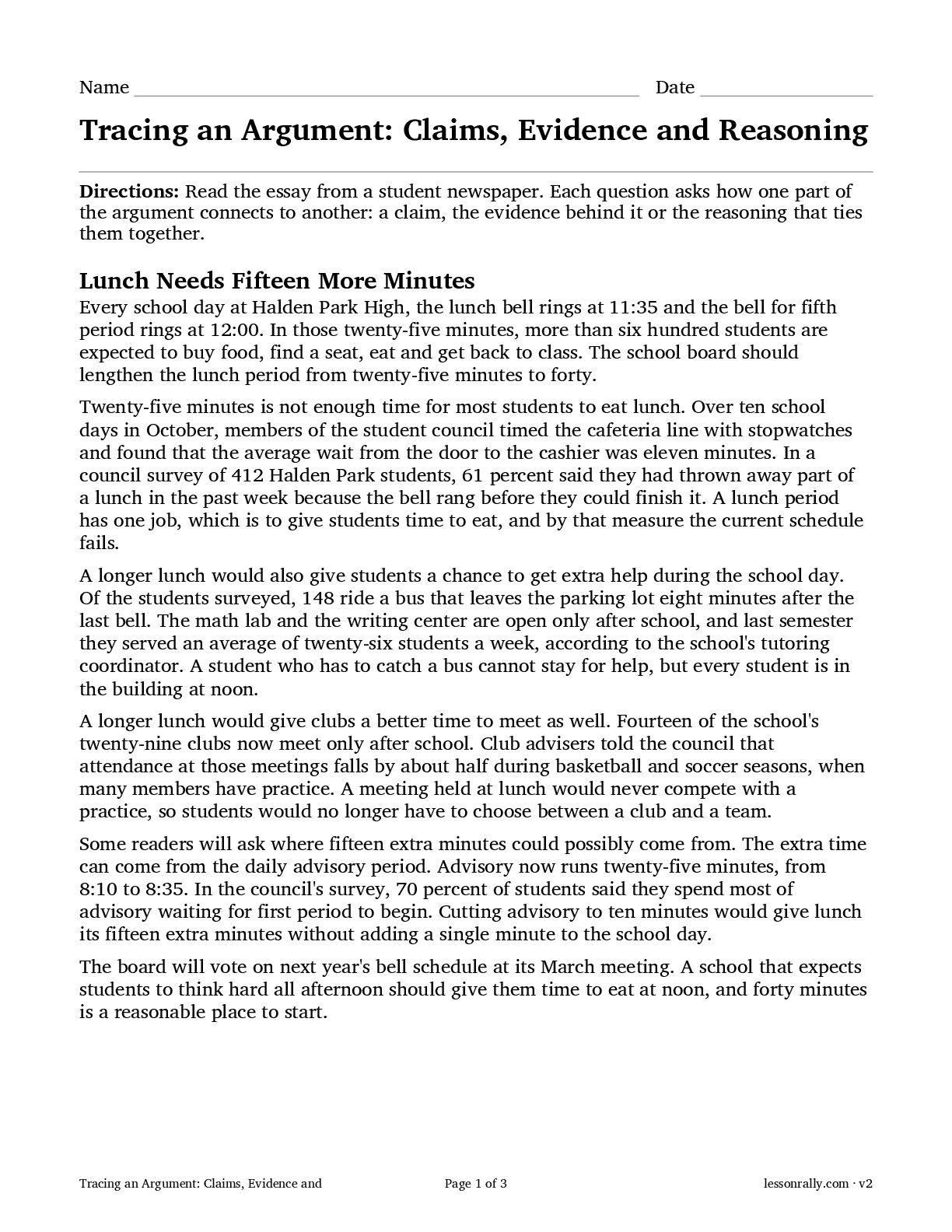
Read the essay from a student newspaper. Each question asks how one part of the argument connects to another: a claim, the evidence behind it or the reasoning that ties them together.

Lunch Needs Fifteen More Minutes

Every school day at Halden Park High, the lunch bell rings at 11:35 and the bell for fifth period rings at 12:00. In those twenty-five minutes, more than six hundred students are expected to buy food, find a seat, eat and get back to class. The school board should lengthen the lunch period from twenty-five minutes to forty.

Twenty-five minutes is not enough time for most students to eat lunch. Over ten school days in October, members of the student council timed the cafeteria line with stopwatches and found that the average wait from the door to the cashier was eleven minutes. In a council survey of 412 Halden Park students, 61 percent said they had thrown away part of a lunch in the past week because the bell rang before they could finish it. A lunch period has one job, which is to give students time to eat, and by that measure the current schedule fails.

A longer lunch would also give students a chance to get extra help during the school day. Of the students surveyed, 148 ride a bus that leaves the parking lot eight minutes after the last bell. The math lab and the writing center are open only after school, and last semester they served an average of twenty-six students a week, according to the school's tutoring coordinator. A student who has to catch a bus cannot stay for help, but every student is in the building at noon.

A longer lunch would give clubs a better time to meet as well. Fourteen of the school's twenty-nine clubs now meet only after school. Club advisers told the council that attendance at those meetings falls by about half during basketball and soccer seasons, when many members have practice. A meeting held at lunch would never compete with a practice, so students would no longer have to choose between a club and a team.

Some readers will ask where fifteen extra minutes could possibly come from. The extra time can come from the daily advisory period. Advisory now runs twenty-five minutes, from 8:10 to 8:35. In the council's survey, 70 percent of students said they spend most of advisory waiting for first period to begin. Cutting advisory to ten minutes would give lunch its fifteen extra minutes without adding a single minute to the school day.

The board will vote on next year's bell schedule at its March meeting. A school that expects students to think hard all afternoon should give them time to eat at noon, and forty minutes is a reasonable place to start.


Question 1

The essay gives reasons about eating, extra help and clubs. Which statement expresses the main claim that those reasons support?

Choose one answer.

  • Every club should move its meetings from after school to lunch.
  • The cafeteria should hire more cashiers so that the line moves faster.
  • The school should replace advisory with a daily tutoring period.
  • The school board should give students a forty-minute lunch period.

Question 2

The writer claims, "Twenty-five minutes is not enough time for most students to eat lunch." Which sentence from the essay gives evidence for this claim?

Choose one answer.

  • "The math lab and the writing center are open only after school, and last semester they served an average of twenty-six students a week, according to the school's tutoring coordinator."
  • "In a council survey of 412 Halden Park students, 61 percent said they had thrown away part of a lunch in the past week because the bell rang before they could finish it."
  • "Fourteen of the school's twenty-nine clubs now meet only after school."
  • "In the council's survey, 70 percent of students said they spend most of advisory waiting for first period to begin."

Question 3

Which claim does this sentence from the essay most directly support?

"Club advisers told the council that attendance at those meetings falls by about half during basketball and soccer seasons, when many members have practice."

Choose one answer.

  • "The extra time can come from the daily advisory period."
  • "Twenty-five minutes is not enough time for most students to eat lunch."
  • "A longer lunch would also give students a chance to get extra help during the school day."
  • "A longer lunch would give clubs a better time to meet as well."

Question 4

In the paragraphs about eating, extra help and clubs, the first sentence states the paragraph's claim and the evidence follows. How does this order help readers?

Choose one answer.

  • It shows readers which of the figures came from the student council.
  • It tells readers what each figure is meant to prove before they reach it.
  • It lets readers judge the figures before they learn what the writer thinks.
  • It keeps readers guessing about the essay's main claim until the end.

Question 5

The paragraph about eating ends with this sentence: "A lunch period has one job, which is to give students time to eat, and by that measure the current schedule fails." What does this sentence add to the paragraph?

Choose one answer.

  • It reports another finding from the student council's survey of students.
  • It explains why the line and survey figures show that lunch is too short.
  • It states the paragraph's claim before any of the supporting evidence appears.
  • It answers readers who believe the cafeteria line already moves quickly enough.

Question 6

Which two sentences does the writer use to show why the current after-school tutoring schedule limits access to extra help?

Choose 2 answers.

  • "Fourteen of the school's twenty-nine clubs now meet only after school."
  • "Of the students surveyed, 148 ride a bus that leaves the parking lot eight minutes after the last bell."
  • "The math lab and the writing center are open only after school, and last semester they served an average of twenty-six students a week, according to the school's tutoring coordinator."
  • "Over ten school days in October, members of the student council timed the cafeteria line with stopwatches and found that the average wait from the door to the cashier was eleven minutes."
  • "Advisory now runs twenty-five minutes, from 8:10 to 8:35."

Question 7

Suppose the writer wanted to add one sentence to the paragraph about clubs. Which sentence would give the strongest new evidence for that paragraph's claim?

Choose one answer.

  • Clubs give students a chance to lead projects, organize events and make friends outside their own classes.
  • Every student at Halden Park should join at least one club before graduating, regardless of when it happens to meet.
  • The chess club, the oldest organization at Halden Park, was founded more than fifty years ago by two teachers.
  • Last spring the robotics club moved its meetings from after school to lunch for a month, and attendance doubled.

Question 8

What does the paragraph that begins "Some readers will ask" contribute to the argument?

Choose one answer.

  • It states the essay's main claim for the first time, near the end of the argument.
  • It offers a fourth reason that twenty-five minutes is far too short a time for lunch.
  • It admits that a forty-minute lunch would unavoidably make the school day longer.
  • It answers a practical objection by showing where the extra time would come from.

Reviews

No reviews yet.

Reviews come from teachers who assigned this activity to a class.

Sign in to write a review

Have a topic of your own? Make a printable worksheet and online quiz, free.

Create an activity

Answer key

Answer keys come with Premium

Print this worksheet with the correct answers marked. The key includes any explanations, sample answers, and rubrics supplied with the activity.

Answer keys aren't public: only teachers with Premium and the people who can edit an activity can download one, so students can't get a ready-to-print key from this page.

Premium includes:

  • No ads for you, and no ads for your students on the assignments you post.
  • Answer keys for printable worksheets, with the correct answers marked and any explanations, sample answers, and rubrics.
  • Create with AI: up to 100 activities a year (5 during the free trial), with every answer checked before you see the draft.

$29 a year, plus sales tax where it applies.

New Premium teachers can try it free for 7 days. A card or other payment method is needed to start. Unless you cancel before the trial ends, you are charged then and the plan renews every year.

Already have Premium or edit this activity? Sign in